
Table of Contents
Get more resume writing tips, career insights, and workforce trends in your personalized search experience.
As prices rise and paychecks fail to keep up, many workers are reaching their breaking point. Zety’s Career Trade-Offs Report takes a closer look at how workers’ financial stress is influencing their biggest life and career decisions—from delaying homeownership to accepting second jobs just to stay afloat.
The findings reveal a workforce forced to compromise, as it trades ambition for stability, personal milestones for practicality, and long-term goals for short-term survival.
Workers Are Priced Out of Progress
Homeownership, retirement savings, and family planning have all been delayed or abandoned in 2025, leaving employees feeling stuck and uncertain about the future. Zety’s Priced Out of Progress Report found that:
- 36% of workers said they felt anxious or frustrated about achieving life goals on their current salary.
- 37% reported homeownership feels out of reach.
- 40% admitted to struggling to save for retirement.
- 50% said they feel that starting or growing a family is unattainable.
Career trade-off: Many employees are postponing key life decisions, such as moving out or starting a family, to manage day-to-day expenses. Financial pressures are reshaping personal timelines and future plans.
Debt Is Shaping Career Decisions
No longer just a financial burden, debt has now become a career constraint. With nearly half of Americans owing $25,000 or more, debt is narrowing career options and fueling widespread anxiety about the future.
According to Zety’s Debt & Career Impact Report:
- Nearly 2 in 5 (38%) workers have taken on second jobs just to cover debt payments.
- 37% have accepted jobs they didn’t want just to stay afloat.
- 78% fear U.S. tariffs will make it harder to manage or repay debt.
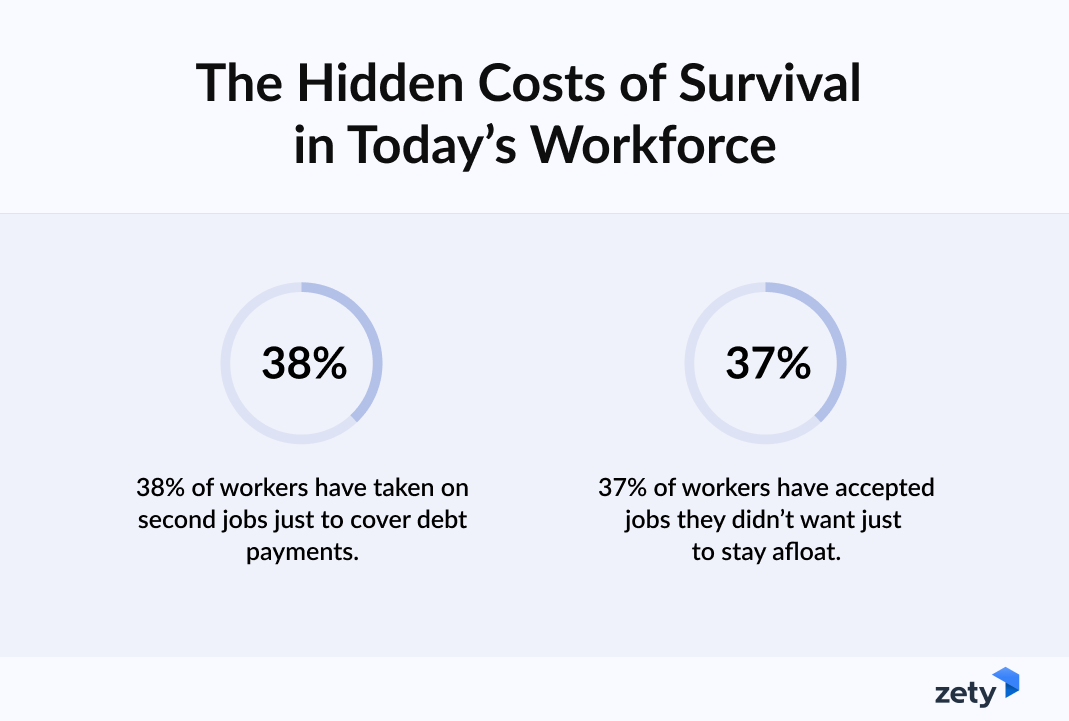
Career trade-off: High levels of debt are narrowing career options and pushing workers into roles or extra shifts they wouldn’t otherwise choose. Long-term ambitions are being sacrificed to meet immediate financial obligations.
Pay Gaps and Transparency Drive Employee Expectations
Fair compensation and pay transparency emerged as top priorities in 2025. Zety’s Pay Gaps & Perceptions Report highlighted the following:
- 37% said they frequently compare their salary to others in their workplace or industry.
- 1 in 3 (32%) employees said they believe they’re underpaid compared to their peers.
- 77% said dissatisfaction with their salary has negatively impacted their work productivity or engagement.
- 9 in 10 (89%) said knowing salary ranges for roles in their organization would improve their trust in leadership.
Career trade-off: When salary fairness is unclear, employees invest energy in monitoring compensation instead of focusing on skills or advancement. As a result, engagement suffers while career development takes a backseat.
Employees Prioritize Job Stability Over Pay
2025 has forced workers to weigh compensation against job security amid industry layoffs and fears of AI-driven job loss. Zety’s Pay on Pause Report revealed that:
- 41% haven’t received a meaningful raise in more than two years.
- Most employees (45%) believe they deserve a 4%-6% raise this year, yet 66% avoided asking because of tariffs or other external pressures.
- The majority (61%) said they are willing to accept a smaller or no raise due to concerns about layoffs and job security.
Career trade-off: Concerns about layoffs or economic shifts are prompting workers to accept smaller raises or pass on promotions. Security is taking priority over potential earnings, even when it limits financial growth.
The career trade-offs workers are making today could impact the labor market for years to come. How employers, policymakers, and job seekers respond to these financial strains will determine whether 2026 becomes a year of stalled progress or one of meaningful change.
For press inquiries, contact Skyler Acevedo, public relations specialist, at skyler.acevedo@bold.com.
Methodology
The findings presented are compiled from four Zety reports conducted throughout 2025, surveying between 995 and 1,101 U.S. employees per study. Respondents answered different types of questions about their experience with stagnant pay, limited raises, and debt, including yes/no questions; scale-based questions, where they indicated their level of agreement with statements; and multiple-choice questions, where they could select from a list of provided options.

Follow Zety as a preferred source in Google
Get more resume writing tips, career insights, and workforce trends in your personalized search experience. Learn more >

Share:


