







Table of Contents
Get more resume writing tips, career insights, and workforce trends in your personalized search experience.
Gen Z isn’t just using social media to scroll; they’re using it to build their careers. Zety’s Gen Z Misinfluence Report shows platforms like Instagram, YouTube, and TikTok have become central to how this generation navigates work, from discovering job opportunities to making major professional decisions.
But this shift comes with a tradeoff. While social media is unlocking faster, more accessible career pathways, it’s also exposing Gen Z to a wave of bad career advice—creating a new tension between opportunity and risk in the modern job search.
Key Findings
- The trust gap: All Gen Z respondents (100%) use social media for career advice, with nearly half (45%) trusting creators and influencers more than traditional recruiters or career coaches.
- The cost of “misinfluence”: Despite high trust levels, a staggering 94% of Gen Z admit to following viral career advice that was misleading or negatively impacted their job search.
- Social media as a job board: 69% of Gen Z have successfully secured a job through Instagram and 28% have done so through TikTok.
- The “vibe check” recruitment barrier: Almost all (99%) of Gen Z research a company’s social media before applying, and 63% will walk away if the content feels “overly polished” or inauthentic.
The Rise of the Social Media Career Coach
Social media has become the ultimate career counselor for Gen Z. All respondents (100%) report using social platforms for career advice or tips. Further, 45% say they trust career advice from social media more than traditional sources (career coaches, recruiters, etc.).
When seeking out advice, Gen Z strongly prefers highly visual and creator-led platforms:
- YouTube (80%)
- Instagram (73%)
- Facebook (40%)
- X (Twitter) (38%)
- TikTok (32%)
- Reddit (30%)
- LinkedIn (26%)
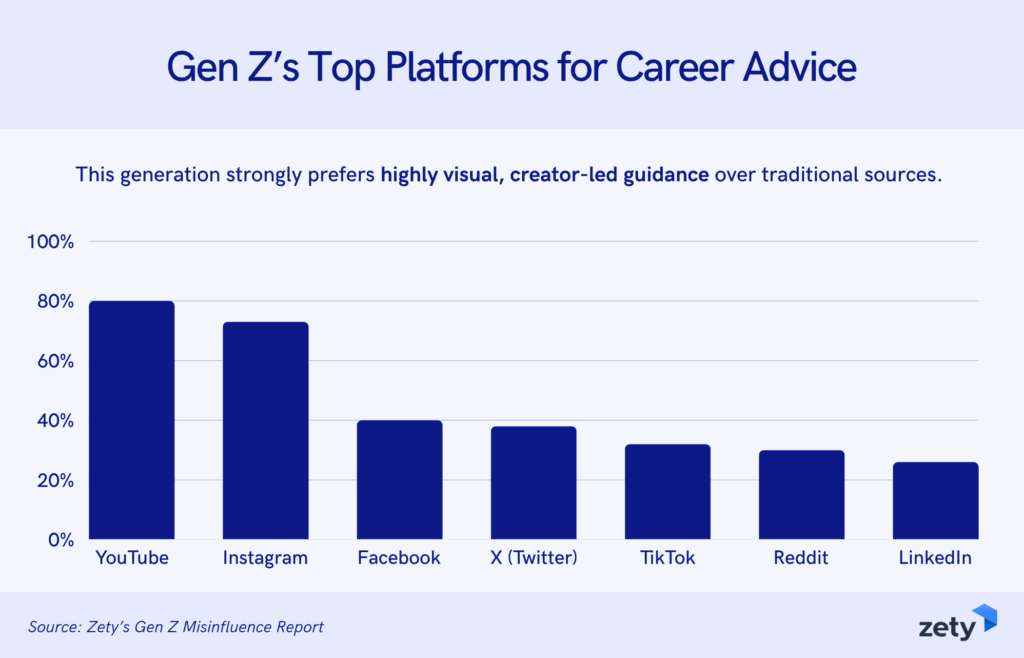
What this means: Career influence is becoming more decentralized, with creators shaping how Gen Z defines success, growth, and opportunity. This shift raises important questions about how credibility is evaluated when guidance is driven by reach and engagement rather than formal expertise.
Viral Advice Is Driving Major Life Decisions (& Mistakes)
Consumption of social media career advice is driving major career shifts. Based on tips they’ve seen online, Gen Z workers report taking the following real-world actions:
- Changed industries or fields (60%)
- Started a side hustle (41%)
- Quit their job (36%)
- Began freelancing or gig work (31%)
- Negotiated pay (27%)
- Enrolled in a course or certification program to build skills (16%)
Relying on unverified viral content comes with severe risks, however. Despite placing immense trust in these platforms, a staggering 94% of Gen Z admit they have followed social media career advice that proved to be misleading or harmful to their job search.
What this means: Career decisions are increasingly influenced by fast-moving content cycles, where visibility can outweigh accuracy. As a result, missteps aren’t isolated—they scale quickly, amplifying the impact of poor advice across a large audience.
Gen Z’s Job Search Playbook
When it comes to building professional connections and finding open roles, traditional networking is taking a back seat. With 98% of Gen Z effectively using social platforms to land jobs, this generation is bypassing professional sites in favor of everyday consumer apps.
Respondents report successfully securing a job or internship through social media platforms such as:
- Instagram (69%)
- Facebook (39%)
- X (Twitter) (36%)
- Reddit (30%)
- TikTok (28%)
The following platforms are also used to network:
- Instagram (74%)
- Facebook (38%)
- Reddit (33%)
- TikTok (29%)
- X (Twitter) (28%)
What this means: The job search is blending into everyday digital behavior, making career discovery more continuous and less intentional. This evolution expands access to opportunities while also increasing competition in spaces that weren’t traditionally designed for hiring.
The “Vibe Check”: What Deters Gen Z From Employers
For companies trying to recruit younger workers, it’s crucial to maintain a positive social media presence. The data shows that nearly all (99%) of Gen Z workers use social media to research a company before applying.
These are the biggest social media red flags that can quickly turn Gen Z candidates away:
- Overly polished or inauthentic marketing content (63%)
- Posts with political or controversial statements unrelated to the job (59%)
- Inconsistent or confusing messaging across company platforms (44%)
- Negative comments from customers, clients, or previous employees (24%)
- Excessive focus on perks or superficial achievements over meaningful work (22%)
What this means: Candidates are evaluating companies through a lens of consistency, tone, and transparency across platforms. Small signals, like mismatched messaging or overly curated content, can influence perception early and shape whether a company feels worth engaging with.
Beyond the Scroll: The New Professional Reality
As social media continues to shape how Gen Z approaches work, the challenge moving forward isn’t just access to information; it’s making sense of it. For both job seekers and employers, success will depend on navigating an environment where influence is constant, feedback is immediate, and perceptions are formed long before any formal interaction takes place.
For press inquiries, please contact Skyler Acevedo at skyler.acevedo@bold.com.
Methodology
The findings presented are based on a nationally representative survey conducted by Zety on February 23, 2026. The survey collected responses from 919 Gen Z workers and examined their use of social media for career guidance, networking, job searching, skill-building, and decision-making, including the real-world actions taken based on advice found on digital platforms.
They answered different types of questions, including yes/no; open-ended, scale-based questions, where respondents indicated their level of agreement with statements; and multiple-choice, where they could select from a list of provided options.
All participants were screened to ensure they were currently residing in the U.S., actively employed, and part of the Gen Z generation (aged 18–27) at the time of the survey.
About Zety
Zety’s Resume Builder is a premier platform that leverages advanced AI tools to help job seekers stand out and land interviews effortlessly. Offering step-by-step guidance, curated content suggestions, and 100s of professional, ATS-friendly resume templates, it allows users to feel confident crafting tailored applications. Millions of professionals rely on Zety’s interactive suite—which also features an easy-to-use Cover Letter Generator—to produce high-quality documents that are free to create and ready to download. Since 2016, Zety’s career blog has provided free data-driven insights aimed at empowering professionals at every stage of their journey. The editorial team includes Certified Professional Resume Writers, with the best career advice and evidence-based findings featured in Business Insider, CNBC, and Forbes, among others. Stay connected with Zety on LinkedIn, Facebook, Instagram, and YouTube for free expert career tips and updates. Follow Zety as a preferred source in Google to receive more workforce trends, career insights, and labor market research in your personalized search experience.

Follow Zety as a preferred source in Google
Get more resume writing tips, career insights, and workforce trends in your personalized search experience. Learn more >

Share:


