









Table of Contents
Get more resume writing tips, career insights, and workforce trends in your personalized search experience.
You’ve heard of sick leave and vacation days, but what about heartbreak leave?
The Heartbreak Leave Report from Zety reveals that 1 in 3 U.S. workers are already taking time off after a breakup, calling out sick or using vacation days to recover from romantic loss, disrupting workplace productivity, engagement, and attendance.
While the concept of “heartbreak leave”—formal days off to recover from romantic loss—may sound unconventional, the data suggests employees are already taking time off after breakups, just quietly and without support.
Key Findings
- Impact on attendance: 1 in 3 workers have called out sick or used PTO to recover from a breakup, with men and younger employees being more likely to call out.
- Breakups take a toll: 43% say their workplace productivity suffers, while 38% report lower motivation and engagement.
- Need for formal leave: 1 in 3 workers believe employers should offer “heartbreak leave.”
- Estimated recovery time: 40% believe they need at least 3 days of PTO after a breakup.
- Flexible support is key: 31% say remote work days are most helpful after a breakup, while 23% would prefer adjusted deadlines or workload.
Breakups Are Already Disrupting Work
The effects of heartbreak ripple through the workplace. According to the survey of 1,020 U.S. employees:
- 43% say a breakup negatively affected their productivity or ability to focus.
- 38% report lower motivation or engagement at work.
- 33% have taken sick days or PTO specifically to recover from a breakup.
- 25% say breakups affected their attendance or punctuality.
- 23% say breakups impaired their decision-making or problem-solving.
- 17% say heartbreak has negatively impacted their relationships with colleagues or managers.
What this means: Emotional strain from heartbreak can reduce individual productivity and engagement while also affecting team collaboration and workplace dynamics. Recognizing and addressing these impacts proactively allows managers to support staff before challenges escalate.
Younger Workers & Men Most Likely to Take Time Off
The likelihood of taking time off work after a breakup varies across demographics:
- Men (36%) are more likely than women (28%) to take time off after a breakup.
- Gen Z workers are most likely to take time off (47%), followed by Millennials (45%), Gen X (31%), and Baby Boomers (11%).
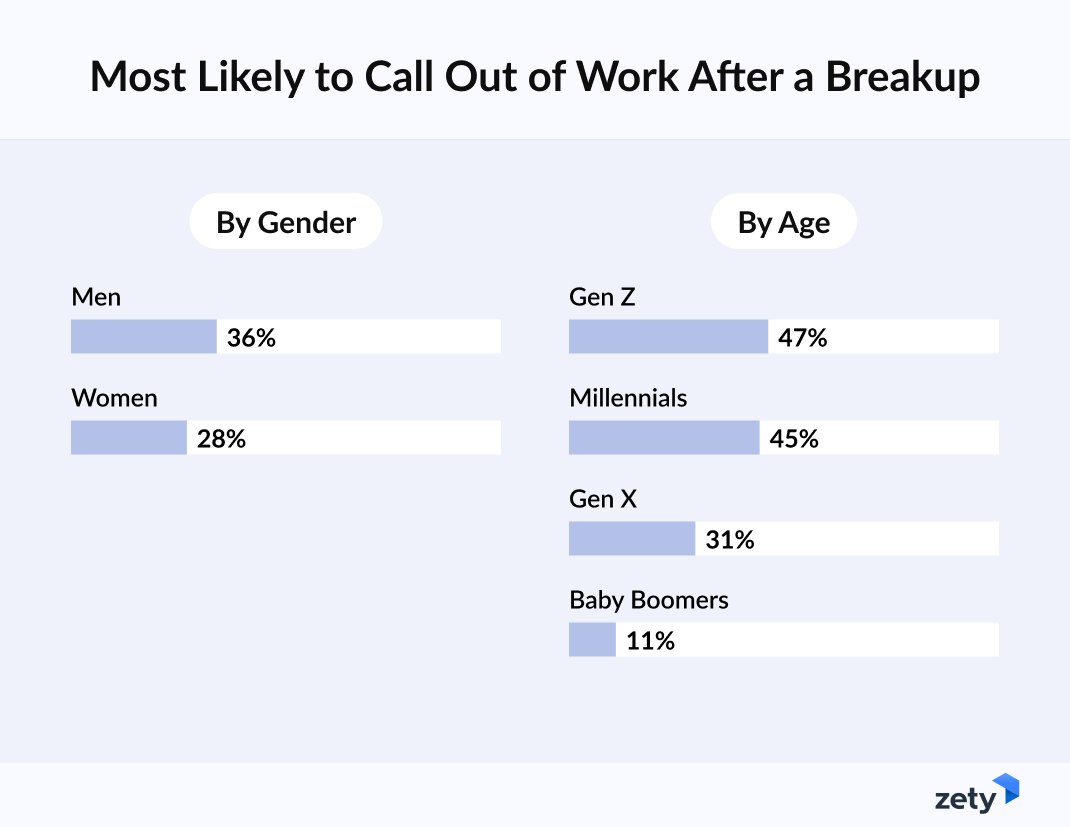
What this means: Breakups affect employees differently depending on their age and gender, which can influence absenteeism and engagement. Companies that consider these differences can better support workers and reduce hidden disruptions.
Employees Want “Heartbreak Leave,” But Fear Judgement
Many workers believe employers should acknowledge heartbreak as a legitimate workplace issue:
- 1 in 3 (33%) feel employers should offer “heartbreak leave” (formal days off to recover from romantic loss).43% say they would be likely to use “heartbreak leave” if it were offered.
However, stigma remains a significant barrier:
- 65% say they would feel uncomfortable requesting heartbreak leave due to fear of judgment or negative consequences.
What this means: Even when employees see the value of formal support for heartbreak or breakups, stigma prevents them from taking it, highlighting the importance of creating a culture where emotional health is normalized and respected.
How Much Time Do Workers Say They Need?
When asked how much paid time off is necessary to recover from a breakup, employees reported:
- 1 day (33%)
- 2 days (27%)
- 3 days (22%)
- 4+ days (18%)
What this means: While recovery needs vary, most employees feel a short period of time for emotional leave from work is sufficient to regain focus, indicating that modest policy changes could make a meaningful difference in retention and engagement.
Flexibility Is Crucial to Employees
Beyond paid time off (30%), employees say these flexible support options would be most helpful after a breakup:
- Remote work days (31%)
- Flexible hours (31%)
- Privacy, e.g. fewer check-ins or meetings (26%)
- Adjusting deadlines or workload (23%)
What this means: Having options and control over work allows employees to navigate heartbreak more effectively. Flexible arrangements enable them to feel supported while staying connected and productive during emotionally challenging times.
For press inquiries, contact Skyler Acevedo, public relations specialist, at skyler.acevedo@bold.com.
Methodology
The findings presented are based on a nationally representative survey conducted by Zety using Pollfish on January 5, 2026. The survey collected responses from 1,020 U.S. employees and examined the impact of romantic breakups on the workplace, attitudes toward “heartbreak leave,” and the types of workplace support they find most helpful after a breakup. Respondents answered different types of questions, including yes/no, scale-based questions where they indicated their level of agreement with statements, and multiple-choice where they could select from a list of provided options. The sample consisted of 53% female, 46% male, and 1% nonbinary, with 17% Gen Z, 28% Millennials, 27% Gen X, and 28% Baby Boomers.
About Zety
Zety’s Resume Builder is a premier platform that leverages advanced AI tools to help job seekers stand out and land interviews effortlessly. Offering step-by-step guidance, curated content suggestions, and 100s of professional, ATS-friendly resume templates, it allows users to feel confident crafting tailored applications. Millions of professionals rely on Zety’s interactive suite—which also features an easy-to-use Cover Letter Generator—to produce high-quality documents that are free to create and ready to download. Since 2016, Zety’s career blog has provided free data-driven insights aimed at empowering professionals at every stage of their journey. The editorial team includes Certified Professional Resume Writers, with the best career advice and evidence-based findings featured in Business Insider, CNBC, and Forbes, among others. Stay connected with Zety on LinkedIn, Facebook, Instagram, and YouTube for free expert career tips and updates. Follow Zety as a preferred source in Google to receive more workforce trends, career insights, and labor market research in your personalized search experience.

Follow Zety as a preferred source in Google
Get more resume writing tips, career insights, and workforce trends in your personalized search experience. Learn more >

Share:


