Table of Contents
Get more resume writing tips, career insights, and workforce trends in your personalized search experience.
As organizations adopt AI tools at increasing speed, a growing number of workers say quality standards are quietly slipping, creating a new and often invisible burden at work. Zety’s Rise of Workslop Report finds that low-quality AI-generated output, known as “workslop,” is now a routine part of many employees’ workloads, costing time, increasing stress, and eroding morale.
According to the study, most workplaces have not fully embraced “workslop,” but tolerance is rising. While 39% of employees say low-quality AI output is completely unacceptable and corrected, a majority report some level of acceptance, especially when deadlines are prioritized over polish—leaving workers to fix problems themselves.
Key Findings
- Workslop is widespread. 1 in 5 employees say low-quality AI work is often overlooked if deadlines are met, while nearly one-third say it is noticed but tolerated.
- Time loss is significant. 66% of workers spend up to 6 hours or more each week correcting errors caused by “workslop.”
- Employee impact is growing. “Workslop” contributes to higher stress (29%), lower morale (25%), reduced productivity (25%), and burnout (21%).
- Generational tolerances differ. More than half of workers (53%) believe younger generations are more tolerant of “workslop” than older colleagues.
Shifting Standards Around Quality
As AI tools become embedded in daily workflows, attitudes toward quality appear to be changing. In their workplace, employees report that “workslop” is viewed as:
- Completely unacceptable and corrected: 39%
- Somewhat unacceptable but tolerated: 31%
- Somewhat acceptable and overlooked if deadlines are met: 21%
- Completely acceptable, with speed prioritized over polish: 9%
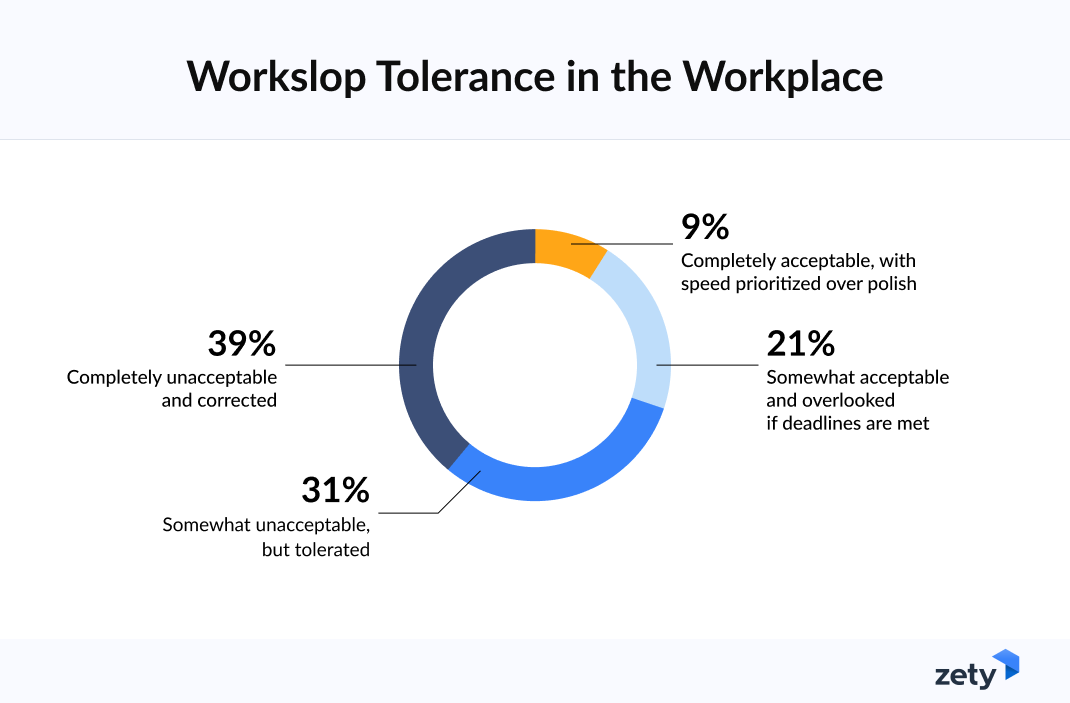
What this means: Workplaces may be recalibrating expectations for output, prioritizing speed over accuracy. This gradual normalization of lower-quality work could make it harder to hold teams accountable and risks embedding inefficiency as a standard practice.
The Hidden Cost to Workers
When “workslop” reaches employees’ inboxes, nearly half (49%) say they fix the issues themselves rather than escalate or reject the work. This added labor often goes unrecognized, yet it adds up quickly. Two-thirds of workers report spending up to six or more hours each week correcting AI-related errors.
As a result, employees say “workslop” significantly or moderately harms:
- Stress levels: 70%
- Productivity: 67%
- Overall morale: 65%
- Burnout risk: 53%
What this means: Employees are effectively taking on the side effects of AI, turning minor errors into a significant personal workload. Over time, this invisible labor can undermine engagement, reduce focus on core responsibilities, and increase turnover risk.
Broader Workplace Risks
Beyond individual strain, workers also see organizational consequences. The top perceived risks associated with “workslop” include:
- Wasted time and lost productivity: 36%
- Spread of misleading or false information: 30%
- Damage to professional or organizational reputation: 24%
What this means: Accepting low-quality AI output can damage both internal workflows and external credibility. Mistakes that go uncorrected may erode trust, distort decision-making, and create long-term vulnerabilities.
The data highlights a growing tension in the modern workplace: as AI accelerates output, workers are increasingly responsible for absorbing the quality costs. Without clearer standards and accountability, speed risks becoming the default measure of success, leaving employees to shoulder the consequences.
For press inquiries, contact Skyler Acevedo, public relations specialist, at skyler.acevedo@bold.com.
Methodology
The findings presented are based on a nationally representative survey conducted by Zety using Pollfish on January 8, 2025. The survey collected responses from 1,000 U.S. employees who have encountered workslop and examined its impact on their daily work, trust in leadership, stress and productivity, and attitudes toward AI training. Respondents answered different types of questions, including yes/no, scale-based questions where they indicated their level of agreement with statements, and multiple-choice where they could select from a list of provided options. The sample consisted of 49% female, 50% male, and 1% nonbinary respondents, with 12% Gen Z, 30% millennials, 32% Gen X, and 26% baby boomers.
About Zety
Zety’s Resume Builder is a premier platform that leverages advanced AI tools to help job seekers stand out and land interviews effortlessly. Offering step-by-step guidance, curated content suggestions, and 100s of professional, ATS-friendly resume templates, it allows users to feel confident crafting tailored applications. Millions of professionals rely on Zety’s interactive suite—which also features an easy-to-use Cover Letter Generator—to produce high-quality documents that are free to create and ready to download. Since 2016, Zety’s career blog has provided free data-driven insights aimed at empowering professionals at every stage of their journey. The editorial team includes Certified Professional Resume Writers, with the best career advice and evidence-based findings featured in Business Insider, CNBC, and Forbes, among others. Stay connected with Zety on LinkedIn, Facebook, Instagram, and YouTube for free expert career tips and updates. Follow Zety as a preferred source in Google to receive more workforce trends, career insights, and labor market research in your personalized search experience.

Follow Zety as a preferred source in Google
Get more resume writing tips, career insights, and workforce trends in your personalized search experience. Learn more >

Share:


