















Table of Contents
Get more resume writing tips, career insights, and workforce trends in your personalized search experience.
Holiday gifting at work can pressure employees to spend, with little expectation of receiving anything from their employer.
Zety’s Workplace Holiday Gifting Report found that 43% of workers say holiday gift expectations cause them financial stress, while 53% don’t expect a holiday gift from their employer this year.
Based on a survey of 1,040 U.S. workers, the data reveals the financial pressure surrounding office gift exchanges, what employees receive from their employers, and how those gifts compare with what they actually want.
Key Findings
- Over 1 in 3 (35%) have bought or contributed to a workplace holiday gift for their manager because they felt obligated.
- The majority (77%) would prefer a cash bonus as a holiday gift, while only 34% typically receive one.
- $50–$99 is the most common minimum value (26%) that would make a holiday gift from an employer feel meaningful.
- Employees say receiving a holiday gift would make them feel more valued (53%) and more motivated at work (35%) in the new year.
Office Gifting Obligations Add to Holiday Budgets
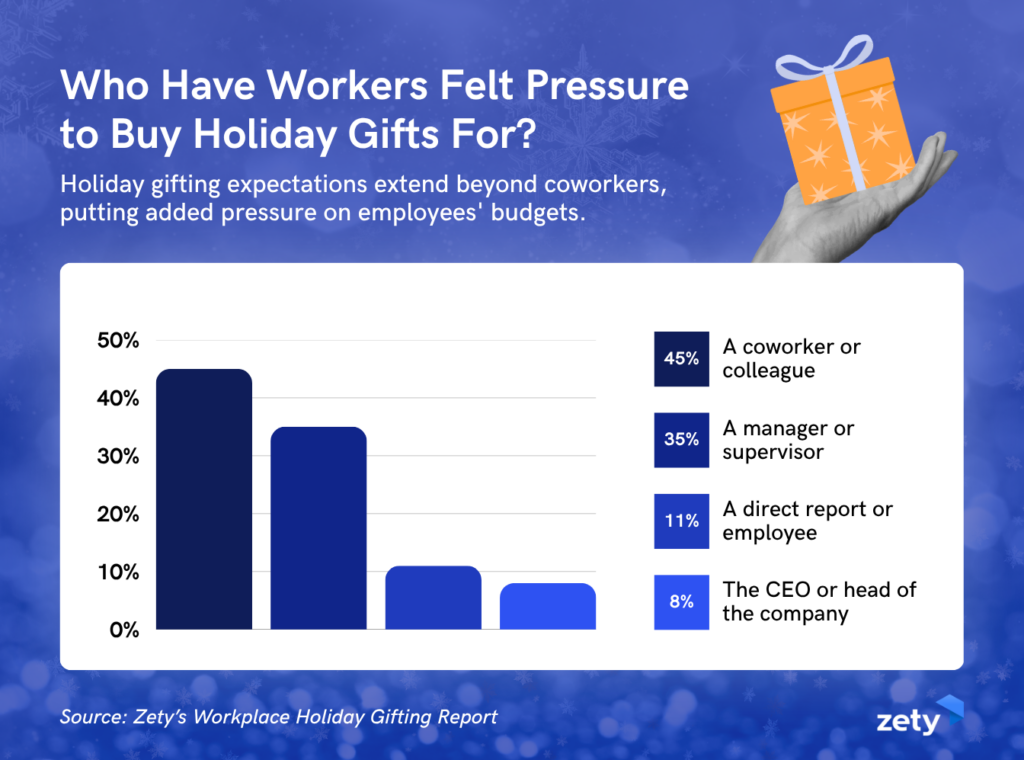
Workers have felt obligated to spend on holiday gifts for people throughout their workplace, including:
- 45% — A coworker or colleague
- 35% — A manager or supervisor
- 11% — A direct report or employee
- 8% — The CEO or head of the company
Expectations around office holiday gift-giving at work carry a financial burden. 43% of workers say workplace holiday gift expectations cause them financial stress, including buying individual gifts, contributing to group gifts, or participating in gift exchanges.
What this means: Calling a gift exchange optional does little if employees worry that sitting it out will look bad. Employers can ease office holiday gift pressure by setting clear gifting expectations and making sure participation never becomes a test of team spirit.
More Than Half Don’t Expect a Holiday Gift From Their Employer
While workplace gifting expectations can pressure employees to spend, most (53%) don’t expect a gift from their employer.
When asked what holiday gifts to employees would need to be worth to feel meaningful, $55 to $99 was the top choice:
- 26% — $50–$99
- 22% — $100–$199
- 17% — Less than $50
- 9% — $200–$299
- 8% — $500 or more
- 3% — $300–$399
- 2% — $400–$499
For others, the price tag matters less: 13% say monetary value wouldn’t determine whether an employer gift felt meaningful.
What this means: Sentiment around meaningful employee gifts varies among workers. Offering flexible options within a set budget lets them choose what fits their needs without having to explain their finances or personal circumstances.
Holiday Gifts Don’t Always Match Employees’ Wish Lists
Cash bonuses show the largest gap between what employees want and what they typically receive: 77% would most like a cash bonus, while only 34% typically get one.
Here’s how employees’ holiday wish lists compare with what their employers provide:
| Holiday Gift or Perk | What Employees Typically Receive | What Employees Would Most Like to Receive |
| Gift card | 39% | 39% |
| Cash bonus | 34% | 77% |
| Holiday party or company celebration | 25% | 12% |
| Team meal | 24% | 9% |
| Company-branded items | 15% | 5% |
| Flexible work hours | 10% | 13% |
| Additional PTO | 8% | 24% |
| Non-company-branded gifts | 8% | 6% |
What this means: The cost of organizing a holiday event doesn’t necessarily translate into value for each employee. Employers should assess their workplace gifting guidelines by what employees get out of them, alongside what the company spends.
Office Holiday Gifts Could Boost Morale in 2027
Looking ahead to the new year, more than half (53%) of employees say receiving a holiday gift would make them feel more valued.
Survey results revealed how holiday gifting at work makes employees feel:
- 53% — More valued
- 35% — More motivated at work
- 34% — More satisfied with their job
- 18% — More loyal to their employer
What this means: A holiday gift can be a welcome thank-you, but employers shouldn’t treat it as a retention strategy. The gesture carries more weight when employees also feel appreciated in their everyday work, through regular recognition and support from their managers.
For press inquiries, please contact Skyler Acevedo at skyler.acevedo@bold.com.
Methodology
The findings presented are based on a survey of 1,040 U.S. workers, conducted on October 19, 2026, using Pollfish. The study examined workers’ experiences with holiday gifting in the workplace, including pressure to buy or contribute toward gifts, financial stress, and expectations of receiving a gift from their employer.
Respondents answered different types of questions, including yes/no, open-ended, scale-based questions where respondents indicated their level of agreement with statements, and multiple-choice questions where they could select from a list of provided options.
Demographic Breakdown
The sample included 64% female, 35% male, and 1% nonbinary respondents. By generation, 26% of respondents were Gen Z, 28% were Millennials, 28% were Gen X, and 18% were Baby Boomers.

Follow Zety as a preferred source in Google
Get more resume writing tips, career insights, and workforce trends in your personalized search experience. Learn more >

Share:


