
Table of Contents
Get more resume writing tips, career insights, and workforce trends in your personalized search experience.
After a year of wage stagnation, hiring slowdowns, and continued shifts in workplace norms, many employees are entering 2026 with tempered expectations. Zety’s 2026 Job Predictions Report reveals how workers view the job market, hiring trends, and their own career stability heading into the new year.
The data shows that 2 in 3 workers (65%) believe the overall U.S. job market will stay the same or be weaker in 2026 compared to 2025. In addition, 49% expect layoffs to be more common, and 30% expect remote work opportunities to decrease.
Key Findings
- Layoff fears are front and center. 49% of workers expect layoffs to be more common, and 33% say job security/risk of layoffs is their biggest career concern.
- Salary not keeping up with inflation is the biggest concern. The majority (51%) say falling behind on pay is their top worry in 2026.
- Remote work may be losing ground. Three in 10 employees (30%) predict a decline in remote work opportunities as more companies pull employees back to the office.
- Job scarcity tops hiring challenges. Half of employees (50%) believe a lack of available jobs will be the biggest barrier to getting hired this year, followed by competition from AI and automation (48%).
- Workers are prioritizing future-proof skills. The majority (69%) believe AI and tech-related skills will be most valuable for job seekers this year, followed by industry certifications (42%).
Employees’ Top Concerns Going into 2026
As workers look ahead to the new year, their biggest career concerns reveal growing anxieties about job stability and workplace conditions. These worries include:
- Salary not keeping up with inflation (51%)
- Finding a new job if needed (34%)
- Job security/risk of layoffs (33%)
- Burnout or mental health concerns (27%)
- Companies cutting remote/flexible work options (25%)
- Lack of career advancement opportunities (20%)
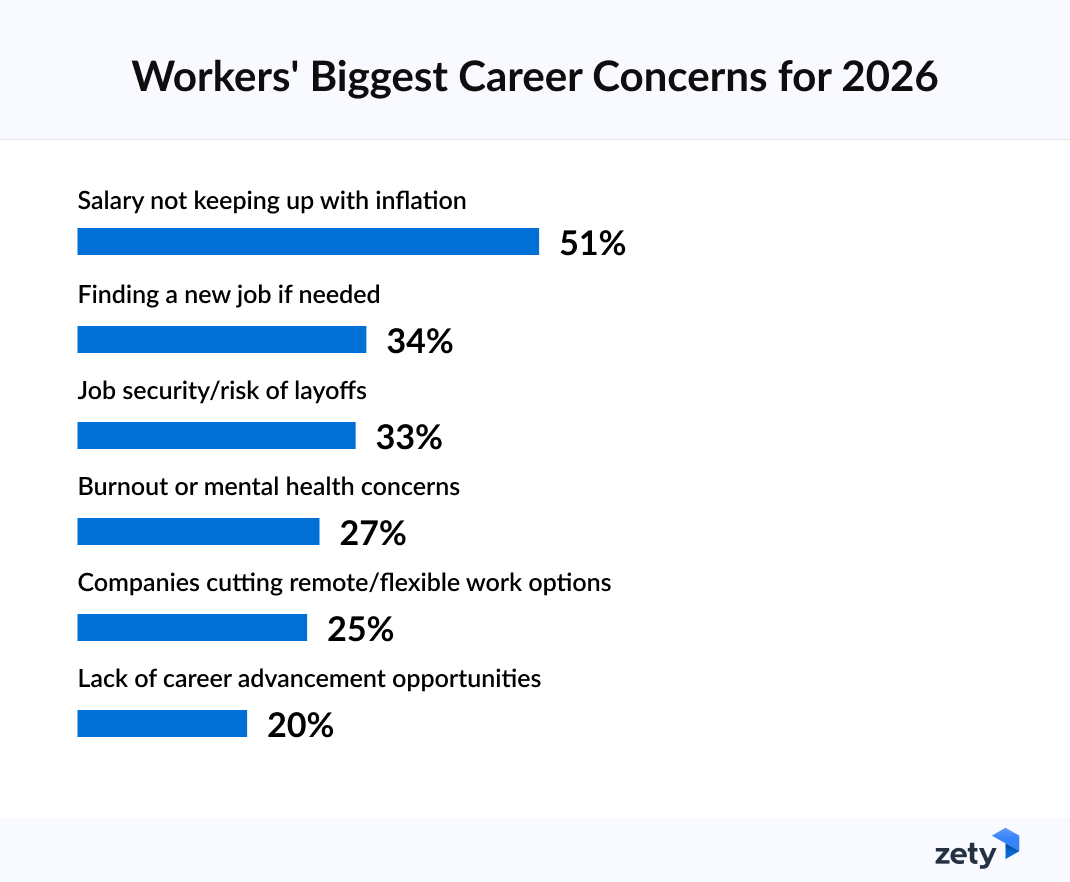
What this means: Concerns around inflation, layoffs, and burnout suggest workers will be cautious about taking risks in their careers this year. Employees may focus less on climbing the career ladder and more on dependable work conditions. Companies that provide stability, transparency, and support for well-being are positioned to earn greater trust and loyalty from their workforce.
Hiring Outlook for 2026
With 40% of employees expecting more companies to pull back on hiring, many are wary of the biggest barriers to getting hired in a competitive market.
When asked about these barriers, employees cited:
- Lack of available jobs (50%)
- Competition from AI/automation (48%)
- Lack of skills (40%)
- Resume gaps (24%)
- Job hopping (18%)
In addition, 1 in 5 employees (19%) believe salaries for new hires will be lower compared to 2025.
What this means: If employees are right, job seekers may face fewer openings and tighter competition. With AI playing a larger role in hiring, candidates may also need to adjust expectations around pay and process. Organizations that maintain steady hiring or offer clear applicant guidance will stand out.
Essential Skills for Job Seekers
To stand out amid potential hiring slowdowns, employees say these skills will be most valuable to job seekers in 2026:
- AI/tech skills (69%)
- Industry-specific certifications (42%)
- Communication and other soft skills (28%)
- Leadership and management (23%)
What this means: Workers understand that staying employable in 2026 requires stronger tech and AI skills. This trend will likely widen the gap between those who upskill and those who do not. Even basic AI literacy or a relevant certification can give candidates a meaningful advantage.
For press inquiries, contact Skyler Acevedo, public relations specialist, at skyler.acevedo@bold.com.
Methodology
The findings presented are based on a nationally representative survey conducted by Zety using Pollfish on December 12, 2025. The survey collected responses from 1,003 U.S. employees and examined their U.S. job market predictions for 2026, concerns about job security and pay, and perceptions of hiring barriers. Respondents answered different types of questions, including yes/no questions; scale-based questions, where they indicated their level of agreement with statements; and multiple-choice questions, where they could select from a list of provided options. The sample consisted of 48% female and 52% male, with 20% Gen Z, 26% millennials, 27% Gen X, and 27% baby boomers.
About Zety
Zety resume templates and Zety’s Resume and Cover Letter Generator are trusted by 12 million users each year. With 100s of options to choose from, including professionally designed resume templates to beat the ATS, users can create a professional resume in less than 15 minutes. Since 2016, Zety’s career blog has provided free data-driven insights to over 40 million readers annually, empowering professionals at every stage. The editorial team includes Certified Professional Resume Writers, with the best career advice and evidence-based findings featured in Business Insider, CNBC, and Forbes, among others. Follow Zety on Facebook, LinkedIn, YouTube, and Instagram for free expert career tips and updates.

Follow Zety as a preferred source in Google
Get more resume writing tips, career insights, and workforce trends in your personalized search experience. Learn more >

Share:


