











Table of Contents
Get more resume writing tips, career insights, and workforce trends in your personalized search experience.
Workplace PTO policies are designed for vacations and sick days, but real life doesn’t always fit into these categories.
In its latest Emotional Leave Report, Zety surveyed 1,020 U.S. employees and found that 49% of workers have needed time off for an emotionally difficult situation, like a family emergency or mental health crisis, but didn’t have the appropriate PTO available.
These personal hardships are testing the limits of standard leave policies and exposing gaps in how companies define time off.
Key Findings
- Emotional support falls short. Over half (57%) of workers don’t believe current PTO policies account for major emotional life events.
- Time off becomes a tradeoff. While many rely on sick days (34%) or vacation days (20%) during a personal crisis, others take unpaid time off (18%) or continue working without any PTO (16%).
- Stigma remains. 2 in 5 feel uncomfortable requesting time off for an emotional or personal crisis under their current PTO policy.
- Top PTO demands are health-related. A mental health crisis (70%) and miscarriage or pregnancy loss (65%) rank as the top life events workers believe should have dedicated PTO.
Workers Make Do Without the Right PTO
Nearly half of employees (49%) say they’ve needed time off for an emotionally difficult situation but didn’t have the appropriate PTO available. This has forced many to rely on whatever leave they can access, such as:
- Sick days (34%)
- Vacation days (20%)
- Mental health days (12%)
For some workers, PTO isn’t even an option:
- 18% take unpaid time off.
- 16% continue working without taking any type of PTO.
The following graph represent the data mentioned above:
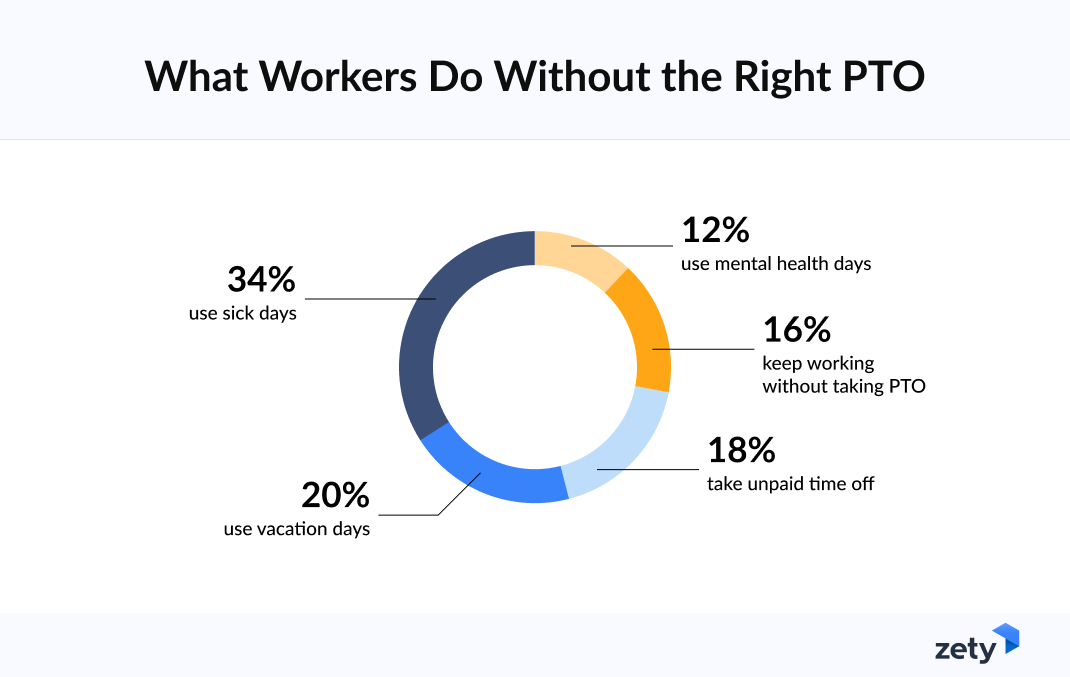
What this means: When employees have to improvise their time off, it signals that existing benefits aren’t aligned with real-world challenges. Relying on mismatched leave types, or none at all, can intensify stress during already difficult moments. Over time, this patchwork approach could erode both wellbeing and productivity.
PTO Policies Don’t Match Emotional Needs
The lack of appropriate leave reflects a broader gap between workplace policies and real-life challenges, and many want employers to expand their approach to time off.
- 57% don’t believe current PTO policies account for major emotional life events.
- 50% strongly support emotional PTO being included in standard employment benefits.
What this means: Traditional leave structures were built around physical illness and scheduled time away, not complex life events. As expectations around mental health and holistic wellbeing evolve, static policies may begin to feel outdated. Employers who reassess these frameworks could gain a competitive edge in attracting and retaining talent.
Employees Hesitate to Request Time Off
Even when time off may be available, workplace culture can make employees reluctant to use it for personal crises:
- 40% feel uncomfortable requesting time off for a family emergency or an emotional or personal crisis under their current PTO policy.
- 39% say their employer has discouraged them (directly or indirectly) from taking time off for personal or emotional reasons.
What this means: Reluctance to request time off often stems from perceived judgment or career risk. When employees feel they must justify emotional hardship, it reinforces stigma rather than support. Addressing culture, not just policy, may be key to meaningful change.
Dedicated Emotional Leave for Major Events
Looking ahead, many workers want more structured support for emotionally significant life events rather than relying on general PTO categories.
- 54% believe emotional-specific PTO (e.g., family and pet bereavement leave, breakup leave) should be separate from mental health days.
Employees say the following life events should have dedicated PTO:
- Mental health crisis (70%)
- Miscarriage or pregnancy loss (65%)
- Medical diagnosis for self (59%)
- Unexpected childcare crisis (52%)
- Medical diagnosis for a close family member or friend (47%)
- Death of a pet (32%)
- Divorce or romantic breakup (25%)
What this means: As employees advocate for defined emotional leave, they are redefining what comprehensive benefits look like. Time off is increasingly viewed through the lens of life impact, not just physical illness. Policies that reflect that shift demonstrate cultural awareness and responsiveness.
For press inquiries, contact Skyler Acevedo, public relations specialist, at skyler.acevedo@bold.com.
Methodology
The findings presented are based on a nationally representative survey conducted by Zety using Pollfish on February 5, 2026. The survey collected responses from 1,020 U.S. employees and examined how workers navigate emotionally difficult life events, the availability of appropriate PTO, and attitudes toward dedicated emotional leave policies. Respondents answered different types of questions, including yes/no, scale-based questions where they indicated their level of agreement with statements, and multiple-choice where they could select from a list of provided options. The sample consisted of 53% female, 46% male, and 1% nonbinary, with 17% Gen Z, 28% Millennials, 27% Gen X, and 28% Baby Boomers.
About Zety
Zety’s Resume Builder is a premier platform that leverages advanced AI tools to help job seekers stand out and land interviews effortlessly. Offering step-by-step guidance, curated content suggestions, and 100s of professional, ATS-friendly resume templates, it allows users to feel confident crafting tailored applications. Millions of professionals rely on Zety’s interactive suite—which also features an easy-to-use Cover Letter Generator—to produce high-quality documents that are free to create and ready to download. Since 2016, Zety’s career blog has provided free data-driven insights aimed at empowering professionals at every stage of their journey. The editorial team includes Certified Professional Resume Writers, with the best career advice and evidence-based findings featured in Business Insider, CNBC, and Forbes, among others. Stay connected with Zety on LinkedIn, Facebook, Instagram, and YouTube for free expert career tips and updates. Follow Zety as a preferred source in Google to receive more workforce trends, career insights, and labor market research in your personalized search experience.

Follow Zety as a preferred source in Google
Get more resume writing tips, career insights, and workforce trends in your personalized search experience. Learn more >

Share:


