Table of Contents
Get more resume writing tips, career insights, and workforce trends in your personalized search experience.
The line separating personal social media use from professional life has all but vanished.
Based on a survey of over 900 Gen Z employees, Zety’s Gen Z Digital Boundaries Report reveals how digital footprints are impacting the careers of young professionals.
The data shows a workforce navigating intense pressure to connect with colleagues online, leading to widespread self-censorship on social media and severe consequences for those who share too much.
Key Findings
- 95% have avoided posting their real opinions online because they believe it could hurt their career.
- 90% have faced negative workplace consequences (e.g., warnings, reprimands, or conflicts) because of something they posted online.
- 67% have felt pressure from managers to connect online, and 25% have felt the same from coworkers.
- Nearly one-third (34%) have separate personal and professional accounts to manage their online presence.
Social Media Missteps Carry Real Career Consequences
Gen Z employees are navigating a workplace where social media activity can carry real professional consequences, influencing both what they share and how they engage online.
- 95% have avoided posting their real opinions online because they believe it could hurt their career.
- 90% have faced negative workplace consequences (e.g., warnings, reprimands, or conflicts) because of something they posted online.
What this means: The expectation of workplace professionalism no longer ends when an employee clocks out. Because peers and employers are actively monitoring personal feeds, young professionals are treating their digital footprints like living resumes. This intense scrutiny has created a culture of strict self-censorship, where the fear of social media affecting employment outweighs the desire for authentic self-expression online.
Blurring Boundaries Between Work & Social Media
As workplace relationships extend into personal platforms, many Gen Z employees report feeling pressure to connect online—67% from managers and 25% from coworkers—shaping who they allow into their social media circles.
Gen Z has added the following people on social media (excluding LinkedIn):
- A coworker (57%)
- A direct manager (57%)
- A manager in another department (44%)
- A subordinate (21%)
- An executive (CEO, VP, etc.) (9%)
What this means: As colleagues become part of the same digital audience, social media starts to influence how inclusion and belonging are perceived. Being looped in or left out of these networks can quietly affect how connected someone feels to their team.
Managing Social Media Risk
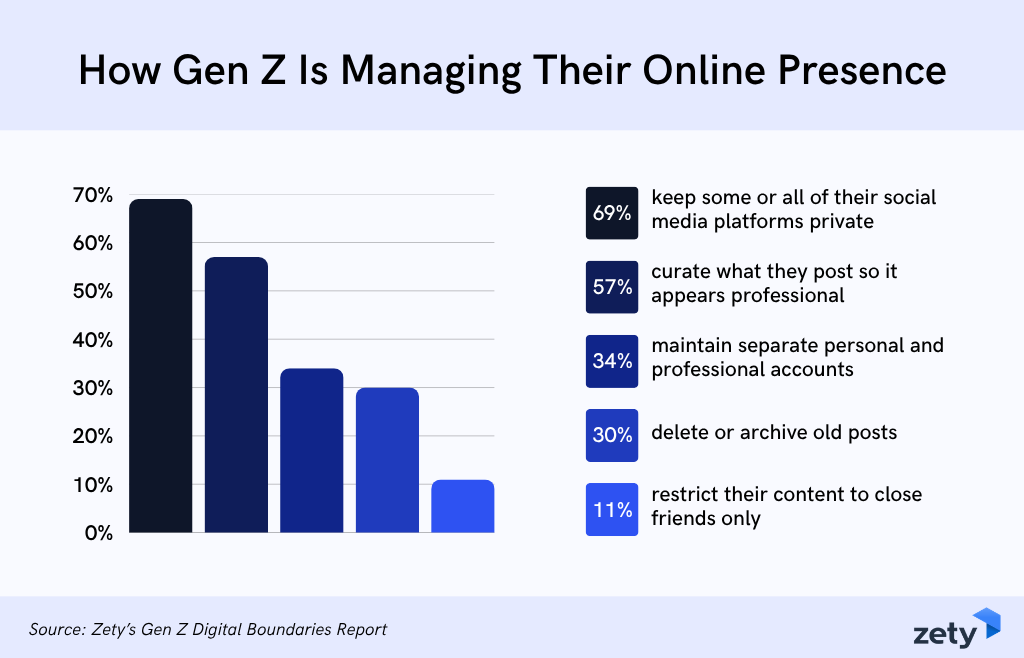
Workers are taking deliberate steps to shape how they appear online and limit potential professional risk:
- 69% keep some or all of their social media platforms private.
- 57% curate what they post to make it appear professional.
- 34% maintain separate personal and professional accounts.
- 30% delete or archive old posts.
- 11% restrict their content to close friends only.
What this means: The social media impact on careers is quietly progressing, whether employees want it to or not. As professional relationships move into personal spaces, the idea of having a truly “off-duty” workplace identity is fading, forcing workers to constantly weigh access, visibility, and boundaries in ways previous generations didn’t have to.
Perception Vs Performance
What’s unfolding as Gen Z social media consequences persist is a shift in how professional reputation is formed and evaluated in real time. Until clearer norms are established, employees are operating in an environment where perception can carry as much weight as performance.
For press inquiries, please contact Skyler Acevedo at skyler.acevedo@bold.com.
Methodology
The findings presented are based on a nationally representative survey conducted by Zety on February 23, 2026. The survey collected responses from 919 Gen Z workers and examined how social media behavior intersects with workplace expectations, including professional consequences, online self-censorship, and how employees manage their digital presence.
They answered different types of questions, including yes/no; open-ended, scale-based questions, where respondents indicated their level of agreement with statements; and multiple-choice, where they could select from a list of provided options.
All participants were screened to ensure they were currently residing in the U.S., actively employed, and part of the Gen Z generation (aged 18–27) at the time of the survey.

Follow Zety as a preferred source in Google
Get more resume writing tips, career insights, and workforce trends in your personalized search experience. Learn more >

Share:


