
Table of Contents
Get more resume writing tips, career insights, and workforce trends in your personalized search experience.
A job reference may seem like a straightforward endorsement, but what happens behind the scenes can be more complicated.
Zety’s research shows that some references recommend people despite their own reservations (40%), some candidates coach or even fake references (19%), and employers don’t always stick to the names they’re given (37%).
Surveying over 1,000 U.S. workers, the Professional References Report found that 42% believe references should have little to no influence on an employer’s final hiring decision, raising broader questions about the role references play in hiring.
Key Findings
- Rise of “backdoor” job references: 37% say a potential employer reached out to a former manager or coworker who wasn’t listed as a reference.
- Candidates struggle to meet reference requirements: Nearly one-third have had difficulty finding enough professional references when applying for a job.
- Some job seekers turn to fake references: 1 in 10 have asked a friend or family member to pose as a former coworker or manager.
- References can come with reservations: More than half (52%) have been asked to recommend someone they weren’t comfortable endorsing, yet 22% gave a positive reference anyway.
How Far Job Seekers Go to Manage References
Rather than leaving references to chance, many candidates take steps to steer the process in their favor.
Workers report using several tactics:
- 39% chose people they know will speak positively about them.
- 11% asked their references ahead of time what they plan to say about them.
- 11% avoided listing a former manager because they expected a negative reference.
- 10% asked a friend or family member to pose as a former coworker or manager.
- 9% coached their reference on what to say.
- 7% intentionally provided outdated contact information.
What this means: References are supposed to help employers evaluate candidates, but candidates naturally shape what that evaluation looks like. When job seekers can select, prepare, or avoid certain references, employers may hear only one version of someone’s professional history rather than a fully independent perspective.
High Risk for “Backdoor” References
Candidates may carefully curate their references, but 37% of workers say a potential employer reached out to a former manager or coworker they never listed.
Meanwhile, the references they do provide aren’t necessarily contacted: just 15% say employers contact their references every time they hire someone, while 47% say sometimes and 38% say rarely or never.
Opinions are divided on employers contacting unlisted references:
- 48% say it’s acceptable, but only with the candidate’s permission.
- 25% say it’s acceptable even without the candidate’s permission.
- 27% say it’s unacceptable to contact people who weren’t provided as references.
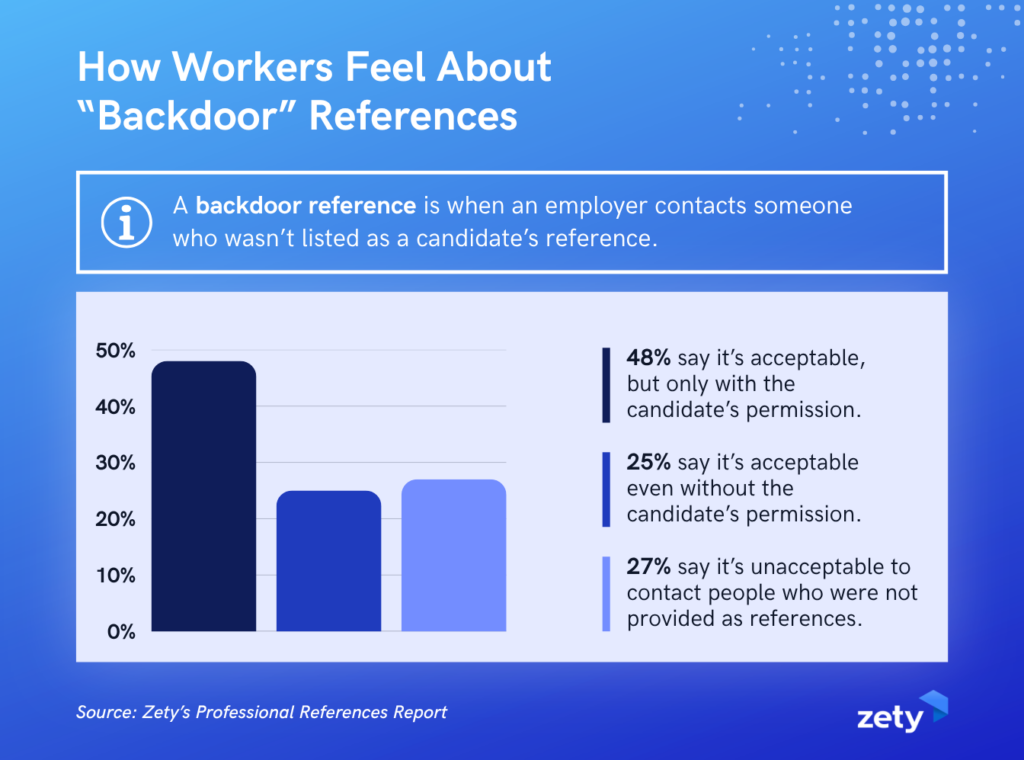
What this means: Going outside a candidate’s reference list can give employers access to perspectives they wouldn’t otherwise hear. But the divided opinions around the practice show that how employers obtain that information matters, particularly when candidates are unaware that those conversations are happening.
Not Every Reference Is an Endorsement
Being selected as a reference doesn’t necessarily mean someone is comfortable recommending the candidate. More than half of workers (52%) have been asked to provide a reference for someone they had reservations about, including:
- 22% who gave a positive reference anyway.
- 18% who gave an honest but mixed or negative reference.
- 12% who declined.
What this means: There can be a gap between agreeing to be a reference and genuinely supporting someone’s candidacy. That makes it important for both sides to discuss what the reference is comfortable endorsing before passing their name along to an employer.
Questioning the True Value of References
Despite their longstanding role in hiring, professional references don’t carry the same value for every worker. Some question their accuracy and influence, while others struggle to meet reference requirements in the first place:
- 42% believe references should have little to no influence on an employer’s final hiring decision.
- 31% have struggled to find enough professional references when applying for a job.
- 22% feel that professional references don’t accurately reflect a candidate’s work performance.
What this means: The traditional reference check assumes that the people contacted can provide meaningful insight into a candidate’s work. The results complicate that assumption, especially when some applicants struggle to produce references and workers themselves question how accurately those references represent performance.
For press inquiries, please contact Skyler Acevedo at skyler.acevedo@bold.com.
Methodology
The findings presented are based on a nationally representative survey conducted by Zety using Pollfish on August 24, 2026. The survey collected responses from 1,007 U.S. employees and examined their experiences, perceptions, and attitudes regarding professional references, including how references are selected, provided, and contacted, as well as their perceived accuracy and influence on hiring decisions.
Respondents answered different types of questions, including yes/no questions; scale-based questions, where they indicated their level of agreement with statements; and multiple-choice questions, where they could select from a list of options.
The sample consisted of 56% female, 43% male, and 1% nonbinary respondents, with 21% Gen Z, 27% millennials, 26% Gen X, and 26% baby boomers.

Follow Zety as a preferred source in Google
Get more resume writing tips, career insights, and workforce trends in your personalized search experience. Learn more >

Share:


