
Table of Contents
Get more resume writing tips, career insights, and workforce trends in your personalized search experience.
The workplace may be entering its “situationship” era.
Surveying over 1,000 U.S. workers, Zety’s latest Workplace Situationships Report reveals that factors like financial pressures and labor market uncertainty are leading many employees to choose job stability over long-term commitment. At the same time, employers are offering less clarity around career growth, job security, and expectations.
These dynamics are driving work situationships: employer-employee relationships defined by mixed signals, uncertainty about the future, and the choice to stay together despite signs that a job may no longer be the right fit.
Key Findings
- Employees are keeping things casual. Over half (59%) of workers don’t see a clear, long-term path with their current employer.
- Employers are sending mixed signals. 63% don’t believe their employer is committed to keeping them long-term.
- There’s a lack of clarity and progress. 32% of workers report limited growth opportunities, while 23% feel unfulfilled or frustrated.
- Employees think it’s too risky to leave. The top reasons workers stay in workplace situationships are financial stability (60%) and comfort or familiarity (47%).
Job Status: It’s Complicated
Like any situationship, many workplace relationships lack a shared vision for the future.
Nearly 6 in 10 respondents don’t see a clear, long-term path forward with their current employer. When asked to define the relationship, workers reported the following:
- 32% say the relationship is casual; they’re satisfied but not thinking long-term.
- 15% are on the way out, actively exploring other options.
- 12% say it’s complicated, meaning they’re unsatisfied but staying put for now.
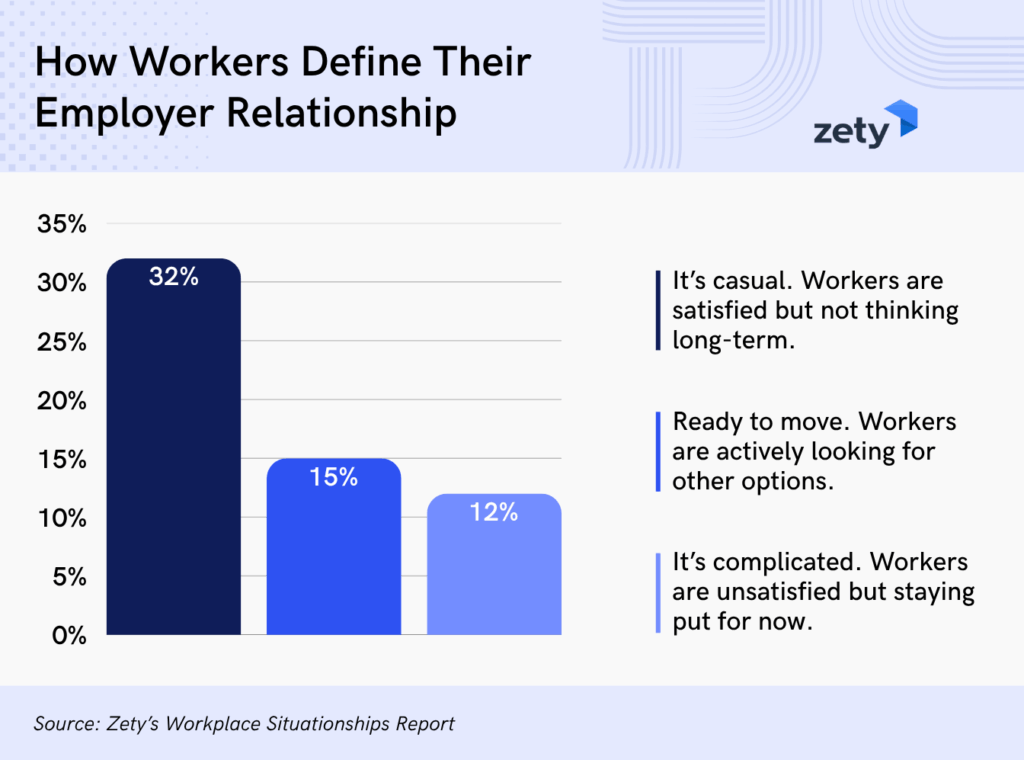
What this means: The traditional career path is being replaced by a professional holding pattern. Most workers no longer view their current roles as long-term investments, choosing instead to coast casually or keep an active eye on the exit.
The Feeling Is Mutual
Questions about commitment run both ways. The majority (63%) of workers don’t feel their employer is loyal and committed to them long-term:
- 31% believe their employer is somewhat invested in keeping them at the company, but believe they could be replaced if needed.
- 16% feel more interchangeable than valued.
- 16% do not feel their employer is invested in keeping them at all.
What this means: These job security and employee loyalty statistics are the corporate equivalent of a standoff where nobody wants to be the first one to commit. Workers aren’t investing their futures in companies that treat them like numbers on a spreadsheet, and employers aren’t providing the security employees crave.
How Jobs Become Situationships
The hallmarks of work situationships look a lot like those of personal ones: a lack of progress, unclear expectations, and growing frustration.
Workers report experiencing the following:
- Limited growth opportunities: 32%
- Feeling unfulfilled or frustrated: 23%
- Poor manager relationships: 19%
- Blurred work-life boundaries: 17%
- Unclear role expectations: 15%
What this means: A job turns into a situationship when communication fades and the opportunity for professional growth disappears. Without clear expectations or a path forward, employees are left in limbo, navigating mixed signals and blurred boundaries.
Why Employees Stick Around
When asked why they remain in jobs that aren’t ideal, respondents pointed overwhelmingly to practical reasons rather than passion:
- 60% stay for financial stability.
- 47% remain because their role feels comfortable or familiar.
- 40% stay for benefits.
- 35% cite flexibility or remote work.
- 29% point to job market uncertainty.
- 29% say better opportunities aren’t available.
What this means: Workers are staying because bills need to be paid, and the external job market feels daunting. Financial survival, familiarity, and essential benefits are heavily outweighing the desire for actual career fulfillment right now. It’s not a professional romance; it’s a marriage of convenience dictated by economic reality.
Professional Limbo
While workers may not be actively seeking an exit, many are also not fully invested in a future with their current employer. Instead, the data suggests a growing number are navigating an in-between state, essentially quiet quitting while they wait for a clearer signal about what comes next.
For press inquiries, please contact Skyler Acevedo at skyler.acevedo@bold.com.
Methodology
The findings presented are based on a nationally representative survey conducted by Zety using Pollfish on May 11, 2026. The survey collected responses from 1,023 U.S. employees and examined their experiences, perceptions, and attitudes regarding workplace commitment, employee retention, career growth, job satisfaction, and employer relationships. Respondents answered different types of questions, including yes/no; scale-based questions, where they indicated their level of agreement with statements; and multiple-choice questions, where they could select from a list of provided options.
Demographic Breakdown
The sample consisted of 53% female, 46% male, and 1% nonbinary respondents, with 19% Gen Z, 27% millennials, 27% Gen X, and 27% baby boomers.

Follow Zety as a preferred source in Google
Get more resume writing tips, career insights, and workforce trends in your personalized search experience. Learn more >

Share:


