
Table of Contents
Get more resume writing tips, career insights, and workforce trends in your personalized search experience.
AI is reshaping how work gets done, but not always for the better. More than half of U.S. employees say they’ve received “workslop” from a manager, raising new concerns about leadership standards and accountability.
What is workslop? In Zety’s latest survey of 1,000 U.S. workers, workslop is defined as AI-generated work that looks polished but lacks accuracy, substance, or proper review. For many employees, it becomes a bigger issue when it comes from leadership. In fact, 85% say receiving this kind of work from a manager reduces their trust.
When low-quality AI work comes from those in charge, it can ripple across teams, signaling unclear expectations and weakening confidence in decision-making.
Key Findings
- Trust at risk: 55% have gotten workslop from a manager or supervisor, and 85% say receiving it damages their trust in leadership.
- AI skepticism rising: 45% say workslop has made them more cautious about AI in the workplace.
- Lack of AI knowledge: 1 in 4 have received no AI training or guidance from their employer.
- Workslop solutions: The majority of employees say clearer quality standards (57%) and better AI training (51%) would reduce workslop.
Eroding Workplace Trust
Submitting low-quality, automated work sends a signal about company standards, shaking confidence in both leadership and overall team performance:
- 74% say receiving workslop lowers their trust in the sender’s work quality.
- 85% say receiving workslop from a manager would reduce their trust in leadership.
- 55% say they’ve already received workslop from a manager or supervisor at their company.
What this means: When leaders rely on low-effort output, it subtly reshapes how authority is perceived. Employees begin to question not just the work itself, but the level of care behind it. Over time, that shift can make collaboration, alignment, and confidence in direction harder to sustain.
Workslop Drives Caution & Reveals Training Gaps
As workslop becomes more visible, employees report growing skepticism of AI tools. Nearly half (45%) say it has made them more cautious about AI’s role in the workplace.
At the same time, the research (also illustrated below) indicates a lack of preparation and support:
- 45% say they have received limited AI training or guidance.
- 24% say they have received none at all.
- Only 31% report receiving detailed training and ongoing support.
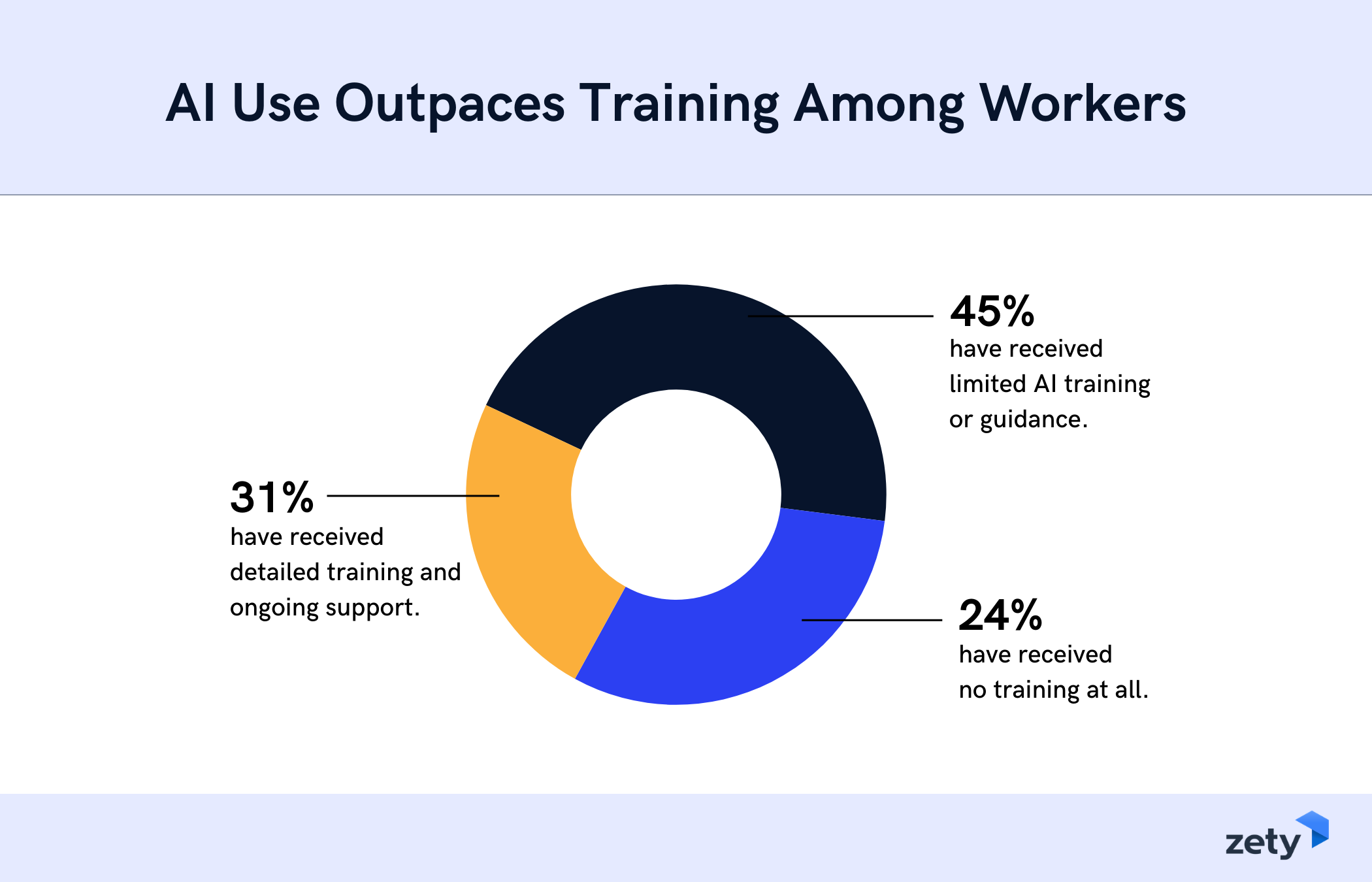
What this means: Hesitation around AI use points to a broader readiness gap inside organizations. Many employees are experimenting with powerful tools without shared expectations or consistent guidance. That disconnect can create uneven performance and uncertainty about what “good” actually looks like.
Reducing Workslop & Raising Standards
While workslop might seem minor, employees believe it has lasting consequences for teams and organizations. The top risks identified include lower trust in AI (57%), reduced productivity (51%), and damage to company reputation (46%).
When asked what would help reduce workslop, workers pointed to practical solutions:
- Clearer quality standards (57%)
- Better AI training for employees (51%)
- Tools to detect errors faster (47%)
- More review/editing time (44%)
- Stronger accountability for mistakes (39%)
What this means: Addressing AI workslop calls for clearer norms around review, ownership, and quality. Teams that establish consistent standards are better positioned to maintain credibility as AI becomes more embedded in daily work. Strong oversight helps protect both performance and reputation.
For press inquiries, contact Skyler Acevedo, public relations specialist, at skyler.acevedo@bold.com.
Methodology
The findings presented are based on a nationally representative survey conducted by Zety using Pollfish on January 8, 2026. The survey collected responses from 1,000 U.S. employees who have encountered “workslop” and examined its impact on their daily work, trust in leadership, stress and productivity, and attitudes toward AI training. Respondents answered different types of questions, including yes/no; scale-based questions, where they indicated their level of agreement with statements; and multiple-choice questions, where they could select from a list of provided options. The sample consisted of 49% female, 50% male, and 1% nonbinary respondents, with 12% Gen Z, 30% millennials, 32% Gen X, and 26% baby boomers.
About Zety
Zety’s Resume Builder is a premier platform that leverages advanced AI tools to help job seekers stand out and land interviews effortlessly. Offering step-by-step guidance, curated content suggestions, and 100s of professional, ATS-friendly resume templates, it allows users to feel confident crafting tailored applications. Millions of professionals rely on Zety’s interactive suite—which also features an easy-to-use Cover Letter Generator—to produce high-quality documents that are free to create and ready to download. Since 2016, Zety’s career blog has provided free data-driven insights aimed at empowering professionals at every stage of their journey. The editorial team includes Certified Professional Resume Writers, with the best career advice and evidence-based findings featured in Business Insider, CNBC, and Forbes, among others. Stay connected with Zety on LinkedIn, Facebook, Instagram, and YouTube for free expert career tips and updates. Follow Zety as a preferred source in Google to receive more workforce trends, career insights, and labor market research in your personalized search experience.

Follow Zety as a preferred source in Google
Get more resume writing tips, career insights, and workforce trends in your personalized search experience. Learn more >

Share:


