
Table of Contents
Get more resume writing tips, career insights, and workforce trends in your personalized search experience.
Much of the work Gen X does happens outside the office. Coordinating medical appointments, providing financial support, and helping family members navigate everyday challenges have become routine responsibilities for many workers, yet they often go unseen.
After surveying over 1,000 Gen X workers, Zety’s Gen X Caregiving Report found that nearly 1 in 4 spend the equivalent of at least two full workdays each week on caregiving responsibilities.
The data sheds light on the significant time and emotional demands many face while holding down a full-time job.
Key Findings
- Time burden of caregiving: 22% spend more than 16 hours a week providing care to loved ones.
- The “sandwich generation” squeeze: 37% of workers who care for aging relatives also support minor or adult children.
- A workplace in crisis: 54% say caregiving causes stress and burnout at work, while 44% struggle to stay focused and productive.
- Limited employer support: 3 in 10 say they receive little or no support from their employer for managing caregiving responsibilities.
- A threat to retirement: 52% say financial responsibilities for others actively impact their ability to save for retirement, and 16% have delayed their retirement entirely.
Who Gen X Is Caring For
Many Gen X professionals are providing financial or logistical support to dependents at different stages of life, including:
- Minor children (under 18): 24%
- Adult children (18+): 23%
- Parents, in-laws, or other adult relatives (e.g., grandparents): 17%
This support can overlap. More than one-third of workers are members of the sandwich generation, meaning they balance caregiving responsibilities for aging relatives with support for minor or adult children.
Overall, nearly 1 in 5 (18%) navigate these caregiving responsibilities alone, without anyone else to share the load.
What this means: Sandwich generation caregiving pressure is hitting Gen X during their peak earning years. For solo caregivers, having no backup means constantly managing family crises, leaving them with little time or energy to focus on their own future goals.
Sandwich Generation Statistics: The Many Forms of Caregiving
Respondents provide support in various ways, from covering living expenses to coordinating healthcare and managing household needs. The most common types of caregiving include the following:
- 40% provide housing and daily living support, such as providing housing, groceries, and transportation
- 35% offer financial support, such as paying bills, rent, or tuition
- 23% cover administrative or logistical issues, such as managing paperwork, finances, and scheduling
- 20% provide healthcare support for an adult, such as managing appointments, medications, and insurance
- 12% give personal care to an adult, such as bathing, dressing, and mobility
- 12% offer childcare, including supervising children and school drop-offs
What this means: Caregiving extends far beyond basic physical chores to include heavy financial, housing, and administrative responsibilities. Because a large percentage of workers are managing bills, housing logistics, and medical scheduling, they’re juggling complex operational tasks alongside their daily careers.
The Second Shift: Time Spent on Care
Juggling these caregiving tasks essentially acts as a second, unpaid job for many in this generation. Gen X workers dedicate the following hours per week to their caregiving responsibilities:
- 15% spend less than 5 hours
- 16% spend 5–15 hours
- 10% spend 16–30 hours
- 12% spend more than 30 hours
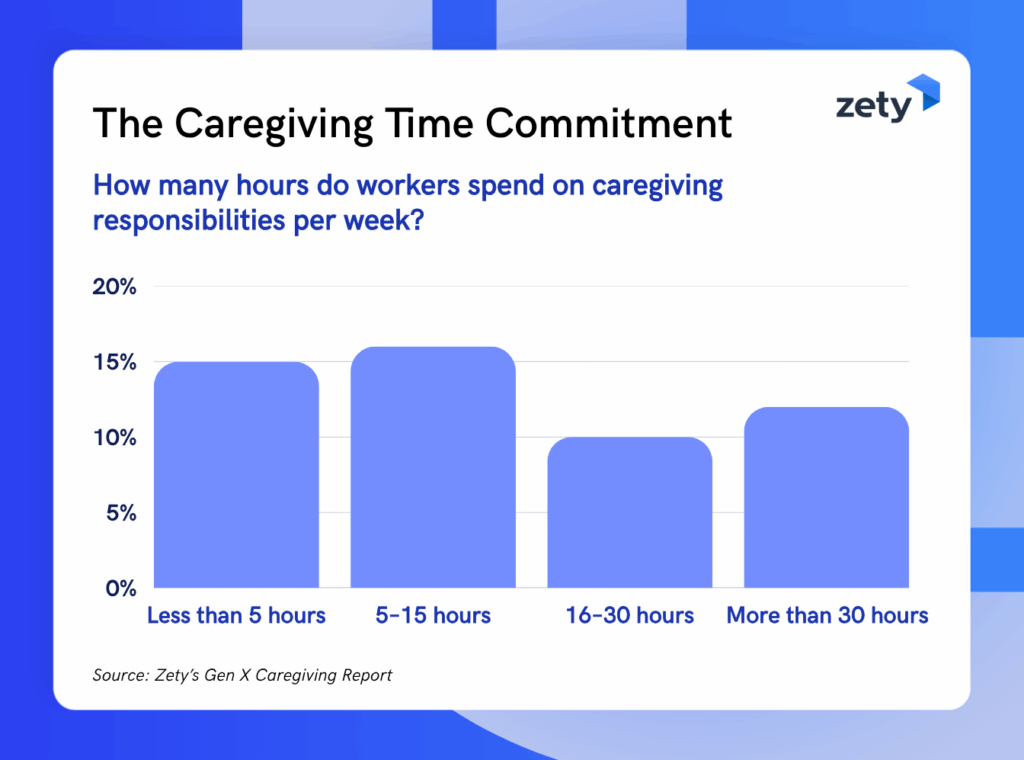
What this means: For workers carrying the heaviest caregiving loads, this constant demand severely cuts into their personal time, leaving them with little to no opportunity for rest and recovery.
The Workplace Cost of Caregiving
The effects of caregiving often extend into the workplace, negatively impacting workers in the following ways:
- Stress levels and burnout: 54%
- Ability to stay focused and productive during work hours: 44%
- Communication and responsiveness: 42%
- Interruptions during the workday, such as appointments, pickups, or emergencies: 40%
- Ability to start and complete work on time: 37%
- Relationships or feedback at work from managers or coworkers: 32%
Despite these challenges, 30% say they receive little or no employer support for their caregiving responsibilities.
What this means: The heavy demands of caring for loved ones inevitably spill over into the workday, driving up stress levels, fracturing professional focus, and leading to caregiver overwhelm and burnout. Because widespread employer support is still lacking, there’s a gap between the workplace flexibility professionals need and what corporate structures actually provide.
Paying the Price for Caregiving
Gen X caregiving responsibilities often require workers to make difficult choices between their family’s immediate needs and their own future financial security. More than half say financial responsibilities for others affect their ability to save for retirement.
Here’s what else they’ve had to sacrifice:
- 19% used their emergency savings.
- 18% took on credit card debt.
- 17% reduced their retirement contributions.
- 16% put off retirement.
- 12% switched to a lower-paying, but more flexible job.
- 10% turned down a promotion or accepted slower career growth.
What this means: Workers are acting as a private financial safety net for their relatives at their own expense. By sacrificing their personal security to handle immediate family needs, this generation may be setting a dangerous trap for their own future retirement.
Working Caregivers: The New Reality
For many Gen X professionals, caregiving is no longer a temporary challenge to work around. It’s become a lasting part of their career reality, influencing how they spend their time, manage their finances, and think about the future.
As these responsibilities become more common, understanding their impact may help inform conversations about employee support, workplace flexibility, and long-term workforce planning.
For press inquiries, please contact Skyler Acevedo at skyler.acevedo@bold.com.
Methodology
The findings presented are based on a nationally representative survey conducted by Zety on June 5, 2026. The survey collected responses from 1,003 Gen X workers and examined the caregiving responsibilities they manage for children, aging relatives, and other dependents. The study explored how these responsibilities affect employees’ time, careers, workplace performance, financial security, and ability to save for retirement.
Respondents answered different types of questions, including yes/no; open-ended, scale-based questions, where respondents indicated their level of agreement with statements; and multiple-choice, where they could select from a list of provided options.
Demographic Breakdown
The sample comprised 52% female, 47% male, and 1% nonbinary respondents. All participants were screened to ensure they were currently residing in the U.S., actively employed, and part of the Gen X generation (aged 46–61) at the time of the survey.
About Zety
Zety’s Resume Builder is a premier platform that leverages advanced AI tools to help job seekers stand out and land interviews effortlessly. Offering step-by-step guidance, curated content suggestions, and 100s of professional, ATS-friendly resume templates, it allows users to feel confident crafting tailored applications. Millions of professionals rely on Zety’s interactive suite—which also features an easy-to-use Cover Letter Generator—to produce high-quality documents that are free to create and ready to download. Since 2016, Zety’s career blog has provided free data-driven insights aimed at empowering professionals at every stage of their journey. The editorial team includes Certified Professional Resume Writers, with the best career advice and evidence-based findings featured in Business Insider, CNBC, and Forbes, among others. Stay connected with Zety on LinkedIn, Facebook, Instagram, and YouTube for free expert career tips and updates. Follow Zety as a preferred source in Google to receive more workforce trends, career insights, and labor market research in your personalized search experience.

Follow Zety as a preferred source in Google
Get more resume writing tips, career insights, and workforce trends in your personalized search experience. Learn more >

Share:


