
Table of Contents
Get more resume writing tips, career insights, and workforce trends in your personalized search experience.
The outlook for 2026 is anything but straightforward for U.S. workers. Findings from Zety’s new 2026 Job Search Split Report reveal a workforce caught between ambition and anxiety. The survey of more than 1,000 U.S. employees found that 47% plan to look for a new job in 2026, while 53% intend to stay in their current roles.
The data shows a clear tension: Workers want higher pay, better benefits, and more growth—but many fear a weakening job market, longer hiring timelines, and the risk of losing stability or remote work. This push-and-pull is shaping 2026 into a year that will be defined by quiet indecision and cautious calculation.
Key Findings
- 47% of workers will job hunt in 2026 (27% actively searching, 20% planning to start), while 53% plan to remain in their current roles.
- 40% want higher compensation, and 72% would accept a full-time return to the office for a 20% raise.
- Among those staying put, 26% cite true job satisfaction, but many are motivated by caution, such as concerns about salary prospects, job availability, loss of remote work, or layoff risk.
- 67% expect it will be difficult to find a new job in 2026, and 56% think it will take longer to land a new job compared to last year.
- 53% believe the job market will decline for employees this year, citing higher unemployment and stagnant wages.
Workers Are Split Between Staying and Searching
2026 begins with a stark divide in career intentions:
- 27% of workers are actively job hunting.
- 20% plan to start searching later in 2026.
- 53% plan to stay in their current roles.
This split reflects a workforce that wants better opportunities but sees risk in making a move.
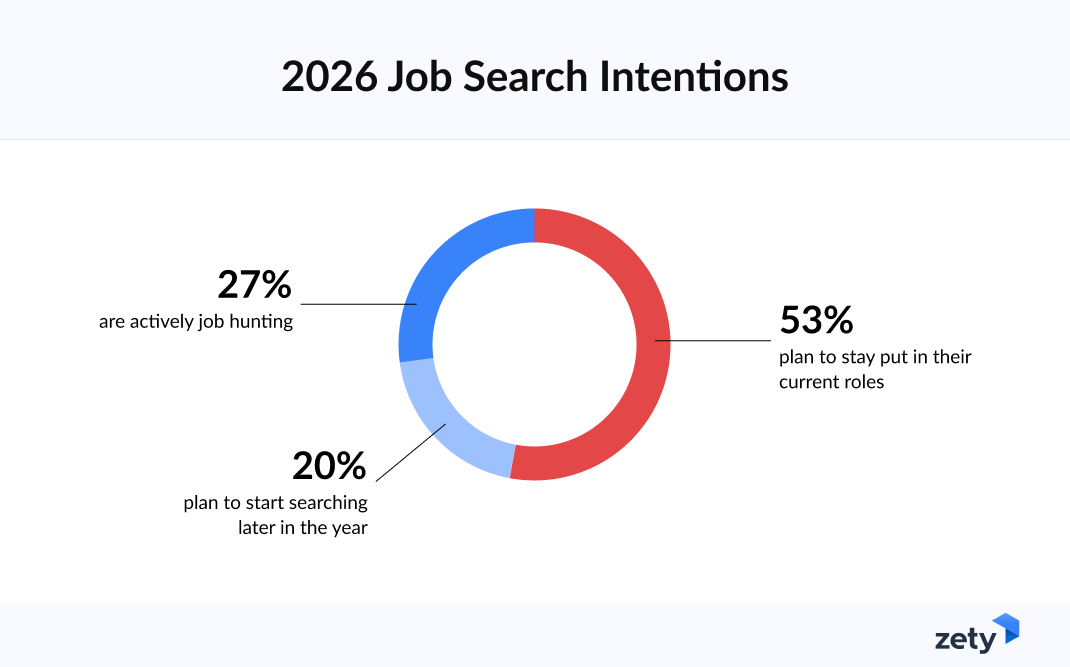
What this means: The workforce is signaling a year of hesitation, where ambition alone isn’t enough to outweigh uncertainty. Employers should expect uneven mobility, with some teams seeing turnover spikes and others surprising stability.
Pulled by Pay: Why Nearly Half Are Preparing to Move
For the 47% considering new opportunities, the pull is clear:
- 40% want higher compensation.
- 22% seek better benefits.
- 17% want more growth.
- 14% want remote or flexible options.
- 7% are fleeing toxic workplaces.
The willingness to trade flexibility for compensation is strong: 72% say they’d return to the office full-time for a 20% raise.
What this means: For many workers, financial pressure is overriding lifestyle preferences, even remote work. Companies that can’t compete on compensation may struggle to retain talent, regardless of culture or flexibility.
Held Back by Fear: Why Just as Many Are Staying Put
While some are preparing to move, others are choosing stability:
- 26% of workers genuinely enjoy their current job.
- 12% don’t think they can find better pay or benefits elsewhere.
- 9% believe jobs in their field are scarce.
- 8% fear losing a fully remote position.
- 5% just received a raise or promotion.
- 4% worry they’d be first to be laid off at a new company.
What this means: The decision to stay reflects a recalibration of risk, not a lack of ambition. With job search uncertainty still high, workers are weighing the costs of change more carefully as economic signals remain mixed.
A Job Market Workers Don’t Trust
The caution is rooted in pessimism about the hiring landscape:
- 67% say it will be difficult to find a new job in 2026.
- 56% think it will take longer to land a new job in 2026 than it did in 2025.
- 53% believe the job market will weaken overall.
What this means: A trust gap is emerging between workers and the broader economy. Until that gap closes, many employees will default to caution in their career decisions.
For press inquiries, contact Skyler Acevedo, public relations specialist, at skyler.acevedo@bold.com.
Methodology
The findings presented are based on a nationally representative survey conducted by Zety using Pollfish on December 12, 2025. The survey collected responses from 1,003 U.S. employees and examined their expectations for the 2026 job market, concerns about job security and pay, and perceptions of hiring barriers. Respondents answered different types of questions, including yes/no questions; scale-based questions, where they indicated their level of agreement with statements; and multiple-choice questions, where they could select from a list of provided options. The sample consisted of 48% female and 52% male, with 20% Gen Z, 26% millennials, 27% Gen X, and 27% baby boomers.

Follow Zety as a preferred source in Google
Get more resume writing tips, career insights, and workforce trends in your personalized search experience. Learn more >

Share:


