















Table of Contents
Get more resume writing tips, career insights, and workforce trends in your personalized search experience.
A layoff may end a worker’s current role, but it doesn’t necessarily end their relationship with the company. Almost half (46%) of laid-off workers would work for their former employer again, according to Zety’s 2026 Layoff Experience Report.
The study surveyed 1,000 U.S. workers laid off within the past two years about how they received the news, the reasons they were given, and the support they received afterward.
While most respondents (86%) were laid off once during this period, 1 in 7 (14%) were laid off two or more times. More than three-quarters (76%) either saw clear signs of an upcoming layoff or suspected one was coming, while 24% said the news came as a complete shock.
Key Findings
- Face-to-face conversations are the most common: 45% were notified of their layoff in person, compared with 21% by phone, 14% by email, and 8% by video call.
- Business factors top reasons for recent layoffs: Downsizing or restructuring ranked number one at 37%, while 1 in 12 (8%) cited AI or technological changes.
- Most workers leave without severance: Nearly two-thirds (63%) of workers received no severance package after losing their job.
- Rehiring remains a possibility: Nearly half (46%) would work for their former employer again.
- Women are less willing to boomerang back: Just 39% of women would return to their former employer, compared with 52% of men.
From Warning Signs to the Layoff Conversation
For most workers, the layoff didn’t come completely out of the blue. More than three-quarters (76%) either saw clear signs of an upcoming layoff or suspected one was coming, while 24% said the news came as a complete shock.
When the decision became final, the top ways workers received the news included:
- 45%: A face-to-face meeting
- 21%: A phone call from my manager or HR
- 14%: Through an email notification
- 8%: On a video call
- 5%: Through rumors before it was official
- 3%: Realized when they lost access to company systems (e.g., email, Slack)
While face-to-face meetings were the most common method, more than 2 in 5 workers received the news through a phone call, email, or video call. Overall, 1 in 7 have been laid off two or more times within the past two years.
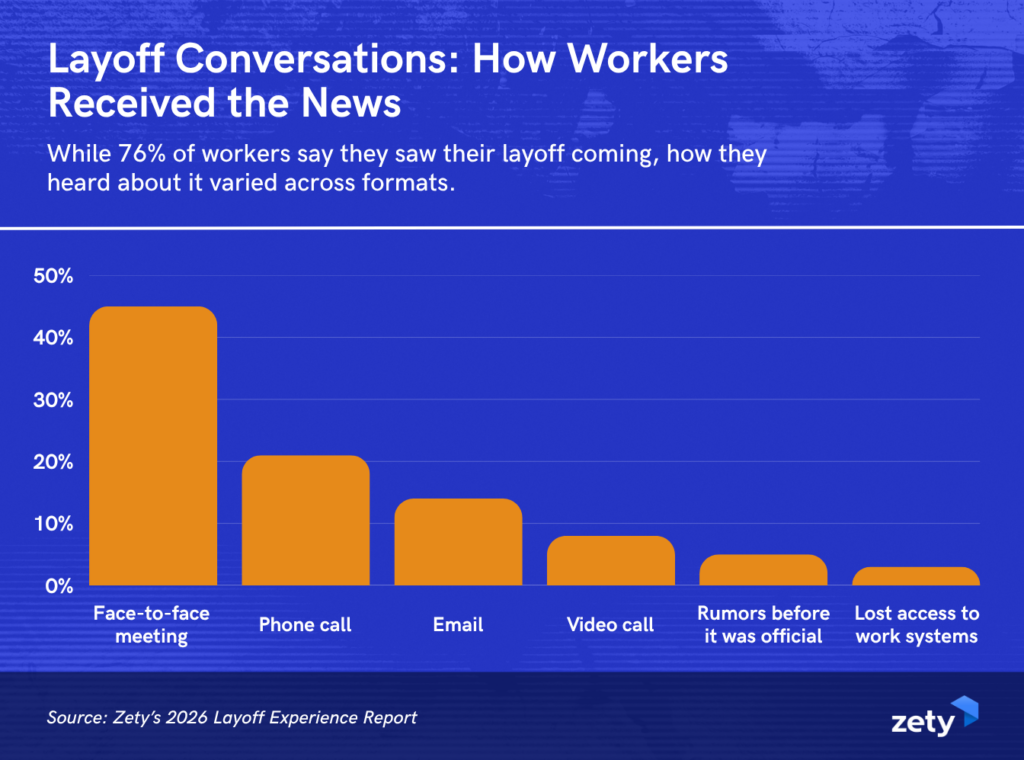
What this means: Even when workers sense layoffs are coming, the official conversation still matters. Employers can replace speculation with clear information and give employees a more direct understanding of what’s happening and what comes next.
Downsizing & Cost-Cutting Lead Layoff Explanations
Workers heard a range of explanations for why their jobs were eliminated, but business-related factors topped the list rather than individual performance.
The most commonly cited reasons included:
- 37%: Company downsizing or restructuring
- 33%: Cost-cutting measures
- 17%: Poor company performance or financial struggles
- 14%: Shift in company priorities
- 12%: Poor personal performance
- 10%: Merger or acquisition
- 8%: AI or technological changes
Although 73% believe their layoff was entirely due to company changes, 27% believe their performance was a factor or the primary reason.
What this means: A layoff can feel deeply personal, even when the decision is driven by broader business needs. Separating those two realities can be important when considering what job loss says about someone’s career or professional value.
Laid-Off Workers Lacked Support, but Many Would Return
For some workers, being laid off doesn’t permanently sever their relationship with an employer, especially as they navigate a difficult labor market. Despite losing their jobs, 46% would work for their former employer again.
Workers’ willingness to return is particularly notable given how they describe the experience itself. 59% say they don’t believe their layoff was handled fairly, and nearly two-thirds (63%) didn’t receive a severance package.
When asked what could have improved the experience, workers pointed to employer support, advanced notice, and increased communication:
- 47%: A better severance package
- 46%: More notice instead of a sudden cut
- 40%: Better communication from leadership
- 27%: Career support
With nearly half of laid-off workers willing to return, former employees could become a future source of boomerang hires as business needs change. That willingness, however, was not shared equally among workers.
What this means: When finding a new job is difficult, workers may be more open to reconsidering an employer they already know, despite dissatisfaction with how their layoff was handled. The frequency of workers returning to former employers may reflect employees separating the layoff itself from their broader experience with the company.
Women Report a Tougher Layoff Experience
Looking at the results by gender, several differences emerged in how workers experienced their layoffs:
- Women were less open to going back: 39% would work for their former employer again, vs 52% of men.
- Women faced a larger severance gap: 66% received no severance package, compared to 60% of men.
- Women were more likely to question fairness: 61% said their layoff wasn’t handled fairly, compared to 56% of men.
What this means: Layoffs may be company-wide decisions, but employees don’t necessarily experience their effects the same way. The gaps between men and women add another dimension to understanding what the process looks like at an individual level.
How an employer handles a layoff can influence its relationship with an employee long after their last day. Clear information, reasonable notice when possible, and meaningful support can help preserve a relationship with former employees who may later return as hires or remain connected to the company as customers, referrals, or advocates.
For press inquiries, please contact Skyler Acevedo at skyler.acevedo@bold.com.
Methodology
The findings presented are based on a nationally representative survey conducted on August 14, 2026, using Pollfish. The survey collected responses from 1,000 U.S. workers laid off within the past two years. The study examined workers’ layoff experiences, including how they received the news, the reasons they were given for their layoff, the support they received from their employer, and how they viewed the way their layoff was handled.
Respondents answered different types of questions, including yes/no, open-ended, scale-based questions where respondents indicated their level of agreement with statements, and multiple-choice questions where they could select from a list of provided options.
The sample included 52% female, 47% male, and 1% nonbinary respondents. By generation, 15% of respondents were Gen Z, 39% were millennials, 34% were Gen X, and 12% were baby boomers.
All participants were screened to ensure they were currently residing in the U.S. and self-reported experiencing at least one layoff within the past two years.
About Zety
Zety’s Resume Builder is a premier platform that leverages advanced AI tools to help job seekers stand out and land interviews effortlessly. Offering step-by-step guidance, curated content suggestions, and 100s of professional, ATS-friendly resume templates, it allows users to feel confident crafting tailored applications. Millions of professionals rely on Zety’s interactive suite—which also features an easy-to-use Cover Letter Generator—to produce high-quality documents that are free to create and ready to download. Since 2016, Zety’s career blog has provided free data-driven insights from career experts and Certified Professional Resume Writers aimed at empowering professionals at every stage of their journey. The Zety Workforce Hub presents current trends and hiring patterns, with the best career advice and evidence-based findings featured in outlets like Business Insider, CNBC, and Forbes, among others. Select Zety as a preferred source on Google to receive more workforce trends, career insights, and labor market research in your personalized search experience.

Follow Zety as a preferred source in Google
Get more resume writing tips, career insights, and workforce trends in your personalized search experience. Learn more >

Share:


