Table of Contents
Get more resume writing tips, career insights, and workforce trends in your personalized search experience.
In the realm of machine learning, you’re the master, bending algorithms and data to your will. But does your resume accurately showcase your skills? Fear not, our guide is here to transform your machine-learning resume into a force to be reckoned with.
With our expert advice, you’ll create a resume so powerful it’ll have hiring managers thinking they’ve discovered the next Alan Turing. Let’s get you hired and set you on the path to AI domination!
You’re about to see a machine learning engineer resume example you can change to fit any machine learning position. You’ll also get easy steps to write a resume for machine learning engineer jobs that’ll earn 10x more interviews than any other.
Want to save time and have your resume ready in 5 minutes? Try our resume builder. It’s fast and easy to use. Plus, you’ll get ready-made content to add with one click. Explore our free resume templates and start building your resume today.
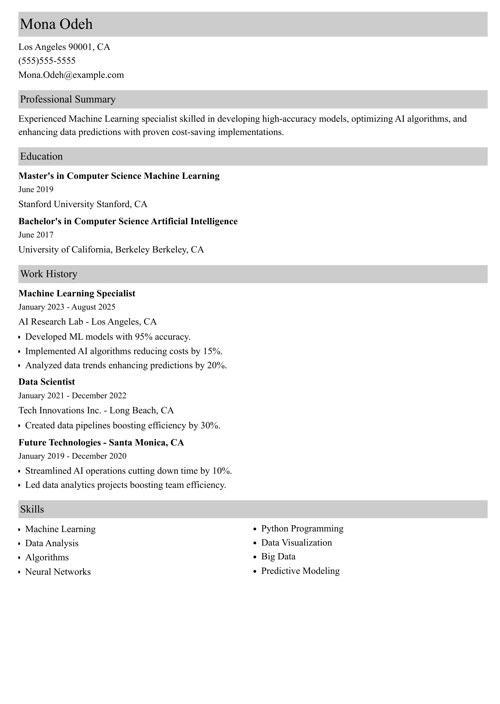
Sample resume made with our builder—See more resume examples here.
One of our users, Pam, had this to say:
Zety is well worth the money! All you do is input your info and Zety turns it into a professional resume that appears like you took hours to make.
Need a special kind of machine learning skills resume? See these guides:
- Data Scientist Resume
- Data Engineer Resume
- Computer Engineering Resume
- Industrial Engineer Resume
- Engineer Resume
- Project Engineer Resume
- Engineering Internship Resume
- Software Engineering Internship Resume
- Bioinformatics Resume
- Best Resume Examples
Sample Machine Learning Resume (Text Version)
Mona Odeh
Machine Learning Engineer
509-333-1486
monazodeh@gmail.com
linkedin.com/in/monazodeh
twitter.com/monazodeh
Passionate machine learning engineer with 4+ years of experience in predictive modeling and data mining. Excited to implement statistical machine learning solutions for Macro Globe. At Stack Intellect, implemented demand forecasting models improving forecast accuracy by 34%.
Experience
Machine Learning Engineer
Stack Intellect
Nov 2017 to Jan 2020
Key Qualifications & Responsibilities
- Designed and developed analysis systems to extract information from large scale data.
- Developed customer segmentation algorithm in R leading to 22% increase in market share.
- Optimized personalization algorithms for applications with 2M+ users.
- Applied data mining to shipping consolidation problem, saving $1.2M.
- Predicted product sales to within 2% by applying logistic regression model.
Key Achievement:
- Mentored organization on big data and analytics, facilitating receipt of Global IT Innovation Award for customer segmentation algorithm.
Machine Learning Engineer
Network Corp
Aug 2015 to Oct 2017
- Developed molecular dynamics simulations using machine learning algorithms to identify protein-DNA interactions with up to 95% fidelity.
- Interpreted 300+ complex simulation datasets using statistical methods.
- Improved accuracy of simulation by 30% using complex algorithms.
- Developed dimensional data modeling to satisfy OLAP needs.
Junior SQL Developer
Haste Vital
July 2014 to July 2015
- Updated and optimized 47+ stored procedures using T-SQL.
- Developed PL/SQL stored procedure, functions and style sheets to reduce data retrieval time by 50%.
- Re-structured schemas with 100+ tables to enhance data integrity.
Education
PhD in Machine Learning
Carnegie Mellon
2010-2014
- Research paper: Machine Learning, Probabilities Explained published in Journal of Cryptology, June 2017
- Senior data mining project written up in TechCrunch.
- Excelled in database and data structure coursework.
Master of Science in Machine Learning
Carnegie Mellon
2008–2010
Bachelor of Science in Computer Science
University of Washington
2004–2008
Skills
- Data and Quantitative Analysis
- Decision Analytics
- Predictive Modeling
- Data-Driven Personalization
- Machine Learning Algorithms
- Organizational and analytical skills
- Understanding of technical documentation
- Communication and presentation
- Problem-solving
Machine Learning Projects
- Created social media sentiment analyzer that tracks 150 million posts per day.
- Developed data mining algorithms for 5 clients online.
- See Portfolio at monazodeh.com
Machine Learning Papers
- Machine Learning Practical Futures published in The Computer Journal, January 2018
- AI, Big Data, and the Internet of Things published in TechWallop, June 2019
Member, Association for Computing Machinery
- Connected 50+ new machine learning engineers with experts in the field.
- As a social media director, routinely interacted with 1,200+ members online.
Here’s how to write a machine learning engineer resume step-by-step.
1. Start With the Right Format for a Machine Learning Resume
The good news? You don’t have to impress other machine learning engineers. (Phew!) But you do have to wow the bigwigs—the corporate vision types. What lights them up like a neural network? Appearances and professionalism. That means your machine learning resume format has to fit the form.
So—
Here’s how to format a machine learning engineer resume template:
- Format: choose the reverse-chronological resume format. It puts your best Stanford-worthy achievements first.
- Fonts: use professional resume fonts like Didot or Calibri for a Sparkbit-worthy look.
- Font size: 11–12 points for text, 13–14 points for resume headings.
- Line spacing: 1 to 1.15.
- Resume margins: 1 inch on bottom, sides, and top.
- File type: send a PDF resume to any job that doesn’t deprecate them. Today’s AI-based ATS systems can scan PDFs.
Include the following resume parts:
- Header: add the right contact information, including a link to your portfolio and/or Github profile page.
- Summary: the lowdown on the key points of your resume.
- Experience: your best machine learning engineer successes.
- Education: a PhD is best, an MsC is second, and a bachelor’s is okay.
- Projects: if you only have a bachelor’s, add a projects section.
- Skills: list the ones they mention explicitly.
- Other sections: published papers are pure gold in an MLE resume.
Pro Tip: Your machine learning resume needs white space. The hiring team isn’t an algorithm. They can’t parse a resume that reads like a wall of code.
2. Add Experience to Your Machine Learning Engineer Resume
The C-suite doesn’t understand what you do. But they need to know you’ve done it. Don’t have a PhD? Then your experience is everything in a machine learning resume. But show your past AI jobs in a certain way to show you’re Sheldon-Cooper-level. Otherwise, they’ll think you’re more like Stuart Bloom.
- List your latest job title.
- Add a company name and years/months.
- Write a short machine learning engineer job description.
- Add 5–6 bullet points (less for older jobs).
- Tell a story with the PAR (Problem-Action-Result) formula in each bullet.
See these machine learning engineer resume samples:
Machine Learning Engineer Job Description for a Resume
Right
Experience
Machine Learning Engineer
Stack Intellect
Nov 2017 to Jan 2020
Key Qualifications & Responsibilities
- Designed and developed analysis systems to extract information from large scale data.
- Developed customer segmentation algorithm in R leading to 22% increase in market share.
- Optimized personalization algorithms for applications with 2M+ users.
- Applied data mining to shipping consolidation problem, saving $1.2M.
- Predicted product sales to within 2% by applying logistic regression model.
Key Achievement:
- Mentored organization on big data and analytics, facilitating receipt of Global IT Innovation Award for customer segmentation algorithm.
Wrong
- Responsible for designing customer segmentation algorithms.
- Handled optimization of personalization algorithms.
- Applied data mining to a shipping consolidation problem to save cost.
- Responsible for prediction of product sales by data modeling.
One of those is Jeffrey-Hawkins-level, but the other is a TRS-80. Your resume design has to draw the eye like example #1. Then stock it with the right achievements.
For an entry-level machine learning engineer resume, do the same thing with standard SWE achievements. The key? Scrape together your best coding moments that show transferable skills. You can talk up ML coding projects in SWE jobs, or just show teamwork or communication skills.
See these entry-level machine learning resume examples:
Entry-Level Machine Learning Resume Samples [Experience]
Right
Junior SQL Developer
Haste Vital
July 2014 to July 2015
- Updated and optimized 47+ stored procedures using T-SQL.
- Re-structured schemas with 100+ tables to enhance data integrity.
- Collaborated in team of 7 developers to create back-end for 3 apps.
Wrong
- Handled the interpretation of complex simulation data.
- Responsible for improving the accuracy of simulation.
- Responsible for designing dimensional data modeling.
Getting hired is all about the proof. If you can show real achievements you’ll get callbacks. Even if you’ve never worked a machine learning engineer job.
Pro Tip: It’s hard to get entry-level machine learning jobs. But there’s a massive shortage of highly-skilled data-wrangling pros. Prove you’re skilled, and you’re in.
Making a resume with our builder is incredibly simple. Follow our step-by-step guide, use ready-made content tailored to your job and have a resume ready in minutes.
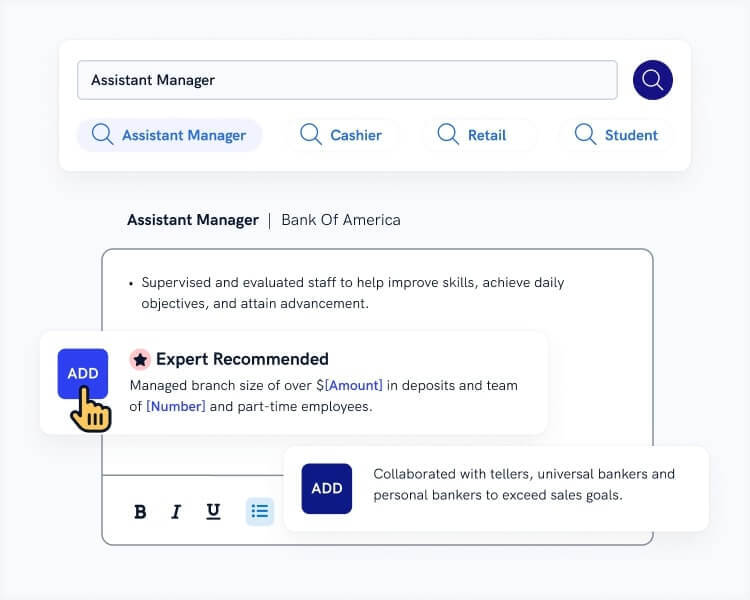
When you’re done, our professional resume builder will score your resume and our ATS resume checker will tell you exactly how to make it better.
Need more advice to make your machine learning engineer stand out like OpenNN? See our guide: How to Show Experience on a Resume
3. Classify Your Education Section
Education is the silver bullet in a machine learning resume. With it, you’ll get attention like Michael I. Jordan. List at least a bachelor’s degree and preferably an MSc. A PhD will seal the deal. But you can’t just say you’ve got it. You must show you aced it. That means finding more successes.
See these machine learning engineer resume examples:
Machine Learning Resume Example [Education]
Right
Education
PhD in Machine Learning
Carnegie Mellon
2010-2014
- Research paper: Machine Learning, Probabilities Explained published Journal of Cryptology, June 2017
- Completed data mining project written up in TechCrunch.
- Excelled in database and data structure coursework.
Master of Science in Machine Learning
Carnegie Mellon
2008–2010
Bachelor of Science in Computer Science
University of Washington
2004–2008
Nice, right? That education section doesn’t just tout the schools. It doesn’t stop at listing your degrees. It adds successes. And that research paper? That’s machine learning job gold. Plus—notice we didn’t add a GPA. You can list yours if it’s high. But if not, save the space for real achievements.
Pro Tip: Research papers are magic in a machine learning resume. If you’ve written more than one, create a section called “Machine Learning Research Papers.”
The education section of your resume for machine learning engineer jobs needs to pop. See our guide: How to Put Your Education on a Resume
4. Put the Right Machine Learning Skills in Your Resume
You can’t automate the skills section of a machine learning resume. Does the company need PCA? Polynomial fitting? Regression? I know you’ve got a lot of skills, but you can’t list them all. You’ve got to classify them to find the best ones for your resume. Then prove each one as shown below.
So—
Start with this list of skills for machine learning engineer resumes:
Machine Learning Resume Skills (Hard Skills)
- Strong Programming Skills
- Data Structures
- Data Modeling
- Predictive Modeling
- Regression
- Classification
- Clustering Models
- Tensorflow
- Pytorch
- Keras
- Numpy
- Pandas
- SciKit Learn
- Unit Testing and CI/CD
- Machine Learning technology
- MATLAB
- Explanatory Analysis
- Natural Language Processing
- C++(STL)
- PySpark.ML
- Python
- Java
Machine Learning Skills for Resumes (Soft Skills)
- Interpersonal Skills
- Presentation Skills
- Teamwork and Collaboration
- Written and Verbal Communication
- Problem Solving
- Attention to Detail
- Time Management
- Critical Thinking
- Organizational Skills
But—which will make managers say, “Wow”?
Here’s how to select the best machine learning engineer skills:
- Write down the machine learning skills in the online job description.
- Circle the ones you have.
- Save those as your resume keywords. List them in your resume.
- Add bullet points that paint pictures of you using those skills.
- Include hard skills and soft skills for a clearer image.
One more thing: people make decisions from emotion, not data. Put that power in your corner. How? By starting each bullet point with resume action words that grip the reader.
See this machine learning resume example:
Say the employer wants simulation development, dataset interpretation, and data modeling.
Machine Learning Resume Examples [Skills]
Right
- Developed molecular dynamics simulations using machine learning algorithms to identify protein-DNA interactions with up to 95% fidelity.
- Interpreted 300+ complex simulation datasets using statistical methods.
- Improved accuracy of simulation by 30% using complex algorithms.
- Developed dimensional data modeling to satisfy OLAP needs.
Machine learning engineer skills in a resume like that work because they splice you to the job. But it’s not as hard as quantum supremacy. You can do it. Can’t get a handle on what skills the company wants most? Simple. Do informational interviews to get a window on their needs.
Based on an analysis of 11 million resumes created using our builder, we discovered that:
- Machine Learning Engineers usually list 22.4 skills on their resumes.
- The most common skills for Machine Learning Engineers are machine learning, support vector machines, random forests, anomaly detection, and team building.
- Resumes for Machine Learning Engineers are, on average, 3.0 pages long.
5. Add Other Sections to Your Machine Learning Engineer Resume
If we did a K-means cluster of machine learning resumes, what would we see? Most likely, resumes that got more interviews wouldn’t just show a PhD and some jobs. They’d list professional associations, projects, published papers, and volunteer work. In other words, they’d show a full-stack human being.
In other words? You can and should add bonus sections.
Choose from:
“Publish or perish,” they say, or—publish and flourish. If you’ve written machine learning articles, the suits will see it as shorthand for “This is Sebastian Thrun in disguise.” If you have more than one, add them in a dedicated section.
If you don’t have a PhD or MSc, you’d better have some projects. Decision-makers see strong project as evidence of skills. But don’t just drop a beginner-level stock picker or sports betting algo in your Github list. Include robust, advanced projects that show you know your CRFs. Here are some sources for projects for machine learning resumes:
Certifications aren’t mandatory in machine learning resumes. But they help. Especially if you’re just dipping your toe in the data ocean, consider adding one or two of the certs below. (But they’re no substitute for a PhD, work experience, published papers, or projects.)
Have you done free machine learning projects? What about leading a local Scout troop or volunteering at a homeless shelter? Pitching in shows more than caring. It shows extra bandwidth and skills just itching to be used.
- Professional Associations
Are you a card-carrying member of AAAI? That shows machine learning isn’t just a thing you do for pay. It’s part of your identity. Pride and ownership are green lights to spot a good future employee.
- Conferences
Have you been to AI Dev Conf or Big Data World? Have you spoken at them? One job-seeker we spoke with said speaking at a conference was the single thing on her resume that made employers want to talk to her.
- Awards and Honors
Did your team receive an AWS Machine Learning Research award? Did you win a Kaggle contest to detect deepfakes or recognize handwritten digits? Make space for those on your resume.
See these machine learning resume samples:
Machine Learning Resume Examples [Other Sections]
Right
Machine Learning Projects
- Created social media sentiment analyzer that tracks 150 million posts per day.
- Developed data mining algorithms for 5 clients online.
- See portfolio at monazodeh.com
Machine Learning Papers
- Machine Learning Practical Futures published in The Computer Journal, January 2018
- AI, Big Data, and the Internet of Things published in TechWallop, June 2019
Member, Association for Computing Machinery
- Connected 50+ new machine learning engineers with experts in the field.
- As a social media director, routinely interacted with 1,200+ members online.
Wrong
- Road tripping
- Golf
Pro Tip: If you’re writing a resume for an internship, it’s all about the education section. That’s where your projects and your publications should take center stage.
Got a thin machine learning resume? You can put hobbies in it to stretch it out. See our guide: List of Hobbies & Interests for a Resume or CV
6. Write a Machine Learning Resume Objective or Resume Summary
Why write a machine learning resume summary or resume objective? It’s the TL;DR version of your resume. It sells your best features. If the manager likes the summary, she’ll keep reading. But it’s easy to do. Just write your resume, then scan it for the greatest hits.
Here’s how to write a career summary:
- Lead with an adjective like resourceful or passionate.
- Add your title (machine learning engineer).
- Mention your years of experience (1, 5, 9+).
- Say what you’ll do (implement statistical machine learning solutions).
- Add the business name (Macro Globe).
- Share your best few successes.
See these examples:
Machine Learning Engineer Resume Summary
Right
Passionate machine learning engineer with 4+ years of experience in predictive modeling and data mining. Excited to implement statistical machine learning solutions for Macro Globe. At Stack Intellect, Implemented demand forecasting models improving forecast accuracy by 34%.
Wrong
Dedicated machine learning engineer with extensive experience in designing and developing machine learning algorithms. Well-structured individual with skills in developing amazing statistical model solutions. Experienced in implementing analytics for different kinds of datasets.
Spam alert! The second of those machine learning resume samples has a lot of adjectives. This candidate is amazing, experienced, and dedicated. Why not let the hiring manager be the judge? I’d rather hire the 4+ candidate with the 34% improvement on his track record.
A career objective works the same. It’s the smart choice for entry-level resumes. Structure it with an adjective, years of experience, your goal, and your resume’s most eye-opening achievements. Did you work as an SQL developer? Find high moments from that job or from school.
See these examples:
Entry-Level Machine Learning Resume Objective
right
Motivated machine learning engineer with skills in data mining and algorithms. Seeking to improve machine learning models for Network Corp. As junior SQL developer at Haste Vital, developed and optimized 50+ stored procedures and functions that reduced data retrieval time 15%.
Wrong
Entry-level machine learning engineer with updated knowledge in data mining and machine learning. A professional individual with a high level of communication and presentation skills. Can work independently and easily adjusted in a team. Skilled in excellent designing and maintaining of machine learning models.
Again, ditch the adjectives and superlatives. Less crowing, more showing. Let your goal and past metrics do the bragging. That’s the only way to keep the suits reading (and drooling) without turning them off.
Pro Tip: How long should a resume be for machine learning engineer jobs? A one-page resume is your best bet. Can’t fit it all in one page? Cut out the boring parts until it sings.
Is this your first machine learning resume? See our guide: First Resume with No Work Experience
7. What About a Machine Learning Cover Letter?
Do you need a cover letter for a machine learning resume? Without question. Managers aren’t trying to hire an algorithm. You can show achievement in a resume, but you can’t show what kind of person you are. Are you easy to work with? Energetic? Only a cover letter can answer that. But fit it to the job.
To write your cover letter:
- Format cover letters first.
- Start your machine learning engineer cover letter with the manager’s name.
- Write a standout first sentence for your cover letter.
- Next, add the few successes the hiring manager will love.
- End your cover letter with an offer.
Pro Tip: Did the company just make a breakthrough in AI? That’s a great fact for your letter’s first sentence. People love to hear good news about themselves repeated.
Want your machine learning engineer resume and cover letter to excel? See our guides: How To Write A Cover Letter in 8 Simple Steps and How to Make a Resume: A Step-by-Step Guide
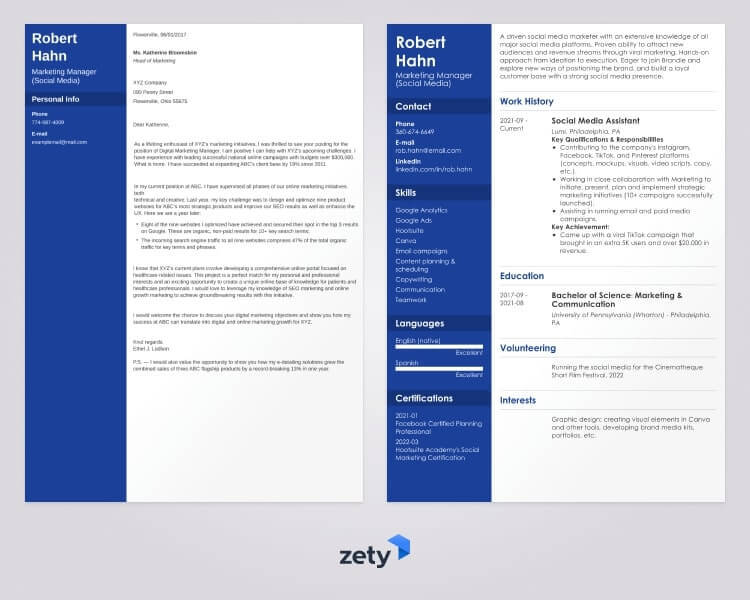
Plus, a great cover letter that matches your resume will give you an advantage over other candidates. You can write it in our cover letter generator here. Here’s what it may look like:
Key Takeaway
Here’s a recap of how to write a machine learning resume:
- Format your machine learning engineer resume template in reverse-chronological order.
- Find machine learning engineer skills in the job listing online.
- List your experience first. Target it to the job like a decision tree.
- Include some numbers to stand out like Terry Sejnowski.
- Add your PhD (or MSc or BS), plus achievements.
- List publications and projects for a massive boost.
- Write a machine learning engineer cover letter to make the hiring team stop dreaming about RNNs.
And if you’re looking for something slightly different, visit our other guides:
- Computer Science Resume
- Solution Architect Resume
- SQL Developer Resume
- .NET Developer Resume
- SSRS Developer Resume
- DevOps Resume
- Programmer Resume
- Full Stack Developer Resume
- Computer Science Internship Resume
That’s it! Now, we’d love to hear from you:
- What’s the most worrying part about writing a machine learning resume?
- Are you scared that your lack of a PhD will sink you?
- Does writing a cover letter make you feel ill?
Let’s chat below in the comments, and thanks for reading!
About Zety’s Editorial Process
This article has been reviewed by our editorial team to make sure it follows Zety’s editorial guidelines. We’re committed to sharing our expertise and giving you trustworthy career advice tailored to your needs. High-quality content is what brings over 40 million readers to our site every year. But we don’t stop there. Our team conducts original research to understand the job market better, and we pride ourselves on being quoted by top universities and prime media outlets from around the world.
Sources

Follow Zety as a preferred source in Google
Get more resume writing tips, career insights, and workforce trends in your personalized search experience. Learn more >

Share:


