Table of Contents
Get more resume writing tips, career insights, and workforce trends in your personalized search experience.
What You Need to Know
- Most resumes should be one to two pages. Entry-level candidates typically need one page, while mid-career and senior-level candidates may need two.
- Recent and relevant work history entries typically include 3 to 5 bullet points, with each bullet highlighting accomplishments, measurable results, or meaningful contributions.
- A second resume page is appropriate when a candidate has enough relevant experience to fill it with substantive content, rather than adding a page for a few additional lines.
When you’re getting ready to apply for a job, one big question might pop into your head: How long should my resume be? Should it be one page? Two pages? More?
A resume is your chance to show off your skills and experience, but you don’t want to overwhelm the person reading it.
In this article, we’ll help you figure out the right length for your resume so you can make a great first impression and get one step closer to landing the job.
Want to save time and have your resume ready in five minutes? Try Zety’s Resume Builder. It’s fast and easy to use. Plus, you’ll get ready-made content to add with one click.
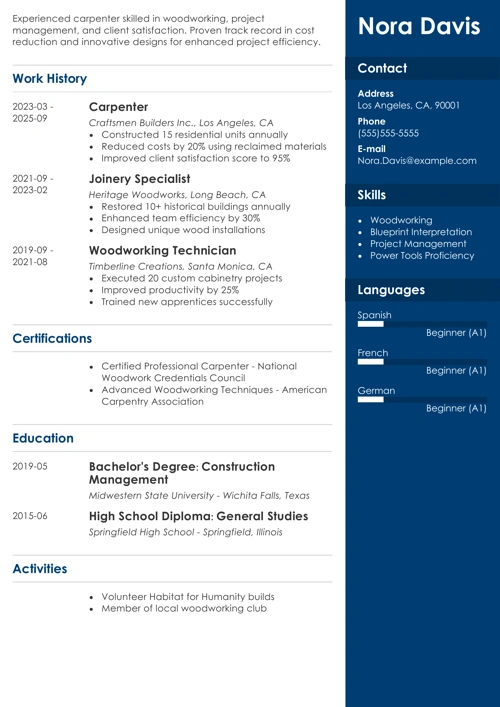
See more professional resume examples made with our builder.
One of our users, Chris, had this to say:
You cannot go wrong with Zety. The company does best at enhancing your resume and helping market yourself better to land the job you love.
How Many Pages Should a Resume Be?
A resume should generally be one to two pages, depending on your experience level and how much relevant information you need to include.
So, how many pages should your resume be? A good rule of thumb when deciding the ideal resume length is to consider your level of experience. Here’s an overview:
| Experience Level | Recommended Length |
|---|---|
| Entry-level (0–5 years of experience) | One page |
| Mid-career (5–15 years of experience) | One to two pages |
| Senior-level (15+ years of experience) | One to two pages |
These guidelines are a starting point, not a strict rule. The key is to tailor your resume to the job and make it a concise overview of your most relevant qualifications. An application for an entry or mid-level position doesn’t need to include all your past roles—just the ones that helped you prepare for this role.
Is a 2-Page Resume Okay?
A two-page resume is okay when you have enough relevant experience, skills, and accomplishments to justify the additional space. A second page can be especially useful for mid-career and senior-level professionals whose relevant experience doesn’t fit effectively on one page.
The key is to make sure the second page adds meaningful information rather than repeating details or including less relevant experience. If your resume spills onto a second page for only a few lines, tighten the content or formatting first. If you have substantial, relevant qualifications that would otherwise be crowded or omitted, using two pages is appropriate.
Ideal Resume Length by Career Stage
The ideal resume length depends largely on your career stage and how much relevant experience you need to present. Entry-level candidates should generally aim for one page, while mid-career and senior-level professionals may use one to two pages.
Entry-Level: 1 Page
A one-page resume is ideal for most entry-level candidates. With fewer years of professional experience, you can usually highlight your education, relevant skills, internships, projects, and early work experience without needing additional space.
Keeping your resume to one page also makes it easier to present your strongest qualifications in a focused, easy-to-scan format.
Mid-Career: 1–2 Pages
A mid-career resume can be one to two pages long, depending on the amount of relevant experience and the number of accomplishments worth highlighting.
One page may be sufficient if your background is focused, while two pages can provide room to show progression across multiple relevant roles. Prioritize recent, relevant experience over older or less applicable positions.
Senior-Level: 1–2 Pages
A one- or two-page resume is common for senior-level candidates, depending on how much relevant experience you need to present.
Focus on the roles, results, and expertise most relevant to your target position rather than attempting to document your entire career. You can usually summarize or omit older experience when it adds little value.
Unique Scenarios: When 3+ Pages May Be Appropriate
Some applications may call for more than two pages, especially when employers or institutions expect a comprehensive record of professional experience.
These situations include academic and research positions, executive roles, and certain federal jobs.
Before exceeding two pages, check the position or country’s specific requirements to see whether a longer resume or CV is expected.
- Executive and C-suite candidates: Senior executives may need additional space to demonstrate leadership, major initiatives, business impact, and a long record of relevant accomplishments.
- Federal positions: Many federal applications require detailed information about an applicant’s work history, responsibilities, and qualifications, so a longer resume may be appropriate.
- Curriculum vitae (CV): Academic, research, and medical positions may require a CV rather than a standard resume. CVs commonly extend beyond two pages because they document publications, research, presentations, and other professional activities.
5 Tips for Achieving the Ideal Resume Length
The ideal resume length depends on the relevance of your experience, not simply how many years you’ve worked. To keep your resume focused, prioritize recent accomplishments, remove outdated details, and use space strategically.
These five tips can help you decide what to include, what to cut, and when an additional page adds value.
1. Prioritize Relevant Experience
Focus your resume on experience, skills, and accomplishments that relate to the position you want. You don’t need to include every job or responsibility from your career. Prioritizing relevant information helps hiring managers quickly understand how your background aligns with the role.
2. Focus on Accomplishments, Not Responsibilities
Use your limited resume space to show what you achieved, not just what you were responsible for. Whenever possible, quantify your impact with numbers, percentages, or other measurable results. Accomplishment-focused content provides more useful evidence of your qualifications.
Aim for 3 to 5 bullet points for each recent or relevant work experience entry, with fewer bullets for older or less relevant positions.
For highly relevant roles, you may use more bullets when each one adds meaningful information. For older positions, consider limiting the entry to one or two key accomplishments or summarizing the role in a single line.
💡Pro Tip: Start each bullet with a strong action verb and focus on what you accomplished. Instead of the vague “Responsible for managing a team of five,” write “Managed a team of five and improved project turnaround time by 20%.” This keeps your resume concise while showing your work’s impact.
3. Remove Outdated or Redundant Information
Cut details that no longer strengthen your application, including outdated skills, repetitive bullet points, and older experience that isn’t relevant to your target role. Removing unnecessary content improves readability and creates space for qualifications that matter more to the employer.
4. Use a Second Page When It Adds Value
Use a second page when you have enough relevant experience and accomplishments to justify the extra space. If you use a second page, fill it with substantive, relevant content rather than leaving it mostly blank.
Don’t add a second page just to make your resume look more substantial. Every section and bullet should contribute meaningful information about your qualifications.
5. Use Formatting to Create Space
Thoughtful formatting can help you fit more relevant content without making your resume difficult to read. Try these adjustments to make better use of the space you already have:
- Set margins to 0.5–1 inch. Start with 1-inch margins, then reduce to 0.5 to 0.75 inches if you need more room. Avoid margins narrower than 0.5 inches.
- Use a 10–12-point resume font for readability. If you need more space, try 10.5 or 11 points before going smaller.
- Use 14–16-point section headings. Make headings easy to find without taking up excessive vertical space.
- Reduce spacing between sections. Use about 6–12 points of space between major sections and 2–6 points between individual bullets.
- Keep line spacing around 1.0–1.15. Single or slightly expanded line spacing can improve readability while using less space than double spacing.
Key Takeaways
- Aim for one to two pages. Choose your resume length based on your experience level and how much relevant information you need to include.
- Prioritize relevant accomplishments. Focus each work history entry on measurable results and contributions, not routine responsibilities.
- Use 3–5 bullets per recent role. Give your most relevant positions enough detail to demonstrate your impact, while keeping older or less relevant roles concise.
- Use a second page strategically. Add a second page when you have enough relevant content to justify it, and make sure it includes substantive information.
- Format for readability. Use reasonable margins, readable font sizes, and efficient spacing to create room without making your resume feel crowded.
Frequently Asked Questions
How long should a resume be for a first job?
A first-job resume should generally be one page. With limited professional experience, focus on relevant education, skills, internships, volunteer work, projects, and other experiences that demonstrate your qualifications. A one-page resume keeps the information focused and gives employers a quick overview of your potential.
Can a resume be too long?
Yes, a resume can be too long if it includes unnecessary, outdated, or repetitive information. Most resumes should be one to two pages, depending on your experience level and how much relevant experience you have. A longer resume may be appropriate for academic, federal, executive, or other roles that require more detailed career information, but every page should add meaningful value.
Does resume length matter for ATS?
Resume length generally doesn’t directly affect whether an applicant tracking system (ATS) can parse your resume. ATS software is designed to identify and organize information such as job titles, skills, and work history. An overly long resume may include less relevant content, and overly compressed formatting can make it harder to read or parse accurately. Focus on relevant content and clear formatting rather than a specific page count.
How far back should a resume go?
A resume should generally cover the past 10 to 15 years of relevant work experience, but there’s no strict cutoff. Include older positions when they’re directly relevant to the role or demonstrate valuable skills, accomplishments, or career progression. For older or less relevant jobs, consider shortening the details or leaving them off to keep your resume focused.
Should a resume include every job you’ve had?
A resume shouldn’t necessarily include every job you’ve had. Focus on positions relevant to the role, that demonstrate transferable skills, or that show meaningful career progression. You can shorten, group, or omit older or unrelated jobs when they don’t strengthen your application. This keeps your resume focused while preserving the experience most relevant to the employer.
\
About Zety’s Editorial Process
This article has been reviewed by our editorial team to make sure it follows Zety’s editorial guidelines. We’re committed to sharing our expertise and giving you trustworthy career advice tailored to your needs. High-quality content is what brings over 40 million readers to our site every year. But we don’t stop there. Our team conducts original research to understand the job market better, and we pride ourselves on being quoted by top universities and prime media outlets from around the world.

Follow Zety as a preferred source in Google
Get more resume writing tips, career insights, and workforce trends in your personalized search experience. Learn more >

Share:


