![Hospitality Resume Example & Guide [+ Hospitality Skills]](https://cdn-images.zety.com/pages/hospitality-resume-example-ztus-cta-02.webp)
Table of Contents
Get more resume writing tips, career insights, and workforce trends in your personalized search experience.
Hospitality jobs can be fun and rewarding, plus they often attract people who are simply great to work with. Unfortunately, not all of these jobs are like that—and you certainly want to avoid ending up working the front desk of a shady motel along the abandoned sections of US 66.
That’s why you need a hospitality resume that proves you’re a great fit for boutique hotels, luxurious restaurants, and chic bars.
This guide will show you:
- A hospitality resume example better than 9 out of 10 others.
- How to write a resume for hospitality jobs to get more interviews.
- A list of the most desirable skills for a hospitality resume.
- How to describe your experience on a resume for hospitality jobs to fill any opening you want.
Looking for a quick way to build a professional resume? Our modern resume software guarantees a fast, straightforward, and easy process. It comes with professionally crafted sections to insert with a single click. See 700+ resume templates and create your resume here.
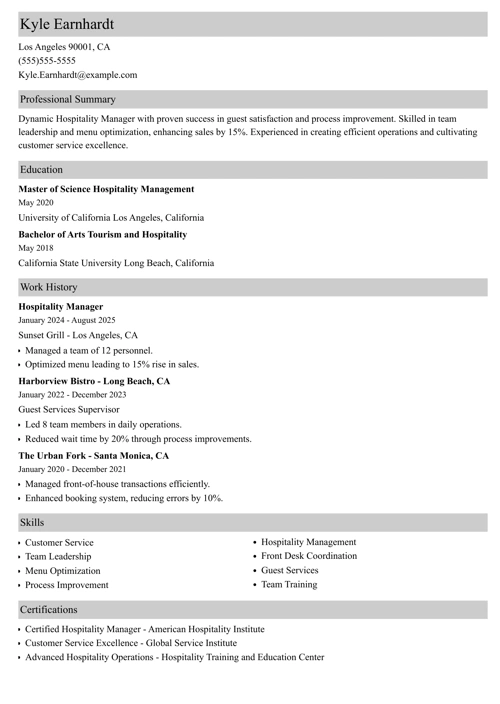
Sample resume made with our builder—See more resume examples here.
One of our users, Anjeanette, had this to say:
Zety suggested tips and revised my resume in a way I never could. Helped me word things in a much more intelligent fashion and got me my dream job.
After reviewing 11 million resumes created with our builder, we’ve collected valuable insights from users spanning different industries and levels of experience. Here are the top takeaways to help you design a more effective resume:
Data-Backed Insights From Actual Resumes
- 57.84% of resumes made with our builder are over 300 words, 28.23% are between 101 and 300 words, and 5.35% are under 100 words.
- 3.59% of our users have no work experience, while 28.86% report having less than 3 years of experience.
- Resumes typically list an average of 12.56 skills.
- On average, resumes include 2.61 previous jobs.
Hospitality Resume Example
Kyle Earnhardt
Front Desk Receptionist
(123) 456-7890
kyleearnhardt@email.com
linkedin.com/in/kyleearnhardt
Summary
Resourceful Hospitality Professional with over five years of experience in hotel operations. I’m eager to help SwiftWing Inc. achieve its objectives, with my Front Desk knowledge and skills. With a passion for customer service and a proven track record in providing excellent hospitality services, I am confident my qualifications will help the company achieve its objectives. Increased overall customer loyalty by 30% at MagnaCore Hotels.
Experience
Front Desk Receptionist
MagnaCore Hotels, Springfield, MA
April 2018–July 2020
Key Qualifications & Responsibilities
- Greeted customers upon arrival and handled check-in/check-out processes efficiently.
- Answered guests’ queries regarding services provided by the hotel and local attractions.
- Processed payments through cash or credit cards and issued receipts for all transactions.
- Provided daily reports on occupancy status and guest feedback to the management team.
- Ensured compliance with hotel policies and procedures related to front desk operations.
Key Achievement:
- Implemented an incentive program that increased guest loyalty by 30%.
Front Desk Clerk
Epsilon Group, Springfield, MA
January 2015–March 2018
Key Qualifications & Responsibilities
- Assisted in resolving customer complaints professionally and promptly .
- Maintained up-to-date records of transactions related to front desk operations such as room reservations, bills receivables, etc., using appropriate software systems .
- Monitored lobby activities including housekeeping staff performance to ensure quality standards are met.
Key Achievement:
- Improved reception area workflow by implementing new organizational techniques which reduced waiting time for customers by 40%.
Education
BSc Hospitality Management
Boston University, Boston, MA
June 2011–May 2015
Relevant Extracurricular Activities
- Volunteered as a tour guide in Boston’s Freedom Trail Tours.
- Organized monthly networking events for fellow hospitality students.
Academic Achievements:
- Awarded Outstanding Student Performance Award for three consecutive terms.
Skills
- Microsoft Office Suite
- Oracle Property Management System (PMS)
- SABRE Booking System
- IDeaS Revenue Optimization System
- Communication
- Problem Solving
- Time Management
- Interpersonal Relationships
- Organization
Certifications
- Certified Hotel Administrator, American Hotel & Lodging Association, 2017
Awards
- 2016 – Employee of the Year Award; MagnaCore Hotels
Memberships
- Member of Hospitality Management Association since 2014
Languages
- English—Native
- Spanish—Advanced
Interests
- Yoga Instructor – Organized yoga classes twice a week at local park
1. 20+ Hospitality Resume Examples for Various Jobs
If you need resumes for specific hospitality jobs, see the guides and samples below—you’ll find resume examples for hospitality jobs in restaurants, hotels, and other establishments.
Restaurant Resume Templates
- Waitress Resume
- Waiter Resume
- Chef Resume
- Catering Resume
- Server Resume
- Barista Resume
- Line Cook Resume
- Cook Resume
- Bartender Resume
- Banquet Server Resume
- Server Resume
- Restaurant Resume
- Fine Dining Resume
- Fast Food Resume
- Barback Resume
- Resume Examples for Every Career
Housekeeping Resume
Management Resume
Front Desk Resume
Others
Want to make the best resume for a hospitality job on earth? Scroll down. I’ll share piles of tips and samples to write great hospitality industry resumes that’ll help you bag the interview.
2. Use the Right Format for a Hospitality Resume
Disaster! The hiring manager just condemned your great hotel resume. Gordon Ramsay wouldn’t use it to shine his shoes with now. What happened? It wasn’t your experience or skills. Those are great. You used the wrong hospitality resume format.
Format is king in a job where tiny details add up to a great guest experience:
- Pick a respected layout like the reverse-chronological resume format.
- Use big headings, lots of white space, and the best resume fonts.
- Go for a minimalist resume template for enhanced readability.
- Save your resume for hotel jobs as a PDF.
Hospitality job resume PDFs look great everywhere and work with ATS systems. MS Word resumes can turn into an unmade bed after you send them.
Pro Tip: Scan the hospitality job description to make sure it doesn’t have a no-PDFs policy. Some companies don’t allow hospitality resume PDFs.
3. Craft a Catchy Summary or Objective for a Hospitality Resume
Congratulations! The HR manager spent half an hour reading your hospitality resume. She’s convinced you’re perfect for the job.
Now let’s come back from la-la land. The truth? She’s got a pile of resumes for hospitality as tall as the Gevora Hotel to read by checkout-time. You have seconds to impress.
The fix? Grab her attention like a nine-foot “Free Breakfast” sign. Write a resume summary or resume objective.
A resume objective shows your passion for the job. Use one if you’re a late arrival to the industry.
A resume summary proves your worthiness with experience. Write one if you’ve got ballrooms-full.
Either way, stuff it with pulse-quickening accomplishments.
Here are two examples:
How to Write a Resume Objective for an Entry-Level Hospitality Resume
Even with no experience, your resume for hotels doesn’t have to seem half-baked. A resume objective shows your passion. But—Pack it with experience.
These two hospitality resume examples explain:
Sample Objective for Hospitality Resumes
right
Efficient front desk clerk with proven guest service skills. Received 99% positive comment cards as front desk fill-in at Motel 148. Commended by manager of Red Roof Inn for strong work ethic as volunteer in hotel laundry. Skilled in POS terminal use and fluent in Spanish.
wrong
Extremely hard-working front desk clerk, skilled in local resources knowledge and computer skills. Fluent in Spanish. Good at providing exemplary guest service and operating POS terminal.
That first hotel resume sample could get you in at a Hyatt Regency. The second? Maybe Fawlty Towers.
But just a sec—Where did a newbie get that much hospitality industry resume experience? He used transferable accomplishments. I’ll show how in a minute.
Now what if you’ve already got experience?
In that case, write a resume summary.
Hospitality Resume Examples [Resume Summaries]
One of these professional hospitality resume samples fails inspection.
WRONG
Presentable front desk clerk. Responsible for all front desk duties at Motel 148, including POS terminal operation, check in, check out, providing guest assistance, and communicating with other hotel staff. Skilled in local resources knowledge and have exemplary interpersonal skills.
What’s wrong with that? Nothing, by itself. But put it in a pile of 300 others and it blends into the wallpaper.
It needs details and measurable achievements.
RIGHT
Friendly AHLEI Certified Front Desk Representative with 2+ years of experience and proven guest service skills. Seeking front desk position with Baltimore Marriott. Maintained 95% positive guest comment cards at Best Eastern Baltimore. Employee of month 3x at Motel 148. Strong interpersonal skills and check-in/check-out skills.
Way to go. The hiring manager just dropped her copy of Without Reservations in her jackfruit salad.
Pro Tip: Got stage fright? Soft-open your hospitality resume objective or resume summary. Write it last and build it from the highlights of your resume.
Making a resume with our builder is incredibly simple. Follow our step-by-step guide, use ready-made content tailored to your job and have a resume ready in minutes.
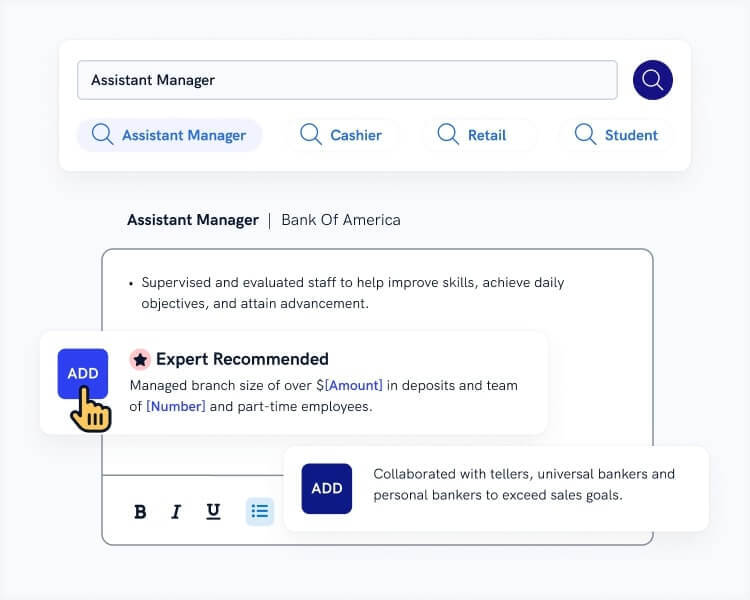
When you’re done, our online resume builder will score your resume and our free ATS resume checker will tell you exactly how to make it better.
4. Highlight Work Experience in a Hospitality Resume
Here’s a question: Is experience important in resumes for hospitality jobs? Only as important as food and lodging.
Don’t have it? Don’t panic. I’ll show you how to use transferable achievements. But you’ve got to list them right or the hiring manager will ditch you like a bathrobe with a burn hole.
Show your last job first, with 3–5 resume bullet points that fit the job.
The next two entry-level hospitality resume examples show how.
Hospitality Resume Examples [Experience]
Compare these sample hospitality resume experience sections:
RIGHT
Front Desk Clerk
Best Eastern Baltimore
2016-2018
- Received 95% positive guest ratings for efficiency and local knowledge.
- Greet and check-in guests in 300+ room hotel with Point of Sale (POS) System.
- Train 3 front desk clerks in POS terminal, guest services, and check-in.
- Balance receipts of $6,000–$9,000 at shift end. Create reports w/99% accuracy.
The hiring manager would need a vacancy between her ears to trash your application. Your professional front desk duties resume just proved your worth.
With a couple management achievements, that could even be a good front desk manager resume.
But evict the details, and:
WRONG
Front Desk Clerk
Best Eastern Baltimore
2016-2018
- Greet and check in guests with Point of Sale (POS) System.
- Responsible for providing local knowledge tips to guests.
- Provide guests with key cards and directions to rooms.
- Balance receipts and create reports.
Hmm. Maybe they’re hiring at the Bates Motel.
And if you have no experience at hospitality jobs? Check out the next two entry-level hospitality resume examples.
How to Write a Resume for Hospitality with no Experience
How do you break into the hospitality industry? Especially with no experience? Are you locked out for good?
Transferable accomplishments are your master key to great hotel jobs with no experience.
Have you ever:
- Volunteered at a hotel laundry?
- Waited tables?
- Tended bar?
- Managed people?
- Led a project?
- Worked a cash register?
- Worked with the public?
Any of those make great experience for a hotel resume.
See the next two entry-level hotel resume samples.
Two Entry-Level Hospitality Resume Samples [No Experience]
Which of these two front desk resume examples is more Bridal Suite than Basement Level?
RIGHT
Hospitality Experience
2017-2018
- Front desk fill-in assistant. Received 99% positive customer comment cards.
- Part-time caterer staff. Promoted from host to waiter for efficiency.
- Volunteer in hotel laundry. Commended by manager for strong work ethic.
WRONG
Hospitality Experience: Haven’t officially held any hospitality jobs, but please believe I’ll do a great job.
Other Experience:
- Auto detailing
- Landscaping
No contest.
That first one could get you hired at the Marriott in Rivendell. The second? Maybe the Overlook needs help.
You must show experience in hospitality-related tasks, even if you’ve never held a job.
Pro Tip: You don’t need 5 years of experience to write a good resume for front desk jobs. Even filling in for a few front desk shifts can build your resume.
Give the hiring manager a wake-up call. Build your hospitality resume with action words. See our guide: 240 Resume Action Words & Power Words to Make Your Resume Shine
5. Put Education on a Resume for Hospitality Jobs
In a resume for the hospitality industry, education isn’t as important as experience.
But schooling is a V.I.P. pass that can get you through the door.
Start with:
- School Name and Location.
- Years in School.
- Degree.
Here’s the magic:
Add relevant accomplishments.
Hospitality Resume Examples [Education]
WRONG
Dundalk High School
2010-2014
- Received degree.
- GPA 2.7
Maybe you’ll get hired as a bellhop at the Econo-Host in Gotham City.
But add the right details, and:
RIGHT
Dundalk High School
2010-2014
- Excelled in computer literacy classes.
- Track team captain, senior year.
- Wrote a senior report on Baltimore area amenities.
Pow. That’s Four Seasons-level.
Pro Tip: Do you need to show your GPA in a hospitality resume? If it’s recent and impressive, yes. Otherwise, save the space for Wyndham-worthy achievements.
Make your front desk or guest services resume education section shimmer like a solid gold welcome mat. See our guide: Education on a Resume: What to Include and How to Do It
6. Select the Right Hospitality Skills for Resumes
Say hello to the HR manager. Her name’s Stacy. Nice liquid desk wave. Near it sit 250+ hospitality resumes. She’d like to torch them all. Know why?
They all list the same hospitality skills. They’re almost carbon copies of each other.
Then she sees your front desk clerk resume. You’ve done something so smart, so simple, Stacy chuckles.
What was your big win? You picked exactly the right skills for a hospitality resume, then you proved them.
Just like this:
Hospitality Resume Examples [Skills]
Let’s say Stacy put these skills in the job description:
Hospitality Skills: (1) Accuracy, (2) Positive Attitude, (3) Problem-Solving
You list those, plus computer skills and check-in/check-out to add a little value.
Then you prove you’ve got those skills in your hotel resume bullet points:
- Used Central Reservations System (CRS) with (1) 99% accuracy.
- Commended 3x by manager for warm, (2) positive attitude.
- Received 3 letters of praise from customers for helping them (3) solve complicated problems.
You’re hired.
The HR manager would trust you to staff a front desk on Mars.
List of Hospitality Skills for a Resume
Let’s kick off your interview parade with a list of hospitality resume skills.
They make great resume keywords too.
Add more from hospitality jobs online.
| Soft Skills | Hard Skills |
| Communication Skills | Local Resources Knowledge |
| Interpersonal Skills | Bilingual |
| Guest Service | Computer Skills |
| Collaboration Skills | Can Work Flexible Schedule |
| Organizational Skills | Accounting |
| Presentable | Conflict Resolution |
| Attention to Detail | Check-In/Check-Out |
| Calm Attitude | Central Reservations Systems (CRS) |
| Problem Solving | Group Reservations |
| Physically Fit | Run Reports |
Hospitality jobs pay $15.97/hr on average. To make more, you need to prove you’ve got high-income skills. One more thing: you need interpersonal skills to get hired, but you can’t say, “I have interpersonal skills.” Maddening? That’s why achievements matter in resumes for hospitality.
Based on an analysis of 11 million resumes created using our builder, we discovered that:
- Hospitality Workers usually list 11 skills on their resumes.
- The most common skills for Hospitality Workers are first aid training, quality assurance, scheduling, correspondence writing, and verbal communication.
- Resumes for Hospitality Workers are, on average, 1.7 pages long.
7. Add Extra Sections to a Resume for Hospitality Jobs
Freeze. Think your hospitality resume is unique? Think again. Hiring managers hate cookie-cutter resumes. You need to prove you’ve got all the amenities.
Make them say, “Wow. This is not just some schlub.” To do that, list awards, trainings, physical activity, certifications—anything that shows real magic.
Put them in “other” sections in your hospitality resume.
Each one should dazzle like the Grand Budapest Hotel.
Hospitality Resume Examples [Other Sections]
WRONG
- Long walks on the beach
- Parrots
RIGHT
Trainings
- 2018 Outstanding Customer Service—Dale Carnegie
- 2017 Why People Complain Hospitality Staff Training—OpenSesame
Certifications
- Certified Guest Service Professional (CGSP)—AHLEI
- Certified Front Desk Representative—AHLEI
Awards
- Employee of the Month 3X—Best Eastern Baltimore
- Most Valuable Team Member—Motel 148
Additional Activities
- AHLA Member—American Hotel & Lodging Association
- Volunteer at Commercial Street Soup Kitchen 2x per month
- Take yoga classes 2x per week to stay in shape.
- Volunteer mentor 1x per month, YMCA.
That right example will fast-track you to the top floor.
Pro Tip: Experience and education often look like walls of text to hiring managers. The more headings you include, the more eye-time your resume for hotel jobs will get.
Not sure how to furnish your resume for hospitality industry jobs? See our guide: +20 Best Examples of Hobbies & Interests To Put on a Resume
8. Write a Matching Hospitality Cover Letter
Do you need to send a cover letter with your hospitality resume? Yes. About 45% of hiring managers toss no-cover-letter resumes.
So, write a hospitality cover letter for front desk hotel jobs. But here’s the thing: Make it short. Make it personal. Make an offer.
- Start with the hiring manager’s name. That’ll catch her eye like a stack of 20s on the lobby carpet.
- Prove you know her needs. (She put them in the job offer.)
- Show you’re the solution. That means sharing your best accomplishment.
This short example hospitality cover letter nails it:
I’ve wanted to work for the Baltimore Marriott for years. Your vision to enhance the lives of customers through unsurpassed experiences fits with mine. Maintaining 95% positive guest comment cards at Best Eastern came naturally for me. The three commendations I received from management for my friendly attitude were only…
Always end a cover letter with an offer. Try, “I’d enjoy the opportunity to share how I earned ten letters of praise from guests.”
Pro Tip: Should you follow up on a hospitality resume and cover letter in 3 days or a week? Umm… both? As long as you don’t overdo it, each follow-up is one more chance to land the interview.
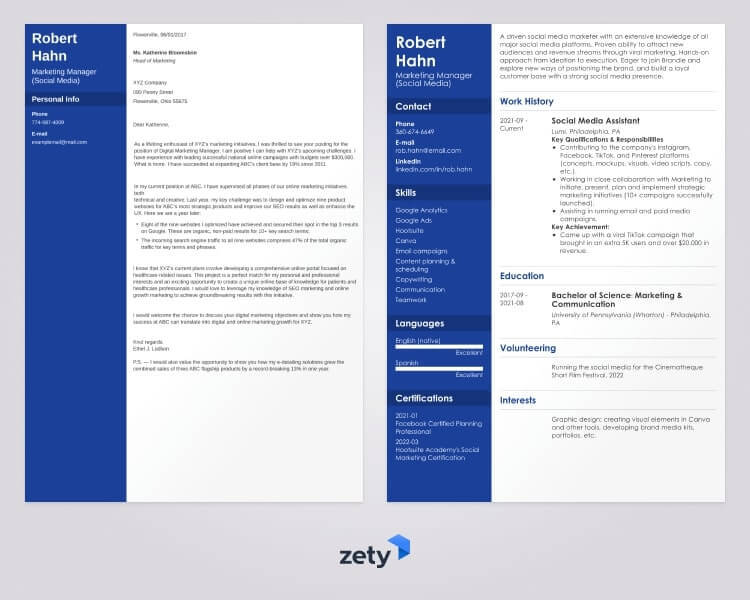
Plus, a great cover letter that matches your resume will give you an advantage over other candidates. You can write it in our cover letter generator here. Here’s what it may look like:
Want your hotel front desk cover letter to sizzle like a fresh-grilled ribeye? See our guide: Cover Letter for a Job Application That Works
9. List Contact Info on a Resume for Hospitality Jobs
You’re goofing it.
You know contact info means:
- Full Name
- Updated Phone Number
- Professional Email Address
Like so:
Bob Jadoo, Front Desk Clerk, bob.h.jadoo@gmail.com, 443-847-6514
You even know “professional email address” means no ILoveGoatYoga2382349023@yahoo.com.
So what’s missing? A LinkedIn address. These days, 87% of recruiters use LinkedIn when they hire.
It lets them see your back-of-house before they interview you.
Pro Tip: Your LinkedIn profile is as crucial as a comfy lobby. Make sure it’s in working order with our guide to optimize your LinkedIn profile.
Need more help to make a hospitality resume worthy of the Beverly Hills Hotel? See our guide: How to Make a Resume for a Job of Your Dreams: Writing Guide (30+ Examples)
Key Takeaway
Here’s a quick recap of how to write a hospitality resume:
- Sell your best stuff first. A hospitality resume objective or resume summary will grab the hiring manager’s attention.
- Read the job description. Stitch your bullet points to the job ad like a hotel logo to a stolen bathrobe.
- Add other sections that prove you’re great to work with. On a hotel resume, that means commendations, certifications, and professional associations.
- Write a hospitality cover letter. Convince the hiring manager you fit her needs.
About Zety’s Editorial Process
This article has been reviewed by our editorial team to make sure it follows Zety’s editorial guidelines. We’re committed to sharing our expertise and giving you trustworthy career advice tailored to your needs. High-quality content is what brings over 40 million readers to our site every year. But we don’t stop there. Our team conducts original research to understand the job market better, and we pride ourselves on being quoted by top universities and prime media outlets from around the world.

Follow Zety as a preferred source in Google
Get more resume writing tips, career insights, and workforce trends in your personalized search experience. Learn more >

Share:


