Table of Contents
Get more resume writing tips, career insights, and workforce trends in your personalized search experience.
If you’re looking for a job in Canada, your resume needs to speak the local language—literally and professionally.
From formatting and length to what personal details to include, knowing the Canadian way can give you a serious edge. In this guide, we’ll break down everything you need to know to create a Canadian-style resume.
Need a quick solution to get your resume ready today? Try our Resume Builder. It’s fast and easy to use. Plus, you’ll get ready-made content to add with one click. Click to pick a resume template and build your resume instantly.
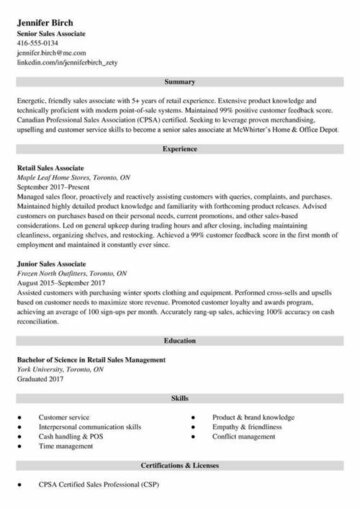
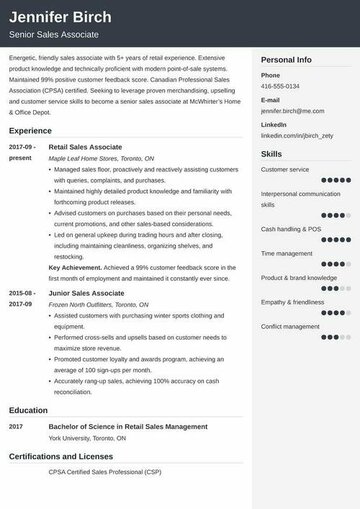
Sample resume made with our builder—See more resume samples here.
One of our users, Chris, had this to say:
You cannot go wrong with Zety. The company does best at enhancing your resume and helping market yourself better to land the job you love.
What Is a Canadian Resume?
A Canadian resume is a professional document that shows your work experience, skills, and education to potential employers in Canada.
It’s similar to a U.S. resume, but Canadian employers have their own expectations for formatting, length, and what personal information you include. The goal is to give a clear, easy-to-read snapshot of why you’re the right person for the job.
U.S. resume vs Canadian resume
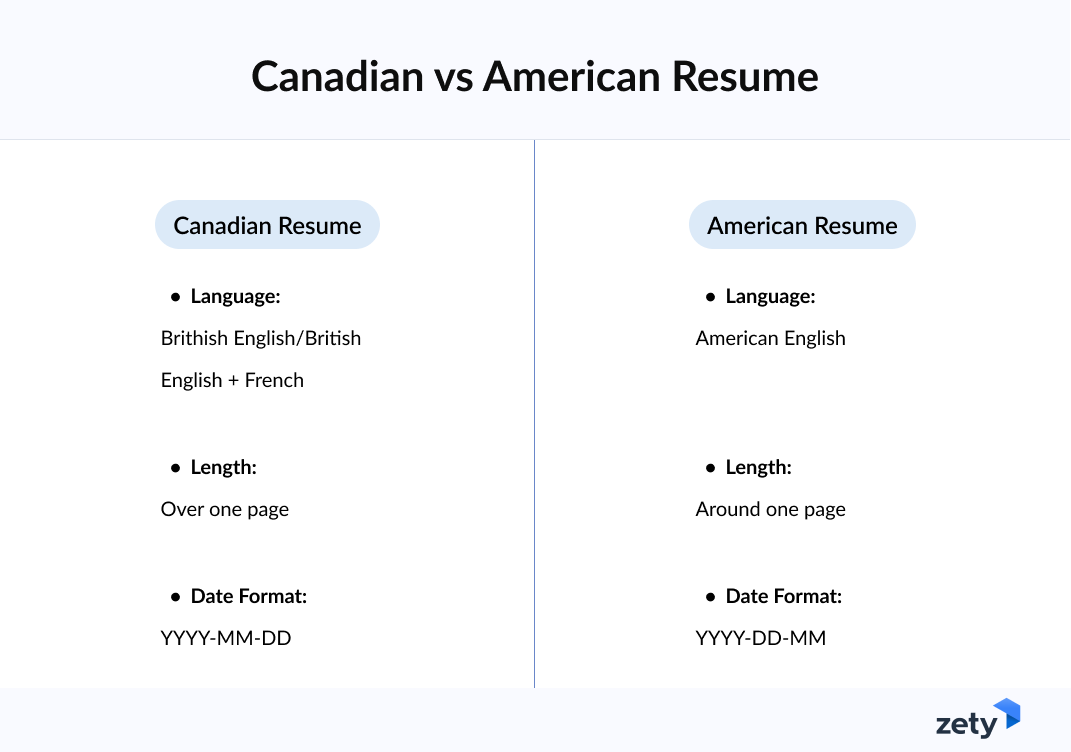
Here are a few key differences between Canadian and U.S. resumes:
- Language: Canadian resumes often use British spellings, while U.S. resumes stick to American English. In bilingual regions of Canada, it’s also common to see resumes written in both English and French.
- Length: U.S. resumes are usually limited to one page, but Canadian resumes can be longer, giving you space to include more details about your work experience and projects.
- Date format: Canadian resumes typically use the “YYYY-MM-DD” format for dates. In contrast, U.S. resumes usually follow the “MM-DD-YYYY” format.
Pro tip: If you live in Europe, Asia, or the Pacific, you probably call a resume a CV. A U.S. resume is the same as what you call a CV, but to get a better understanding of the two terms, take a look at our guide on the differences between a CV and a resume.
What to Include in a Canadian Resume
A typical Canadian resume format consists of the following sections:
- Professional summary
- Work experience
- Education
- Skills
- Additional sections (e.g., certifications, volunteer experience, awards, etc.)
The Canadian resume also follows the same formatting rules as you’d use in the U.S. A good layout ensures that you’ll have a document that looks professional and is easy to read. Follow these guidelines:
- Pick a resume format that aligns with your experience level and career goals.
- Use line spacing set to 1.15.
- Set your resume margins to 1 inch on all sides and double-space between sections to create plenty of reader-friendly white space.
- Choose a professional resume font, like Arial, Calibri, or Times New Roman.
- Clearly differentiate your section headers by using a larger, bold font.
Pro tip: CVs in Canada are very similar to CVs in the U.S. To ace your Canadian CV format, simply follow our CV writing guidelines.
How to Write a Canadian Resume
Let’s go over how to write a resume section by section, the Canadian way:
Header
A standard resume header should include the following:
- Full name
- Job title
- Phone number
- City and province
- LinkedIn or Bold.pro profile, if applicable
- Digital portfolio, if applicable
Professional summary
A professional summary is a three- to four-sentence paragraph at the top of your resume that highlights your most important skills, experience, and accomplishments. Think of it as a quick snapshot that shows employers why you’re the right fit for the job.
Take a look at this example:
Marketing professional with 5 years of experience driving social media campaigns and increasing online engagement by 40%. Skilled in content creation, SEO, and analytics, with a proven track record of boosting brand awareness and generating leads. Adept at managing cross-functional teams and developing strategies that align with company goals to achieve measurable results.
Pro tip: If you have limited experience or are changing careers, opt for a resume objective instead. A resume objective focuses on your career goals, allowing you to show your skills and ambition.
Work experience
Write your work experience in reverse-chronological order, starting with your most recent job. Include your job title, employer’s name and location, and employment dates.
Add up to five bullet points describing your work duties. Or better yet, focus on quantifiable achievements that showcase your impact.
When including numbers, use metric measurements, as Canada uses the metric system. For example, list distances in kilometers instead of miles, weights in kilograms instead of pounds, and temperatures in Celsius instead of Fahrenheit.
This ensures your resume aligns with Canadian standards and is easy for employers to understand. Here’s an example:
Warehouse Supervisor
Northern Logistics | Toronto, ON
January 2021 – Present
- Managed a warehouse team of 12 employees, overseeing daily operations and workflow to ensure timely order fulfillment.
- Coordinated shipping of 2,270 kg of inventory across 320 km weekly, maintaining accuracy and efficiency.
- Implemented a new inventory tracking system that reduced order errors by 15% and improved customer satisfaction.
- Trained and mentored new staff, improving team efficiency and reducing onboarding time by 20%.
Education
The education section highlights your academic background and any relevant training. In Canada, this part of your resume is usually straightforward, but there are a few key points to keep in mind.
Start by listing your most recent education first, including your degree or diploma, the institution’s name, and its location.
Be sure to include your graduation year. If you are still studying, indicate your expected graduation date. If you have limited experience, you can include additional details from your studies, such as honors, awards, relevant coursework, or certifications that relate to the job.
Skills
The skills section highlights what you can bring to the job and gives you a chance to showcase both your practical abilities and personal strengths.
For a Canadian resume, it’s best to include a mix of six to eight hard, soft, and technical skills to give a well-rounded picture of your capabilities.
If you were applying for the warehouse supervisor role mentioned above, here are some skills you could include:
- Inventory management
- Team leadership
- Logistics coordination
- Workplace safety
- Forklift operation
- Microsoft Excel
- Problem-solving
- Time management
Pro tip: Carefully read the job post to identify keywords that signal the skills and experience the employer is looking for.
Additional sections
Adding extra sections to your resume can help highlight your unique qualifications and make you stand out. Consider including these if they’re relevant to the job:
- Certifications and licenses: List any professional certifications, trade licenses, or industry-specific credentials.
- Awards and honors: Highlight recognitions that demonstrate excellence in your field.
- Volunteer experience: Show your community involvement and transferable skills gained through volunteer work.
- Professional affiliations: Include memberships in professional organizations or industry groups.
- Languages: Mention any additional languages you speak, especially if bilingual skills are relevant.
- Projects: Showcase significant work projects, personal initiatives, or academic publications that demonstrate your skills and accomplishments.
- Hobbies and interests: These are optional, but can show personality or relevant skills, especially for creative roles.
Making a resume with our builder is incredibly simple. Follow our step-by-step guide, use ready-made content tailored to your job, and have a resume ready in minutes.
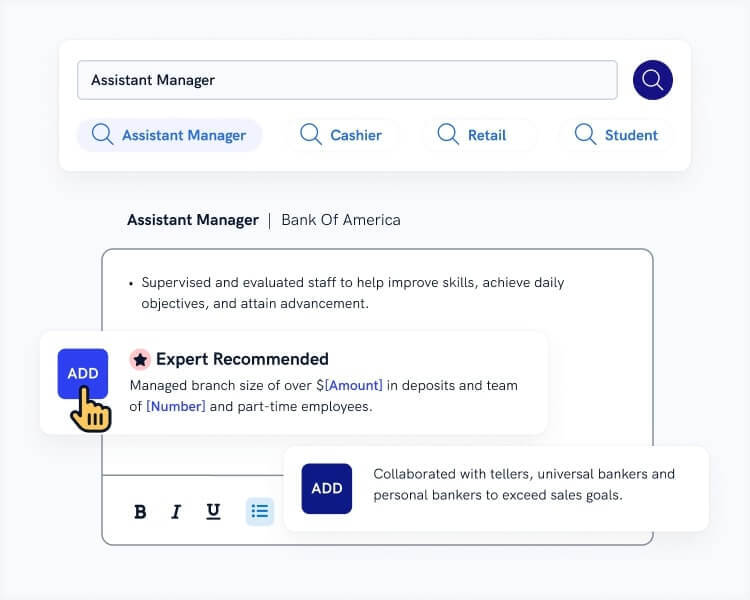
When you’re done, Zety’s Resume Builder will score your resume, and our ATS Resume Checker will tell you exactly how to make it better.
Canadian Resume Template
Follow this standard resume template to ensure your resume is polished:
[Your Name]
[Job Title]
[Phone Number]
[Email Address]
[City, Province]
[Networking Profile]
Professional Summary
[3–5 sentences highlighting your top skills, experience, and achievements. Focus on what you can offer the employer.]
Work Experience
[Job Title]
[Company Name], [City, Province]
Month, Year – Month, Year
- [Achievement-focused bullet point, using metrics and results when possible]
- [Achievement-focused bullet point, converting measurements to metric if relevant]
- [Achievement-focused bullet point highlighting impact]
- [Optional fourth bullet point]
Education
[Degree or Diploma]
[Institution Name], [City, Province]
Graduated: Year
- [Optional: Honors, awards, relevant coursework, or certifications]
- [Optional: GPA]
Skills
[List 6–8 skills, mixing hard, soft, and technical skills]
Canadian Resume Example
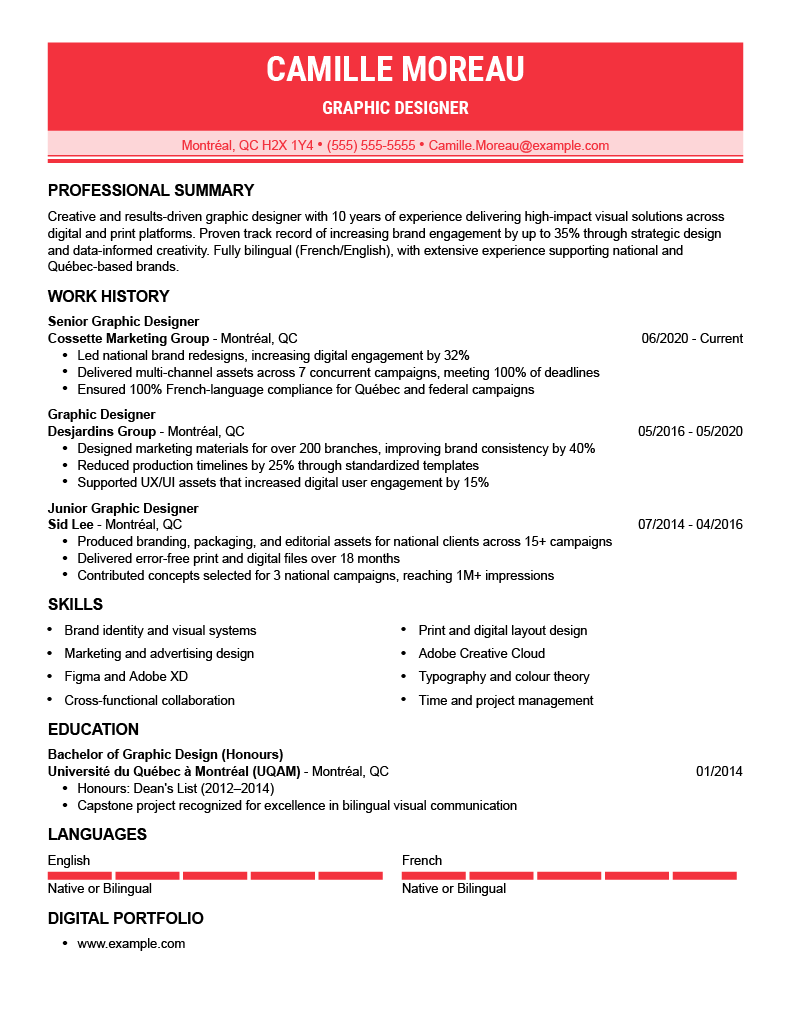
Graphic designer
Customer service representative
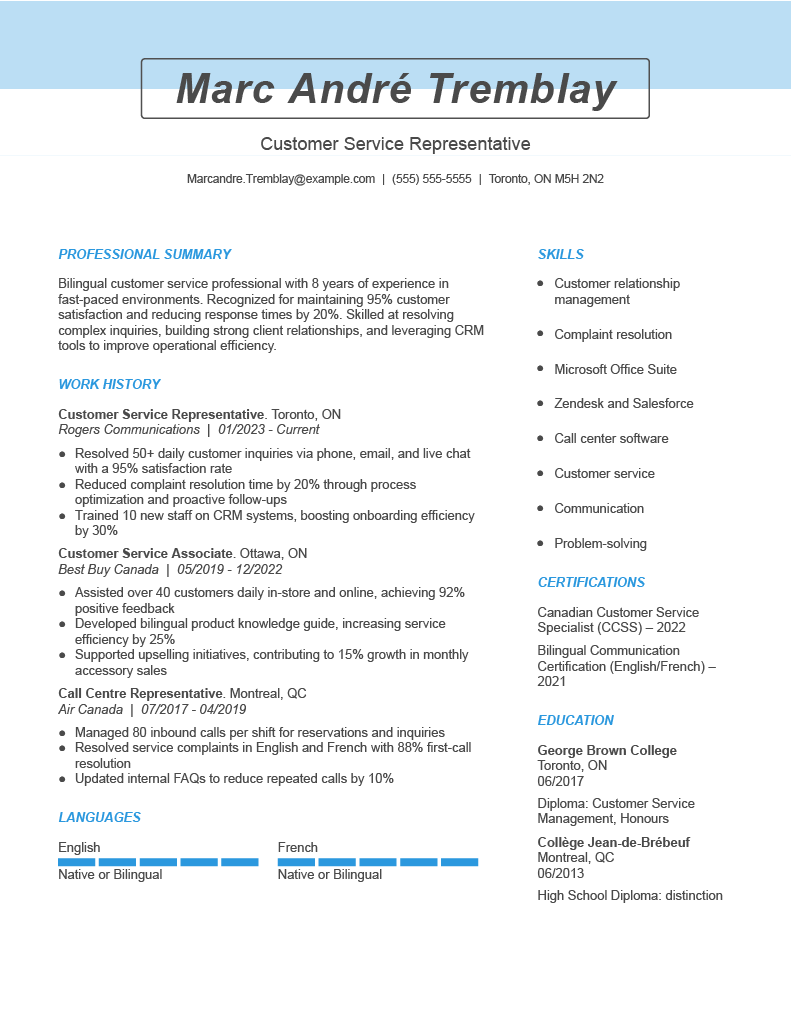
The resume examples above use the American date format (MM-DD-YYYY) because they were built with an American resume builder. When you use a builder to create your resume, double-check the date formatting to ensure it follows Canadian standards.
Key Takeaways
Before you go, remember these key points:
- Tailor your resume for Canada: use metric measurements, British spellings when appropriate, and include more detail to showcase achievements and projects.
- Follow the same formatting rules as U.S. resumes.
- Focus on what you can offer the employer in your professional summary.
- Use reverse-chronological order for work experience, highlight accomplishments with quantifiable results, and convert measurements to metric units.
- List education starting with the most recent degree, including graduation dates, relevant coursework, honors, and certifications.
- Include six to eight skills that mix hard, soft, and technical abilities, tailored to the job description.
- Add certifications, volunteer work, awards, projects, languages, and professional affiliations only if they add value and are relevant to the role.
About Zety’s Editorial Process
This article has been reviewed by our editorial team to make sure it follows Zety’s editorial guidelines. We’re committed to sharing our expertise and giving you trustworthy career advice tailored to your needs. High-quality content is what brings over 40 million readers to our site every year. But we don’t stop there. Our team conducts original research to understand the job market better, and we pride ourselves on being quoted by top universities and prime media outlets from around the world.

Follow Zety as a preferred source in Google
Get more resume writing tips, career insights, and workforce trends in your personalized search experience. Learn more >

Share:


