Table of Contents
Get more resume writing tips, career insights, and workforce trends in your personalized search experience.
Your education section is the foundation for everything else you share about your skills and experience. If it’s weak or unclear, employers may question the rest of your application, even if you’re highly qualified.
But when it’s done right, it shows hiring managers that you’re prepared and serious about your career.
In this guide, you’ll learn exactly how to put education on a resume and where, with examples for different career stages, so yours looks polished and helps you stand out.
Want to save time and have your resume ready in 5 minutes? Try Zety’s Resume Builder. It’s fast and easy to use. Plus, you’ll get ready-made content to add with one click.
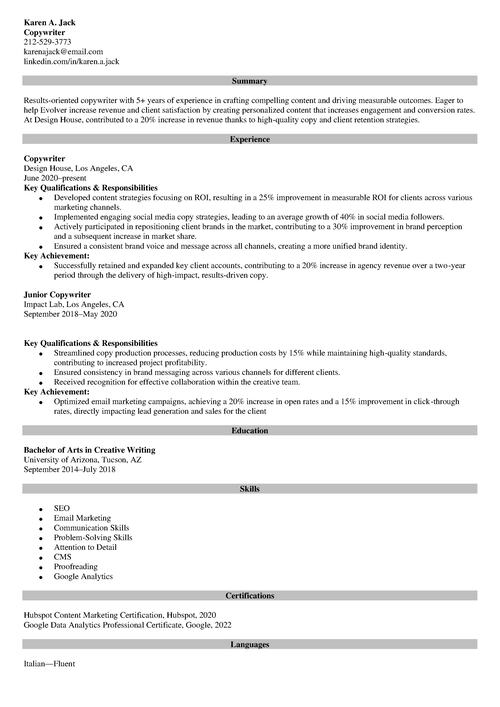
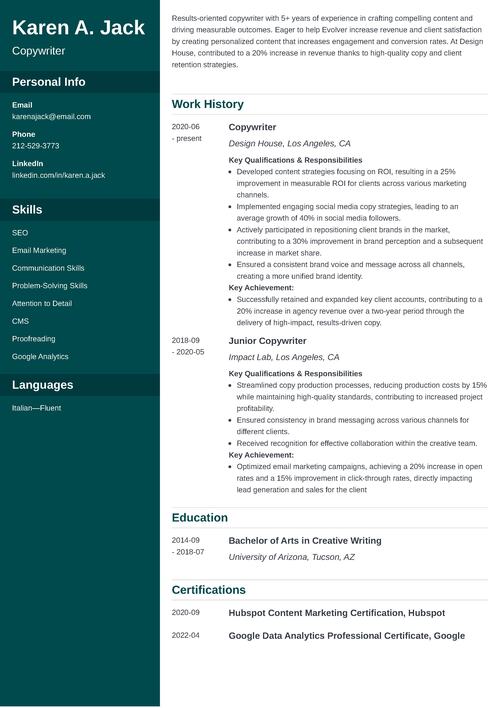
Sample resume made with our builder—See more resume examples here.
One of our users, Nikos, had this to say:
[I used] a nice template I found on Zety. My resume is now one page long, not three. With the same stuff.
What to Include in Your Education Section
Your education section shows employers that you have the knowledge and training needed for the job. Everything you include should support your skills and work experience.
Below are the required and optional academic items to include when writing your resume.
Required Details
Every education section should include these basic details:
Degree Title
Whether it’s an advanced degree, an associate degree, or a high school diploma, it’s essential to list your degree title. For example, “Bachelor of Science in Psychology.”
School or Institution’s Name & Location
Write the name of the institution and its location directly under your degree. Depending on your industry, your school can add prestige to your application if it has a renowned program.
Simply write “University of California, Berkeley, CA.”
Here’s how a standard education section would look:
Education on resume example:
Bachelor of Science in PsychologyUniversity of California, Berkeley, CA
Optional Details
You can add any of these extra details if you’re still a student, recently graduated, or have limited experience. These items will add value to your academic background:
Graduation Date
If you graduated less than 10 years ago, write the year you graduated. If your degree is still in process, list your expected graduation date. For example, “Expected: July 2026.”
Experienced professionals or job seekers who graduated over a decade ago can omit their graduation date to avoid ageism.
GPA
List your GPA only if it’s 3.5 or higher (out of a 4.0 scale).
Relevant Coursework
Relevant coursework adds body to your education section. It highlights exactly what you learned and how it aligns with your target job. This is especially useful in technical or specialized fields.
For example, if you’re applying for an IT role, classes in computer science can boost your resume. Below your graduation or expected graduation date, list two or three class titles:
“Relevant Coursework: Software Development/Programming, Database Management, and Emerging Technologies”
Awards & Honors
If you graduated from an honors program, earned special distinctions, or made it to the Dean’s List, you can include it in your education section. For example, “summa cum laude.”
Extracurricular Activities
Being a member of a college club or organization can showcase relevant hard skills and your commitment to the field from an early stage.
Other memberships, such as student council, also highlight leadership, problem-solving, and decision-making abilities.
Don’t hesitate to include extracurricular activities as long as they’re relevant to your target job. Continuing with the IT example, you could write: “Robotics Club Member (2024–2025).”
Publications
Publications on a resume prove your expertise, especially in communication, education, or STEM fields. Including published work instantly adds credibility to your knowledge and showcases that you went above and beyond during your academic years.
List them in APA or MLA format. For example: “Leadbetter, C., and G. Locklin. “5G as Disruptive Technology.” Journal of Applied Technology, vol. 86, no. 5, 2015, pp. 118-25.”
If you have more than two publications, it’s recommended to create a dedicated publications section for clarity.
Certifications
Certifications can strengthen your resume by showing verified skills and professional training. When including them in your education section, write the certification name, issuing organization, and year earned (if applicable). For example: “AWS Certified Cloud Practitioner (2025).”
Include certifications in your education section if you’re a student or recent graduate, or if you only have one or two certifications. If you’re an experienced professional or have more than two certifications, create a dedicated certifications section.
Here’s how an expanded education section might look:
Education on resume example:
Bachelor of Science in Information Technology University of Texas at Austin – Austin, TXExpected: June 2026
- AWS Certified Cloud Practitioner (2025)
- Dean’s List (2023–2025)
- Relevant Coursework: Software Development/Programming, Database Management, and Emerging Technologies
Making a resume with our builder is incredibly simple. Follow our step-by-step guide, use ready-made content tailored to your job, and have a resume ready in minutes.
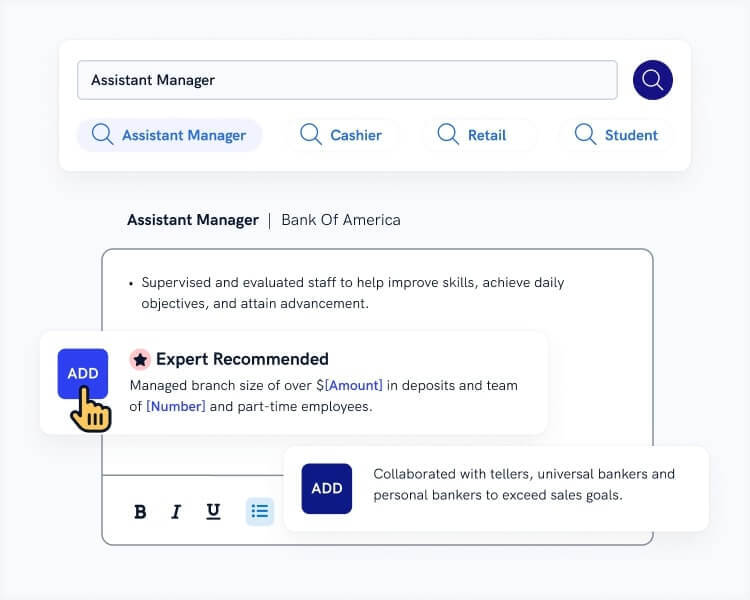
When you’re done, Zety’s Resume Checker will score your resume and tell you exactly how to improve it.
Where to Put Your Resume Education Section
Where the education section of your resume lives matters. Consider your career stage and the relevance of your academic background before deciding.
Follow these simple guidelines:
- Recent graduates: Place your education section at the top of your resume to highlight how your knowledge aligns with the job.
- Entry-level professionals: Use a functional resume to put your skills first, but keep your education section prominent if it’s highly relevant.
- Mid-level or experienced professionals: Opt for a combination or chronological resume that prioritizes your work experience over your education, since employers prefer to know what you’ve accomplished since you graduated.
Pro tip: Zety’s resume templates take the guesswork out of deciding where to place your education section. Simply answer a few questions, and we’ll show you the best resume layouts to showcase your strengths.
How to Format the Education Section of Your Resume
The key to formatting your education section is to keep your resume ATS-friendly, job-focused, and easy to read.
Follow these tips:
- Use keywords from the job listing. If you’re adding details like relevant coursework, match your language to the job requirements to improve your chances of passing applicant tracking systems (ATS).
- List your degrees in reverse-chronological order. Place your most recent or highest degree first.
- Decide how you want to show your degree title. You can either spell out your degree, “Master of Arts,” or use initials “MA.”
- Use consistent formatting. Keep the same font, spacing, and layout for every entry to create a professional look.
- Keep each entry concise. Limit your education section to the most important details and avoid long paragraphs; opt for bullet points instead.
- Place the section strategically. Put your education near the top if you’re a student or recent graduate, and lower if you have several years of experience.
Below are some examples of education section formatting for different situations.
Multiple Degrees
Use this format when you’ve earned more than one degree.
Multiple Degrees
Master of Business Administration (MBA)University of Michigan – Ann Arbor, MIMay 2024
Bachelor of Science in MarketingThe Ohio State University – Columbus, OHMay 2021
Degree in Progress
Use this format if you’re still completing your program.
Degrees in Progress
Bachelor of Science in Computer ScienceUniversity of Florida – Gainesville, FLExpected: May 2027
- Relevant Coursework: Data Structures, Software Engineering, Web Development
Recent College Graduate
This format works well when your education is your strongest qualification.
Recent College Graduate
Bachelor of Arts in EnglishUniversity of North Carolina – Chapel Hill, NCMay 2025
- GPA: 3.7
- Dean’s List (2023–2025)
- Student Newspaper Editor
High School Diploma
Use this format if you haven’t attended college yet or don’t plan to.
High School Diploma
High School DiplomaLincoln High School – Denver, COJune 2025
What Not to Include in Your Education Section
Avoid adding unnecessary or distracting information that doesn’t strengthen your application.
Don’t include the following items in your education section:
- High school details, if you have a college degree or higher
- Unrelated courses or minors that don’t support the job you’re applying for
- Every award or club—only include those relevant to your career goals
- Personal information like age, date of birth, or social media links (unless professional and relevant)
- Incomplete or dropped programs unless they directly relate to the role
- Overly detailed transcripts or excessive GPA precision (e.g., 3.674)
Key Takeaways
Before you go to write your education section, remember these key points:
- Include required details. Mention the degree title, school name and location, and graduation date (or expected date if in progress).
- Add optional details when relevant. Inculde a GPA above 3.5, relevant coursework, awards and honors, extracurricular activities, publications, and certifications.
- Place your education section based on career stage. List it at the top for recent graduates, prominent but secondary for entry-level professionals, and lower for mid-level or experienced professionals.
- List relevant degrees. Organize them in reverse-chronological order and format them consistently for readability and ATS compatibility.
- Only include information that strengthens your application. Skip unrelated courses, minor awards, high school info (if you have a college degree), or personal data.
Frequently Asked Questions
How do you list your education on your resume?
To list your education on your resume, write your degree title, school name and location, and graduation date (or expected date).
Include optional details like GPA, relevant coursework, honors, extracurriculars, and certifications if they strengthen your application. Format entries consistently, use reverse-chronological order for multiple degrees, and tailor coursework or awards to align with the job.
Keep the section clear and ATS-friendly to ensure hiring managers can quickly assess your qualifications.
Why would you include an education section in your resume?
Include an education section to show employers you have the knowledge, training, and academic background required for the job.
It highlights relevant skills, degrees, honors, or certifications, especially for students, recent graduates, or career changers. A well-structured education section also adds credibility to your application and can help you stand out.
Is it okay to omit education on a resume?
You can omit education if it isn’t relevant, or you have extensive professional experience that outweighs your academic background. This is common for experienced professionals who want to highlight skills, accomplishments, and work history.
If a degree or certification is important for the role, then include it to meet job requirements and maintain credibility.
What is the correct order to list degrees?
List your degrees in reverse-chronological order, starting with your most recent or highest-level degree. Include the degree title, school name, location, and graduation date.
For degrees in progress, indicate the expected graduation date. Reverse-chronological order makes it easy for employers to see your most recent education and most relevant qualifications first, which is especially important if your recent degree closely aligns with the job.
About Zety’s Editorial Process
This article has been reviewed by our editorial team to make sure it follows Zety’s editorial guidelines. We’re committed to sharing our expertise and giving you trustworthy career advice tailored to your needs. High-quality content is what brings over 40 million readers to our site every year. But we don’t stop there. Our team conducts original research to understand the job market better, and we pride ourselves on being quoted by top universities and prime media outlets from around the world.

Follow Zety as a preferred source in Google
Get more resume writing tips, career insights, and workforce trends in your personalized search experience. Learn more >

Share:


