











Table of Contents
Get more resume writing tips, career insights, and workforce trends in your personalized search experience.
A perfect resume isn’t about fancy fonts or listing every job you’ve ever had. It’s about clearly showing employers why you’re the right person for the role.
The best resumes highlight your most relevant skills, experience, and accomplishments in a format that’s easy for both hiring managers and applicant tracking systems (ATS) to read. Whether you’re writing your first resume, changing careers, or updating an old one, knowing what to include—and what to leave out—can make all the difference.
In this guide, you’ll learn what makes a resume stand out, how to structure each section, common mistakes to avoid, and see real resume examples you can use for inspiration.
Want to save time and have your resume ready in five minutes? Try Zety’s Resume Builder. It’s fast and easy to use. Plus, you’ll get ready-made content to add with one click.
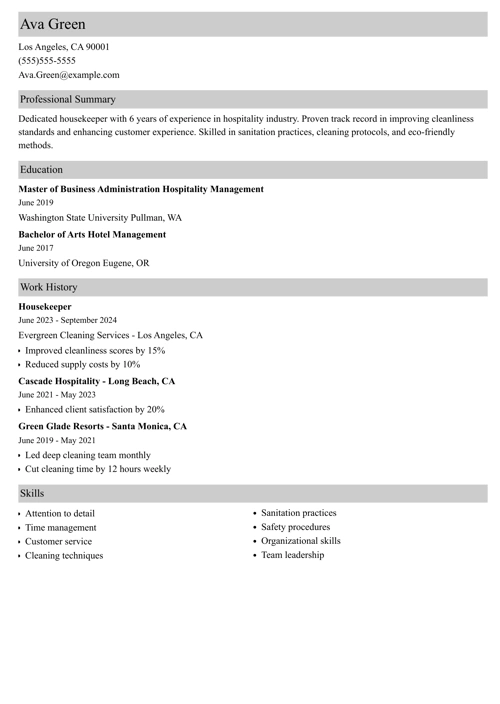
See more professional resume examples made with our builder.
One of our users, Chris, had this to say:
You cannot go wrong with Zety. The company does best at enhancing your resume and helping you market yourself better to land the job you love.
What Is the Perfect Resume?
The perfect resume is tailored to the job, optimized for ATS, and written with clear, action-oriented language that highlights measurable achievements. It quickly shows employers and resume-scanning software why you’re qualified for the role.
The strongest resumes have these characteristics:
- ATS-friendly formatting: Use standard section headings, simple fonts, and a clean layout without graphics, text boxes, or tables that may confuse resume scanners.
- Tailored content: Customize your resume for every application by matching your experience and skills to the job description.
- Strong action verbs: Begin bullet points with powerful action verbs, such as “managed,” “developed,” “implemented,” or “led,” to emphasize your contributions.
- Quantifiable achievements: Include numbers whenever possible to demonstrate impact, such as increasing sales by 20% or managing a $500,000 budget.
- Error-free writing: Consistent formatting and flawless grammar help create a professional first impression.
Remember, there’s no single “perfect” resume for every job. The best resumes are customized to the position, highlight your most relevant qualifications, and clearly show the value you can bring to an employer.
What Should a Perfect Resume Include?
A perfect resume should include your contact information, a professional summary, relevant work experience, skills, education, and any optional sections that strengthen your application.
Every section should demonstrate your qualifications and be aligned with the employer’s needs.
While resumes vary by industry and career stage, employers expect to see these core sections:
- Contact information: Your full name, phone number, professional email address, city, and state, and optional links to your LinkedIn profile or portfolio.
- Professional summary: A brief overview highlighting your experience, strongest qualifications, and career goals.
- Work experience: Relevant positions with accomplishment-focused bullet points that emphasize results instead of responsibilities.
- Skills: A combination of technical and workplace skills that align with the job description.
- Education: Your degree(s), school name, graduation date (or expected graduation date), and relevant coursework if applicable.
- Optional sections: Certifications, projects, volunteer work, awards, publications, languages, or professional memberships that add value to your application.
📣 As you review each section, ask yourself one question: Does this help prove I’m the right candidate for this role? If the answer is no, it probably doesn’t belong on your resume.
How to Write a Perfect Resume
To write a perfect resume, tailor it to the job, choose an ATS-friendly format, and highlight relevant skills and measurable achievements.
Follow the steps below to write a resume that organizes your information clearly and shows employers why you’re the right fit for the role.
1. Choose the Right Resume Format
The right resume format depends on your experience, career goals, and work history. Most job seekers should use a chronological resume because it highlights career progression. Functional and combination formats are better suited for career changers or candidates with limited or nontraditional experience.
Here’s an overview of the three formats:
- Chronological resume: Lists your work experience in reverse-chronological order, beginning with your most recent position. This is the most widely accepted format and works well for professionals with a consistent employment history.
- Functional resume: Focuses on skills rather than work history. This format works well for career changers or candidates with employment gaps, though many recruiters still prefer chronological resumes because they’re easier to evaluate.
- Combination resume: Blends a skills section with a chronological work history. It’s a good choice for candidates with specialized skills or extensive experience who want to emphasize both their qualifications and career progression.
2. Tailor Your Resume to the Job
To create the perfect resume, tailor it to each job by matching your skills, experience, and keywords to the job description. A targeted resume is more likely to pass ATS and show hiring managers that you’re a strong fit for the role.
Take time to review each job posting and identify the skills, qualifications, and responsibilities the company emphasizes. Then, incorporate these relevant keywords naturally throughout your professional summary, work experience, and skills sections.
Prioritize the accomplishments and experiences that are most relevant to the position. You don’t need to include every responsibility from every job you’ve held—instead, focus on achievements that demonstrate your ability to succeed in the role you’re pursuing.
Tailoring your resume for every job may feel time-consuming, but even small adjustments like updating keywords and prioritizing relevant accomplishments can significantly improve your chances of passing ATS and catching a hiring manager’s attention.
3. Write a Compelling Professional Summary
Write a two- to four-sentence resume summary that highlights your key skills, experience, and value as a candidate. Focus on what you do best, how your work creates impact, and why you’re a strong fit for the role, using clear, job-relevant language.
Keep it concise and aligned with the role by incorporating keywords from the job description and emphasizing your most relevant qualifications. Avoid generic statements and focus on outcomes that demonstrate your effectiveness.
Here’s an example of a professional summary from a perfect resume:
Professional Summary
Results-driven digital marketing specialist with 5+ years of experience designing and executing multichannel campaigns across SEO, paid search, and email marketing. Proven track record of increasing qualified lead generation by 32% year-over-year through data-driven optimization and A/B testing. Adept at collaborating with cross-functional teams to deliver consistent, measurable business growth.
4. Highlight Accomplishments, Not Responsibilities
Focus your resume on what you achieved in each role rather than simply listing your day-to-day duties.
Employers want to see measurable impact, so emphasize results, improvements, and outcomes that demonstrate your value. Whenever possible, include numbers, percentages, or other metrics to make your impact more concrete and credible.
Here’s a before-and-after example showing how accomplishments add value:
- Instead of this: Responsible for managing social media accounts.
- Try this: Increased social media engagement by 28% over six months by developing and executing a targeted content strategy.
And here’s an example work history section entry that showcases accomplishments:
Work Experience
Marketing Coordinator
GreenLeaf Digital | June 2022–Present
- Collaborated with a small team to execute 3 product launch campaigns, contributing to a 10% increase in quarterly engagement.
- Improved email marketing performance by increasing open rates by 18% through subject line testing and audience segmentation.
- Supported generation of 400+ qualified leads per quarter by updating landing page content and optimizing forms.
- Assisted in reducing cost-per-click (CPC) by 12% through adjustments to paid search campaigns in Google Ads.
5. Use Strong Action Verbs
Start each bullet point with a strong action verb to clearly show what you did and the impact you made.
Action verbs make your experience sound more confident, direct, and results-focused, which helps your resume stand out to both recruiters and ATS software. Instead of starting with phrases like “responsible for” or “helped with,” use specific verbs that highlight ownership and results.
Here are a few examples of strong action verbs:
Resume Action Words📌
- Achieved
- Analyzed
- Collaborated
- Created
- Delivered
- Designed
- Developed
- Directed
- Engineered
- Executed
- Improved
- Increased
- Implemented
- Managed
- Optimized
- Organized
- Reduced
- Streamlined
- Supervised
- Trained
- Upgraded
6. Include a Variety of Relevant Skills
A perfect resume should include a balanced mix of technical and workplace skills that match the job description. This helps your resume pass ATS scans and quickly shows employers that you have both the hard skills to do the work and the soft skills to succeed in the role.
For the perfect resume, focus on relevance over quantity by prioritizing skills listed in the job posting and supporting them with your experience. Group similar skills together to make them easier to read and scan.
Here’s an example of a balanced skills section:
Skills
- Technical skills: Excel, Google Analytics, SQL, Salesforce, HubSpot, Canva
- Marketing skills: SEO, content strategy, email marketing, paid advertising, A/B testing
- Soft skills: Communication, teamwork, problem-solving, time management, adaptability
A strong skills section is clear, targeted, and adapted to each job so employers can immediately see your qualifications without searching through your entire resume.
💡Pro Tip: Whenever possible, reinforce important skills through accomplishments in your work experience rather than relying solely on a standalone skills section.
7. Keep Formatting Simple & ATS-Friendly
Keep your resume format clean, simple, and easy to scan so both hiring managers and ATS can read it without issues. Use standard section headings, a readable font, and consistent spacing, and avoid design elements that may confuse ATS software.
Complex formatting can cause important information to be missed or misread by automated systems. Here are a few tips for formatting a perfect resume:
- Use standard resume fonts like Arial, Calibri, or Times New Roman.
- Keep body text between 10–12 points and section headers between 12–16 points.
- Use bold styling for a clear, consistent structure without overdesigning the resume.
- Use clear headings, such as “Work Experience” and “Skills.”
- Avoid tables, text boxes, graphics, or columns that may disrupt parsing.
- Save and submit your resume as a PDF unless the employer requests another format.
In most cases, your resume should be one page if you’re early in your career and no more than two pages if you have extensive, relevant experience. Focus on including the information that best supports the job you’re applying for instead of trying to fill a certain page count.
8. Proofread Carefully
Proofread your resume carefully to catch spelling, grammar, punctuation, and formatting errors before submitting it. Even small mistakes can make you appear less detail-oriented and reduce your chances of moving forward in the hiring process.
Read your resume slowly, and, if possible, have someone else review it for clarity and accuracy. Pay close attention to consistency in verb tense, formatting, dates, and spacing.
Making an error-free resume with our builder is incredibly simple. Follow our step-by-step guide, use ready-made content tailored to your job, and have a resume ready in minutes.
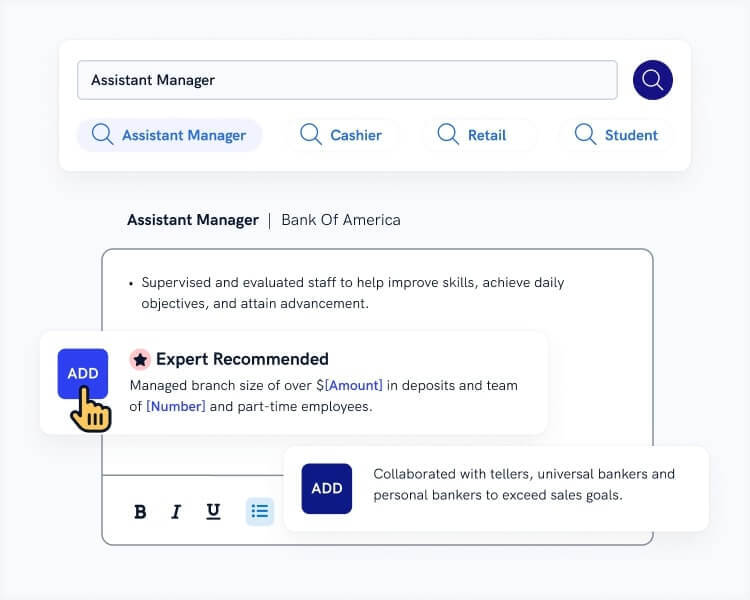
When you’re done, Zety’s ATS Resume Checker will score your resume and show you exactly how to improve it.
Perfect Resume Template
A perfect resume template is a clean, ATS-friendly structure that organizes your information clearly and highlights your most relevant qualifications first. It should be simple, easy to scan, and adaptable to different roles so you can quickly tailor it for each job application.
Below is a standard, effective resume template you can copy and customize:
[Full Name]
[City, State] | [Phone Number] | [Email Address] | [LinkedIn URL] | [Portfolio URL]
Professional Summary
[Two to four sentence summary of your experience, key skills, and measurable achievements tailored to the job.]
Work Experience
[Job Title]
[Company Name] | [Month Year]–[Month Year]
- [Achievement-focused bullet point with measurable result]
- [Achievement-focused bullet point describing impact]
- [Achievement-focused bullet point showing improvement or outcome]
- [Achievement-focused bullet point demonstrating contribution to team or company]
[Job Title]
[Company Name] | [Month Year]–[Month Year]
- [Achievement-focused bullet point]
- [Achievement-focused bullet point]
- [Achievement-focused bullet point]
Skills
- Technical skills: [Skill 1], [Skill 2], [Skill 3], [Skill 4]
- Industry skills: [Skill 1], [Skill 2], [Skill 3]
- Soft skills: [Skill 1], [Skill 2], [Skill 3]
Education
[Degree, Major]
[School Name] | [Graduation Year]
- [Optional: GPA, honors, coursework, or academic achievements]
Additional Sections (Optional)
[Certifications] | [Projects] | [Volunteer Experience] | [Awards] | [Languages]
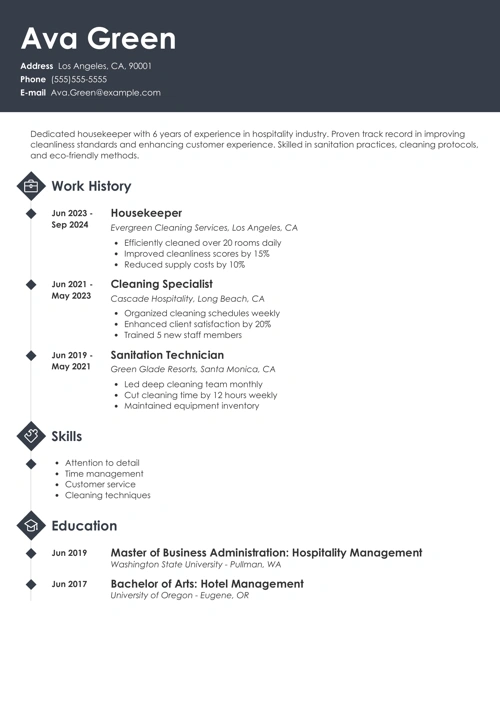
Perfect Resume Examples
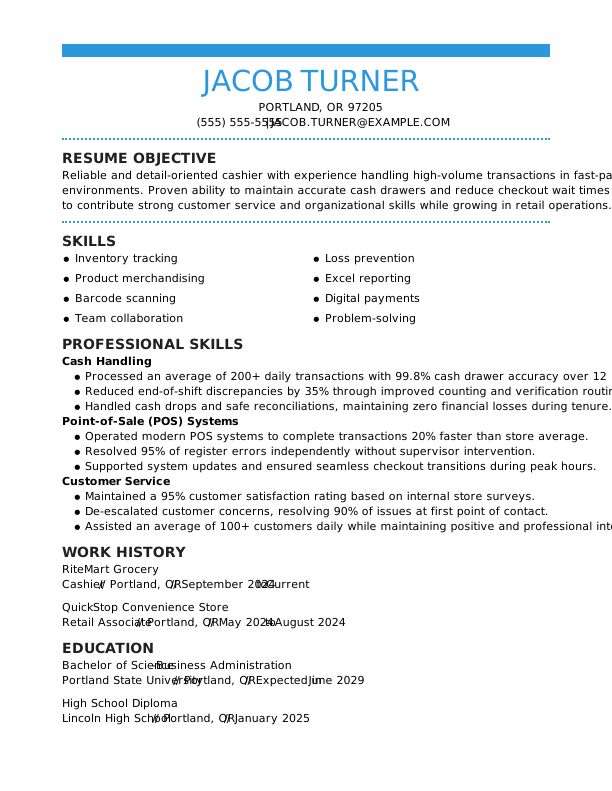
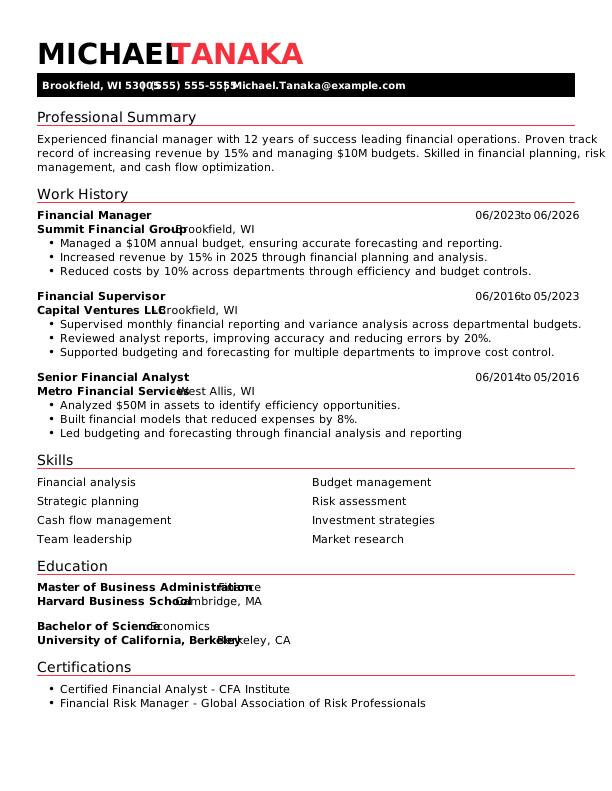
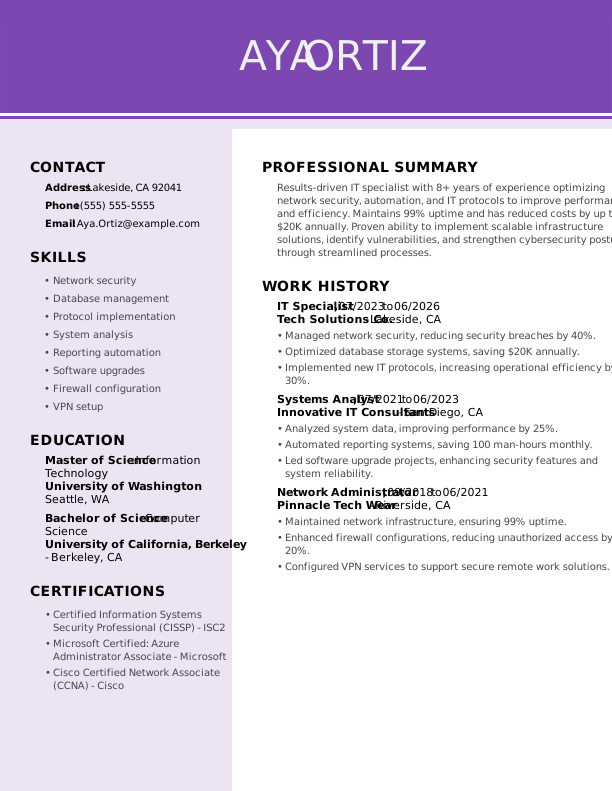
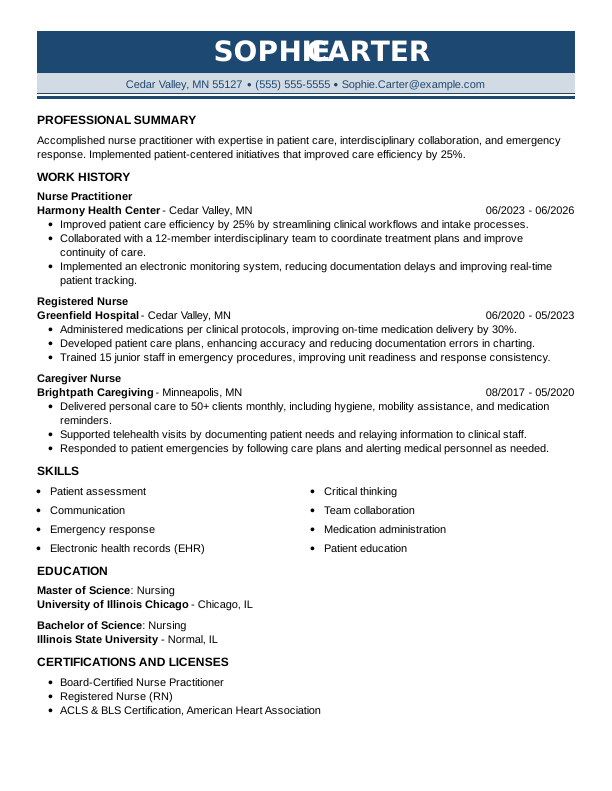
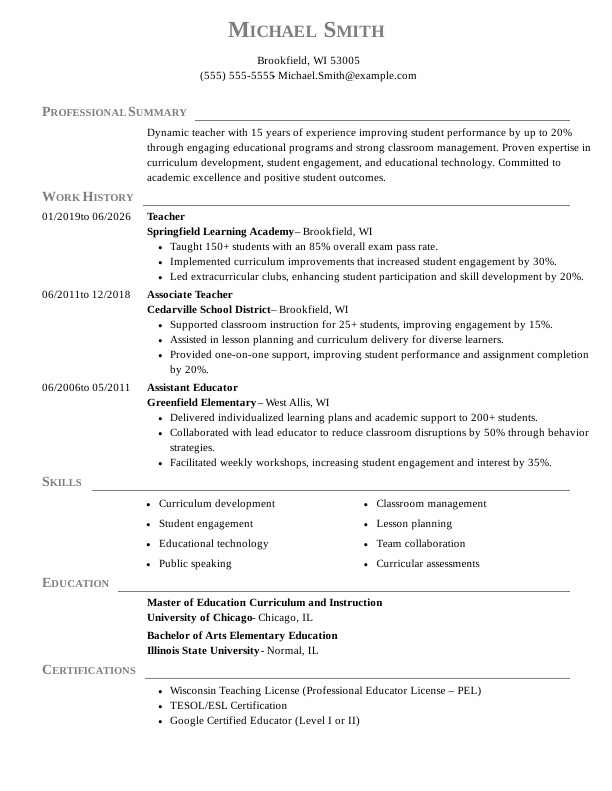
The perfect resume examples below show how to present skills, work history, and impact effectively across different career stages and industries.
Cashier Resume
Financial Manager Resume
IT Specialist Resume
Nurse Practitioner Resume
Teacher Resume
A strong cover letter that aligns with your resume can help you stand out by connecting your experience directly to the role and showing why you’re the right fit. You can create a tailored version using our Cover Letter Generator.
Here’s an example of what it may look like:
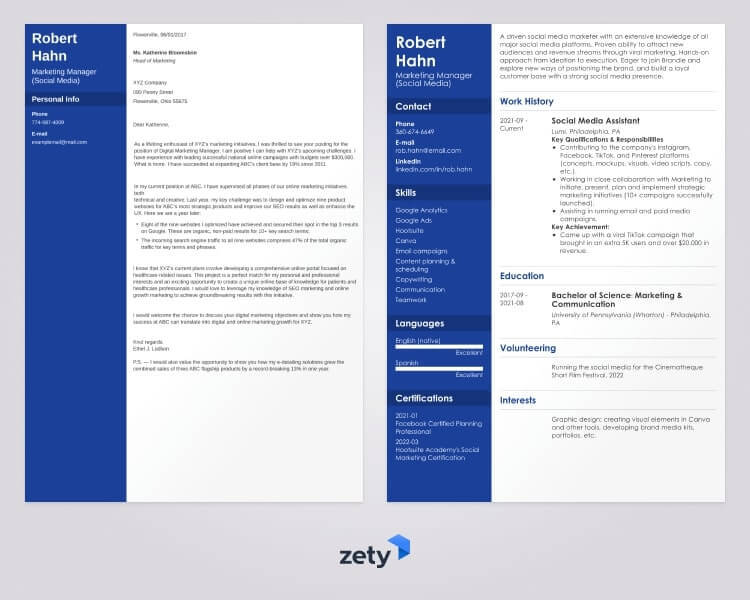
Explore our full section of cover letter templates and craft your perfect cover letter.
Common Mistakes That Prevent a Resume From Being Perfect
Even a strong resume can lose impact if it includes avoidable issues. Before submitting your resume, make sure you’ve avoided these common mistakes:
- Using the same resume for every application. Tailor your skills, experience, and keywords to each job description.
- Listing responsibilities instead of achievements. Focus on measurable results that demonstrate your impact.
- Using overly complex formatting. Tables, graphics, text boxes, and unusual fonts can make resumes more difficult for ATS to parse accurately.
- Including irrelevant or outdated information. Prioritize experience and skills that support your target role.
- Submitting a resume with spelling or formatting errors. Even minor typos can leave employers with a poor first impression.
Key Takeaways
While there’s no single “perfect” resume for every job, the strongest resumes quickly communicate your value and relevance to a specific role. The goal isn’t to list everything you’ve done, but to present a focused, easy-to-scan snapshot of your strongest qualifications and most relevant achievements.
✅ Here are a few key takeaways to consider while you make your perfect resume:
- A perfect resume is a tailored document that clearly highlights your most relevant skills, experience, and measurable achievements to show employers why you’re the best fit for a specific role.
- ATS-friendly formatting is important because it ensures your resume can be accurately scanned and ranked by hiring systems, helping you avoid layout issues that could hide or misinterpret key information.
- Strong resumes focus on measurable achievements instead of only listing responsibilities, which helps demonstrate the real impact you made in previous roles using clear results, numbers, or outcomes.
- Using action verbs helps make your experience more dynamic and impactful by clearly showing ownership of your work and emphasizing what you accomplished rather than what you were assigned to do.
- Pairing your perfect resume with a tailored cover letter strengthens your application by allowing you to expand on key achievements, explain your fit for the role, and connect your experience more directly to the employer’s needs.
Frequently Asked Questions
What are the five P’s of a resume?
The five P’s of a resume are purpose, positioning, presentation, personalization, and proof. Purpose focuses on tailoring the resume to a specific job. Positioning highlights how you differentiate yourself. Presentation refers to formatting and readability. Personalization aligns content to the employer’s needs. Proof demonstrates achievements with measurable results and evidence of impact. Following these principles helps you create a clear, targeted, and effective resume that’s easier for employers to evaluate.
What are six skills to put on a resume?
Six useful skills to put on a resume include communication, teamwork, problem-solving, time management, technical proficiency, and adaptability. These skills demonstrate your ability to work with others, manage responsibilities, and succeed in different work environments, making your resume more attractive to employers across industries.
What are red flags on a resume?
Red flags on a resume include unexplained employment gaps, frequent job-hopping without clear progression, vague or exaggerated job descriptions, spelling and grammar errors, and a lack of measurable achievements. Employers also view inconsistent formatting, missing dates, or overly generic content as warning signs that reduce credibility.
What are the three C’s of a resume?
The three C’s of a resume are clarity, conciseness, and consistency. Clarity means your experience, skills, and achievements are easy to understand at a glance, using simple language and organized sections. Conciseness ensures you include only relevant information, avoiding unnecessary detail so your resume stays focused and easy to scan. Consistency means using uniform formatting, tense, spacing, and structure throughout the document, creating a polished, professional impression and improving readability for hiring managers and ATS.
What are the five most important parts of a resume?
The five most important parts of a resume are your contact information, professional summary, work experience, skills, and education. Your contact information makes it easy for employers to reach you, while a professional summary gives a quick snapshot of who you are and what you bring to the table. Work experience shows what you’ve done and the impact you’ve made, skills highlight your key strengths, and education rounds out your background and credentials.
About Zety’s Editorial Process
This article has been reviewed by our editorial team to make sure it follows Zety’s editorial guidelines. We’re committed to sharing our expertise and giving you trustworthy career advice tailored to your needs. High-quality content is what brings over 40 million readers to our site every year. But we don’t stop there. Our team conducts original research to understand the job market better, and we pride ourselves on being quoted by top universities and prime media outlets from around the world.

Follow Zety as a preferred source in Google
Get more resume writing tips, career insights, and workforce trends in your personalized search experience. Learn more >

Share:


