














Table of Contents
Get more resume writing tips, career insights, and workforce trends in your personalized search experience.
Your culinary journey started with your mom’s cooking. But it’ll definitely not end at home. Once all your friends learned about your culinary talents, you became the most popular person in your circle.
But while cooking for friends is rewarding, it doesn’t fulfill your ambitions. You’re a chef. You belong in a restaurant. A top one. There’s just one last step on your journey to restaurants from Michelin’s guide: your culinary resume. Write one and send it while it’s hot.
This guide will show you:
- A culinary resume example better than 9 out of 10 other resumes.
- How to write a culinary resume that will land you more interviews.
- Tips and examples of how to put skills and achievements on a culinary resume.
- How to describe your experience on a resume for a culinary to get any job you want.
Want to save time and have your resume ready in 5 minutes? Try our resume builder. It’s fast and easy to use. Plus, you’ll get ready-made content to add with one click. Explore our free resume templates and start building your resume today.
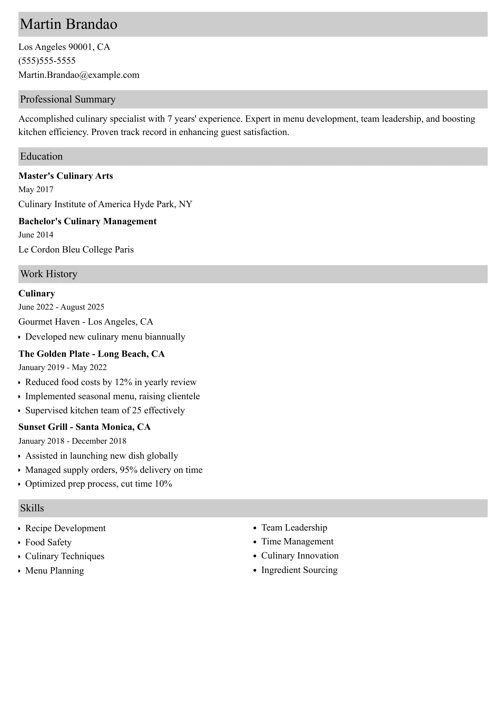
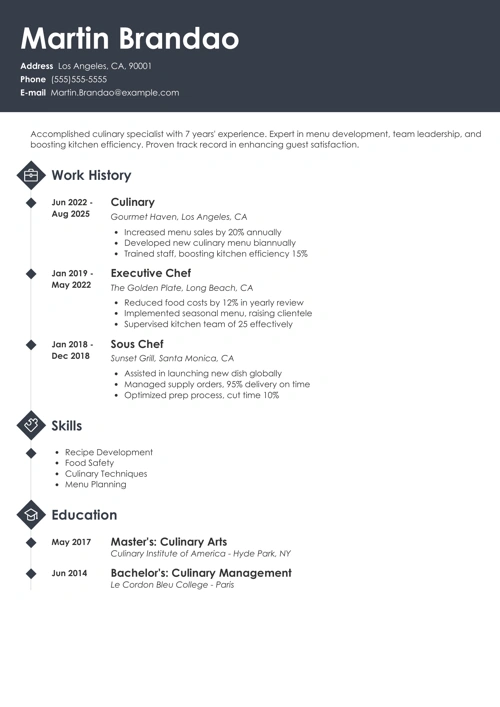
Sample resume made with our builder—See more resume examples here.
One of our users, Anjeanette, had this to say:
Zety suggested tips and revised my resume in a way I never could. Helped me word things in a much more intelligent fashion and got me my dream job.
Do you need a certain kind of resume for culinary jobs? See our other guides:
- Chef Resume Sample & Guide
- Food Service Resume Sample & Guide
- Restaurant Resume Sample & Guide
- Restaurant Manager Resume Sample & Guide
- Restaurant Server Resume Sample & Guide
- Cook Resume Sample & Guide
- Subway Resume Sample
- Resume Examples for All Careers
Culinary Resume Sample
Martin Brandao, Head Chef
martin.q.brandao@gmail.com
linkedin.com/in/martinqbrandao
603-481-7565
Professional Summary
Talented head chef with 7+ years of experience. Skilled in staff management and creating menus. Seeking to enhance the dining experience at The Joyous Ocelot. At The Prawn Broker, received two five star reviews from Massachusetts Life Magazine for, “exciting menu, flawlessly executed.” Served a packed house 5 nights a week thanks to vibrant word of mouth.
Work Experience
Chef
The Prawn Broker
Feb 2014–May 2019
- Served as head chef in 110-seat five-star restaurant. Presided over a sous chef, 6 junior sous chefs, and a kitchen staff of 20.
- Maintained five-star reviews from Massachusetts Life Magazine’s head food critic. She praised my menu as exciting and flawlessly executed.
- Served 500+ dinners per night, 5 nights a week. Built unstoppable word-of-mouth thanks to creative and intriguing menu.
- Trained 25 chefs, sous chefs, and other kitchen staff in food safety, preparation, storage, and presentation best practices.
Chef
Northern Maine Outdoor Center
Jan 2012–Feb 2014
- Ran kitchen in remote but popular year-round outdoor center.
- Raised restaurant rating from three-star to four-star in 15 months.
Education
2012 Cambridge School of Culinary Arts
Professional Chef’s Program Graduate
- Pursued a passion for farm-to-table cuisine.
- Excelled in food safety and menu-creation coursework.
2007–2011 Boston College
Bachelor of Science in Business Administration
- Wrote a weekly column on smoked foods preparation in student paper.
- President, student culinary arts club.
Skills
- Technical Skills: Staff management, menu creation, business knowledge, food safety
- Soft Skills: Interpersonal skills, leadership, time management, collaboration
Activities
- Wrote three cookbooks that sold 1,200 and 1,500 copies.
- Make clam & corn chowder 1x a week at Bunker Hill Mission.
Here’s how to write a culinary resume that gets jobs:
1. Choose the Best Culinary Resume Format
Culinary professionals like chefs, sous chefs, and pastry chefs have expert-level food-preparation knowledge. They create and implement menus that excite and delight their patrons. A culinary resume must show skills in food safety, kitchen management, and other chef and kitchen skills.
Presentation matters.
That’s true in a dining room and in a resume for culinary jobs.
So—
You need a well-proportioned resume.
That’s why the resume samples for experienced culinary pros online use the chronological resume layout.
It’s the best layout for resumes, just as clock-face plating is the best food presentation style. It puts things in the right order for the customer.
- The order of resume sections is header, experience, education, skills, then sections like publications or conferences.
- In your resume name header, display your name and contact info.
- There’s no need to put an address on your resume. Just list your city or town.
- Save your culinary arts resume in PDF format, provided the job posting doesn’t tell you different.
Pro Tip: What font should a resume be in? Pick an easy-reading font like Calibri, Cambria, Verdana, or Helvetica.
2. Write a Culinary Resume Objective or Resume Summary
The restaurant manager is busy.
Your culinary resume must be appetizing right away.
So write a short elevator speech. It’s called a professional profile or a profile summary for a resume.
Either way, it’s a sampler of all your finest culinary moments.
Here’s the recipe:
- An adjective (talented, accomplished)
- Title (Chef, Sous Chef, etc.)
- Years of experience (7+, 5)
- Your target (enhance the dining experience)
- A taste of your skills (staff management, creating menus)
- Skills proof (5-star reviews, served packed house)
- Measures that convince (two reviews, 5 nights)
In a resume with no experience, you won’t have all those ingredients.
So—prove transferable abilities from non-culinary roles in an objective on your resume.
Example: if you managed a team of hotel valets, that proves leadership.
Pro Tip: How long should a professional resume be for culinary jobs? One page, unless your many food service accomplishments would rival Paul Bocuse’s.
3. Pair Your Resume with the Culinary Job Description
You’re a culinary pro, not a resume-writing pro.
Don’t make this rookie mistake:
Don’t whip up a generic culinary resume for every job opening.
Knowing how to write experience in a resume means knowing how to tailor your resume to each position.
- Match your job titles to the online opening. If they say, “Head Chef,” that’s you. If they say, “Executive Chef,” use that.
- You also need accomplishments for resume for culinary roles. Pick your proudest moments when you used the skills they’re asking for.
- As with your summary, add numbers. “500+” works better than “a lot.”
Pro Tip: Spice things up by using the right verbs for resumes, like “served, trained, raised.” Never settle for the bland “responsible for” or “handled.”
4. Elevate Your Culinary Resume Education Section
Most resume education sections are as alike as canned food.
Make yours sizzle.
Don’t stop with your school name, dates of attendance, and degree.
Show off your culinary skills with more achievements.
Did you lead a culinary club? That proves leadership. Did you excel in food safety classes? That’s another plus.
Pro Tip: Definitely list cum laude on your resume for culinary jobs if you scored that high. Was your GPA more in the McDonald’s zone? Then leave it off unless you graduated this year.
5. List More Than Culinary Skills in Your Resume
List these work skills in your culinary resume:
Culinary Resume Skills
This technical skills list gives the basics:
- Business knowledge
- Kitchen management
- Menu creation
- Food safety
- Presentation
- Food quality
- Cost control
- Infrared Salamander Broiler
- Vulcan 70in. Gas Range
- Working with suppliers
- Sourcing food and kitchen supplies
Of course you’ll need some soft skills too:
- Interpersonal skills
- Leadership
- Time management
- Spoken & written communication
- Collaboration
- Delegation
- Active listening
- Self motivation
- Efficiency
- Detail oriented
- Problem solving
- Creativity
- Organization
And remember to use a good mix of hard skills vs soft skills in your culinary arts resume. But don’t list too many. Go heavy on the few abilities the job ad holds in high regard.
Insights from 11 million resumes crafted with our builder show that:
- On average, the typical resume for a Culinary Chef includes 12.6 skills.
- Skills such as meal preparation, menu development, cost control, and equipment maintenance are top choices for Culinary Professionals.
- The average resume length for Culinary Chefs is 2 pages.
Making a resume with our builder is incredibly simple. Follow our step-by-step guide, use ready-made content tailored to your job and have a resume ready in minutes.
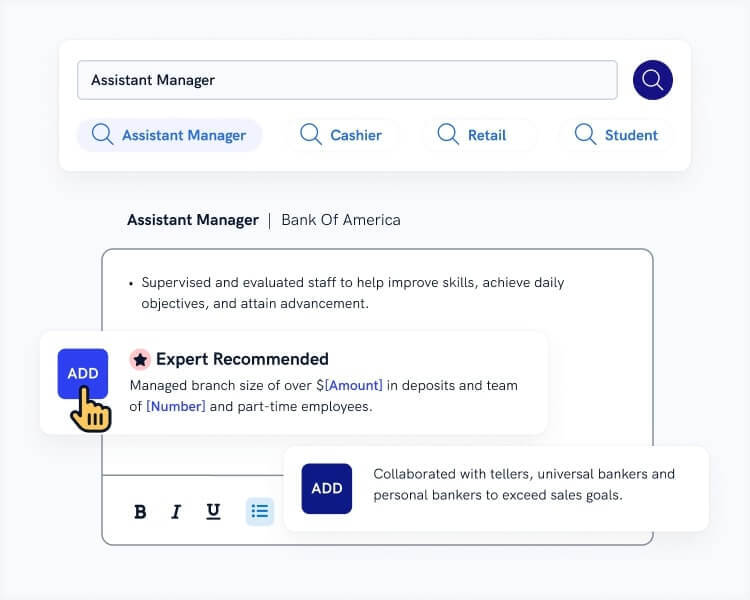
When you’re done, our online resume builder will score your resume and our resume checker will tell you exactly how to make it better.
6. Add “Other” Sections to Your Culinary Resume
You can’t stop after “education.”
That’s as boring as a dry, plain chicken breast.
Add one or two of these:
- Activities
- Freelance work
- Reviews or media writeups
- Publications
- Side projects
- Conferences
- Commendations from superiors
- Personal interests
- Honors
- Awards
- Community service on a resume
- Languages
- Fitness interests
Pro Tip: Listing certifications on a resume is easy. If they matter for the job, make a “Certifications” section under “Education.” If they’re “extra,” add them to “Activities.”
7. Send a Cover Letter With Your Culinary Resume
Should I submit a cover letter with my culinary resume?
It’ll boost your chance of getting hired.
But—
Don’t make an over-processed culinary cover letter.
- Of the different cover letter formats, the three-paragraph style is your friend.
- When starting a cover letter, mention something memorable like your biggest culinary “win.”
- In your culinary cover letter middle, show you’re the perfect choice. If they have a Vulcan Broiler and you made 200 meals a night with one, say so.
- When you’re closing a cover letter, offer something tasty. Example: “I’d be glad to share why Massachusetts Life Magazine called me the best chef in the state.”
- How long are cover letters? They should be half a page.
Unsure how to follow up on a job application? Send a short, polite note once a week, with a brief reminder of the most memorable fact in your cover letter.
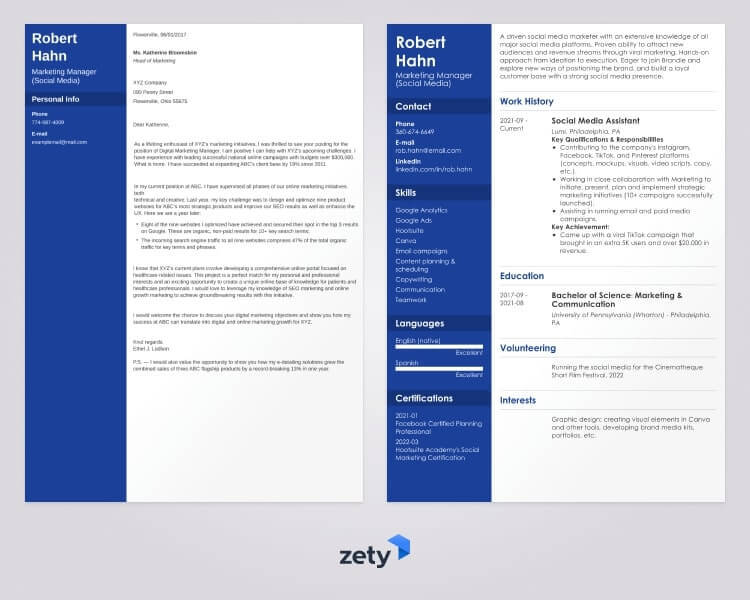
Plus, a great cover letter that matches your resume will give you an advantage over other candidates. You can write it in our cover letter builder here. Here’s what it may look like:
That’s it!
That’s how to write a culinary resume.
About Zety’s Editorial Process
This article has been reviewed by our editorial team to make sure it follows Zety’s editorial guidelines. We’re committed to sharing our expertise and giving you trustworthy career advice tailored to your needs. High-quality content is what brings over 40 million readers to our site every year. But we don’t stop there. Our team conducts original research to understand the job market better, and we pride ourselves on being quoted by top universities and prime media outlets from around the world.

Follow Zety as a preferred source in Google
Get more resume writing tips, career insights, and workforce trends in your personalized search experience. Learn more >

Share:


