Table of Contents
Get more resume writing tips, career insights, and workforce trends in your personalized search experience.
To stand out in the competitive finance industry, your resume needs to highlight your expertise and accomplishments in a way that commands attention. But how do you demonstrate your value without going overboard?
Keep reading for tips on crafting a finance resume that will open doors and get you noticed.
Want to save time and have your resume ready in 5 minutes? Test our rapid Resume Builder to save energy and keep things fast and easy. You’ll also get tailored, ready-made descriptions to add with one click. Draft your document using resume templates for free download available here.
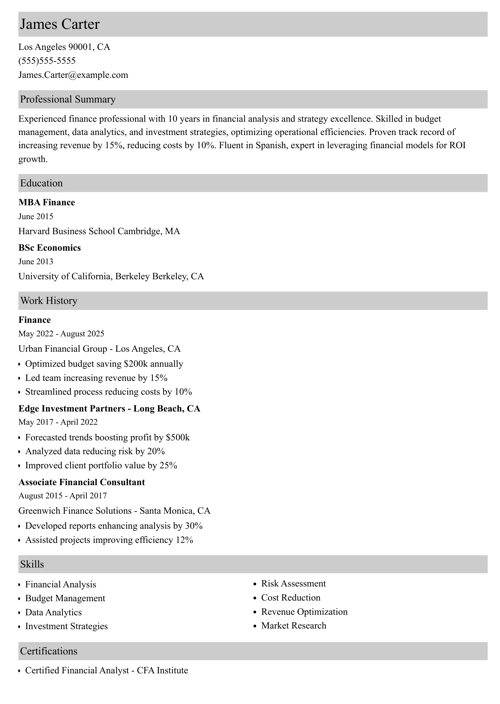
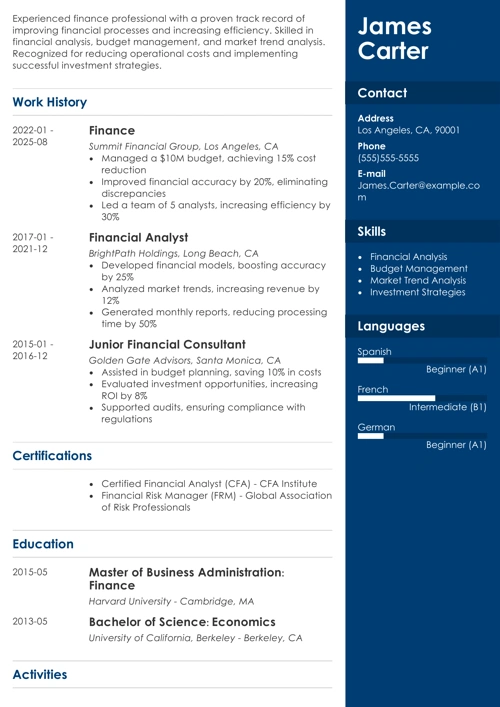
Sample resume made with our builder—See more resume examples here.
One of our users, Brittanya, had this to say:
Zety really helped me create the best resume possible. It pointed out how things could be better on my existing resume and suggested many things to be re-worded or removed.
Explore more articles focused on advancing your finance career:
- Accounting Clerk Resume
- Accounting Resume
- Accounts Payable Resume
- Bank Manager Resume
- Branch Manager Resume
- Entry-Level Accounting Resume
- Entry Level Business Analyst Resume
- Financial Analyst Resume
- Financial Controller Resume
- Insurance Sales Agent Resume
- Private Equity Resume
- Senior Accountant Resume
- Resume Examples for Any Job
Finance Resume Example
James Carter
Financial Manager
(555) 234-5678
james.carter@email.com
linkedin.com/in/james-carter
Summary
Results-driven Financial Manager with 10+ years of experience in financial planning, budgeting, and investment strategy. Skilled in risk management, cost optimization, and financial reporting. At Summit Finance Group, led a cost reduction initiative that improved profitability by 18%. Eager to apply financial expertise and strategic insights to drive growth at BrightPath Financial Services.
Experience
Financial Manager
Summit Finance Group, New York, NY
April 2017–February 2025
Key Qualifications & Responsibilities
- Managed financial planning, forecasting, and budgeting for a portfolio exceeding $50M.
- Developed risk management strategies that reduced financial exposure and improved operational efficiency.
- Led investment analysis and portfolio management, ensuring optimal asset allocation.
- Prepared detailed financial reports and presented insights to executive leadership.
- Implemented cost-saving initiatives, improving cash flow and overall financial health.
Key Achievement
- Led a cost reduction initiative that improved profitability by 18%, optimizing resource allocation and expense control.
Senior Financial Analyst
BrightEdge Consulting, Boston, MA
June 2014–March 2017
Key Qualifications & Responsibilities
- Conducted financial analysis and modeling to support strategic business decisions.
- Developed pricing strategies and investment recommendations for corporate clients.
- Assisted in financial risk assessments and implemented internal control measures.
- Created dashboards for tracking key financial performance indicators.
Key Achievement
- Designed an automated financial reporting system that reduced data processing time by 30%.
Education
Master of Business Administration (MBA), Finance
University of Pennsylvania, Wharton School, Philadelphia, PA
September 2012–May 2014
Bachelor of Science in Finance
New York University, New York, NY
September 2008–May 2012
Skills
- Financial Planning & Forecasting
- Investment Strategy & Risk Management
- Cost Reduction & Expense Optimization
- Financial Modeling & Data Analysis
- Budgeting & Cash Flow Management
- Tax Compliance & Regulatory Reporting
- ERP & Financial Software (SAP, QuickBooks, Excel)
- Team Leadership & Stakeholder Communication
Certifications
- Chartered Financial Analyst (CFA), 2016
- Certified Management Accountant (CMA), 2017
Awards
- Outstanding Financial Strategy Award – Summit Finance Group, 2023
- Top Analyst Recognition – BrightEdge Consulting, 2016
Memberships
- Member, CFA Institute
- Member, Financial Management Association (FMA)
- Member, American Finance Association (AFA)
Interests
- Participating in corporate finance seminars to stay updated on industry trends.
- Volunteering as a mentor for aspiring finance professionals.
Here’s how to craft a finance resume that gets you hired:
1. Choose the Right Format for Your Finance Resume
Finance professionals work in banks and financial institutions to assist individuals and businesses with their financial needs. Your finance resume should demonstrate that you possess both the skills and experience required to help an organization achieve its financial goals.
Finance is a broad field, covering various specializations. Roles range from analysts and specialists to managers and directors, each requiring its own set of skills and expertise.
The good news is that unemployment in the financial sector is very low and the number of job opportunities is steadily on the rise.
The challenge? Competition is fierce, and recruiters don’t have much time to review each resume.
To stand out, follow these resume formatting rules:
- Check that your resume contact information is up to date. Double check your social media footprint for anything that might be seen as unprofessional or unethical.
- Optimizing your LinkedIn profile is a must. It is to give recruiters a deeper insight into your experience and interests.
- Out of all resume styles, the chronological layout is the go to for finance resumes. It highlights your professional job experience and financial skills which is exactly what you want to underline. An added bonus is that it’s also the format that most recruiters recognize and quite ATS compliant.
- For a clean resume template, choose a resume font that’s professional and easy to read. You know that people rarely read the fine print so make sure to use a good font size and leave some white space for better visibility.
- If you want your resume layout looking like one of your professionally formatted spreadsheets, save it in a PDF format.
Many job seekers wonder how long their resume should be. A good rule of thumb is that a one-page resume template should do the trick, unless you’ve been in finance as long as the U.S dollar.
Read more: Best Resume Structure
2. Write a Summary or Objective for a Finance Resume
Start your finance resume with a strong resume profile, or to be precise, a career objective or summary. This brief paragraph sets the tone for your resume and helps recruiters immediately see that you’re the candidate they’re looking for.
If you’ve been in the finance field for over two years, opt for a career summary:
- Think about the key points in your experience and financial skills and make notes. Remember about your career accomplishments—they can really wow recruiters.
- Choose 4 great points and add them to your finance resume summary section to show the recruiter that they can bet their bottom dollar on you.
If you’re writing an entry-level resume or finance intern resume, choose the career objective:
- Focus on the skills and knowledge you’ve gained so far, and explain why you’re a great fit for the company.
- Highlight transferable skills and any quantifiable achievements from past jobs or school that demonstrate your potential and expertise.
Keep it brief—around 3-4 sentences. Don’t forget to tailor it to the job description just like you tailor financial forecasts to the current economic weather.
Read more: How to Start a Resume
3. Craft an Impressive Finance Resume Job Description
To land that dream interview, your resume experience section needs to stand out like a high-return investment:
- Start with your current role and work backward.
- Make each entry clear and concise by adding: job titles, company name, dates of employment, and 6 bullet points max that mention your accomplishments.
- Limit bullet points for older positions—no more than 3.
- Begin each bullet point with a strong action verb.
- Creating a laundry list of duties isn’t the way to go. Instead, use quantifiable achievements to impress. Make the numbers work for you.
- Tailor this section to the specific position to boost your chances of getting noticed.
Read more: How Far Back Should a Resume Go
4. Elevate Your Finance Resume Education Section
Your education matters in finance, so don’t rush through this section.
Here’s how to make it stand out to recruiters:
- Don’t get into too much detail if you have more than a few years of experience. Just list the following: college/university name and location, years you studied, degree, major and minors.
- If you only have a year or two of experience or you’re writing a recent college grad resume, beef up your education resume section with wins from your college days (such as a GPA or Latin honors). Make sure they’re relevant and list no more than 4-6 items.
If you’re fresh to the field or creating a finance internship resume, place your education sectionat the top. You’ll be focusing on your strengths which is the best way to start off your resume with no experience.
Read more: How to List a Degree on a Resume
5. Showcase Your Key Finance Skills on Your Resume
Skills are the backbone of any job, especially in finance, where both analytical skills and interpersonal abilities are equally important. So, don’t overlook the importance of highlighting your skills on your finance resume.
Here’s how to showcase your financial skills effectively:
- Think about the job skills you have—this means soft skills and hard skills, technical skills, and any other relevant skills you’ve got in your portfolio. List them.
- Pick the most relevant financial skills by using the job ad as a cheat sheet. Include those top skills in your financial resume. Always ensure that your skills align with what’s demonstrated in your experience and education sections.
Resume Skills List for Finance Professionals
- Interpersonal skills
- Accounts receivable and payable
- Due diligence
- Cash handling
- Debt and credit management
- Problem-solving skills
- Time management skills
- Negotiating
- Communication skills
- Computer skills
- Financial analysis
- Collaboration skills
- Risk assessment
- Account reconciliation
- SAP
- Microsoft Office skills
- Conceptual skills
Insights from 11 million resumes crafted with our builder show that:
- On average, the typical resume for a Financial Manager includes 14 skills.
- Skills such as cash flow management, profitability analysis, expense control, and budget analysis are top choices for Finance Managers.
- The average resume length for Finance Managers is 3.2 pages.
Making a resume with our builder is incredibly simple. Follow our step-by-step guide, use ready-made content tailored to your job and have a resume ready in minutes.
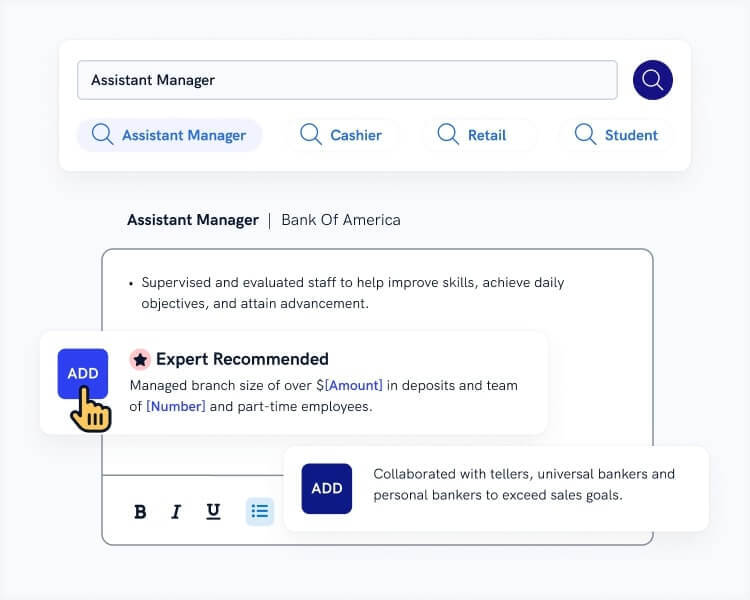
When you’re done, our online resume builder will score your resume and our resume checker will tell you exactly how to make it better.
6. Include Additional Sections in Your Finance Resume
You’ve accomplished a lot, but there’s still room to make your resume stand out.
- Add language skills that can be beneficial to your job. The future of finance will be in emerging markets so your knowledge of their languages will give you an advantage over the competition.
- Add extra sections such as volunteering, achievements and awards, projects, and even hobbies and interests if they’re relevant to finance or prove a certain skill or know how. Finance workers need to have a wide array of skills to be excellent and flexible at their job, so include things that can prove that.
- Don’t forget about your certifications! They’re essential, especially if you’re aiming for roles like finance director, financial analyst, or finance manager.
Read more: What to Put on a Resume
7. Include a Cover Letter with Your Finance Resume
Always include a cover letter, even if the job ad doesn’t ask for one. Recruiters read them, and it’s a chance for you to demonstrate why you’re a valuable asset.
Write a finance cover letter that stands out like a golden ticket:
- Use a professional, modern cover letter format to convey your readiness to get to work.
- Start your cover letter with a compelling hook that grabs the hiring manager’s attention.
- Highlight your experience and skills with concrete examples that show you’re the right fit for the role.
- Add an impactful call to action to end your cover letter.
The ideal length of an effective cover letter is around one page so keep it concise and to the point.
Read more: Finance Cover Letter
Plus, a great cover letter that matches your resume will give you an advantage over other candidates. You can write it in our cover letter builder here. Here’s what it may look like:
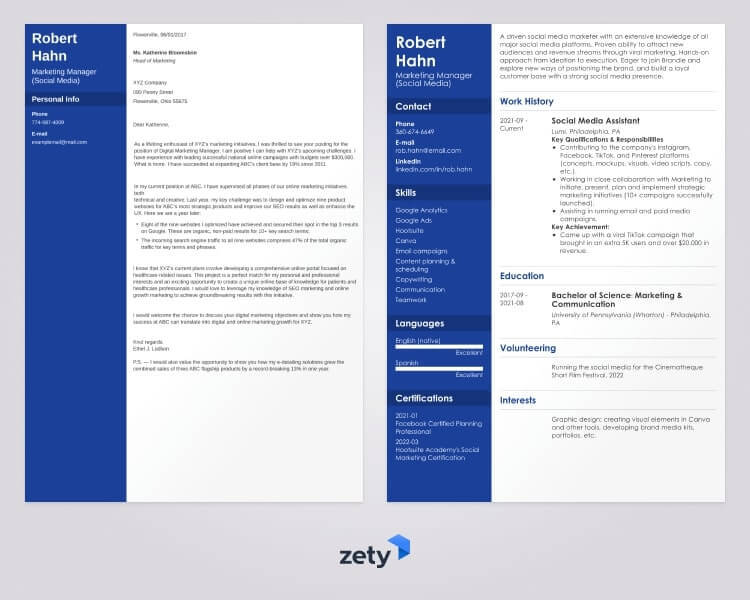
Don’t forget to follow up on your job application. Just like managing a portfolio, it’s important to track your progress and stay proactive.
And that’s the key to crafting a successful finance resume.
About Zety’s Editorial Process
This article has been reviewed by our editorial team to make sure it follows Zety’s editorial guidelines. We’re committed to sharing our expertise and giving you trustworthy career advice tailored to your needs. High-quality content is what brings over 40 million readers to our site every year. But we don’t stop there. Our team conducts original research to understand the job market better, and we pride ourselves on being quoted by top universities and prime media outlets from around the world.
Sources

Follow Zety as a preferred source in Google
Get more resume writing tips, career insights, and workforce trends in your personalized search experience. Learn more >

Share:


