










Table of Contents
Get more resume writing tips, career insights, and workforce trends in your personalized search experience.
Welcome to your career! Well, not quite, but it’s inevitable. After all, you’ve earned it. And you have the CPA exam to prove it. The competition is the only thing that stands between you and your first accounting job.
And to beat them, you need your entry-level accounting resume to stand tall and proud. You need it to raise the hiring manager’s eyebrows like an outside auditor would upon discovering unreported income. You’ll learn how to do this right.
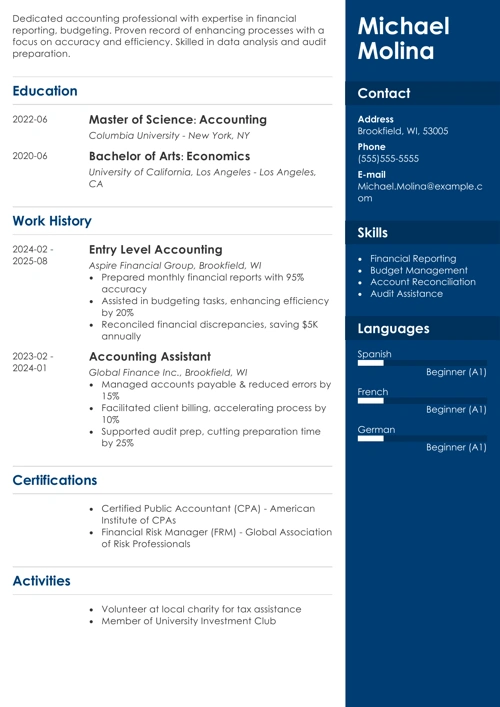
Want to save time and have your resume ready in 5 minutes? Try our resume builder. It’s fast and easy to use. Plus, you’ll get ready-made content to add with one click. Explore our free resume templates and start building your resume today.
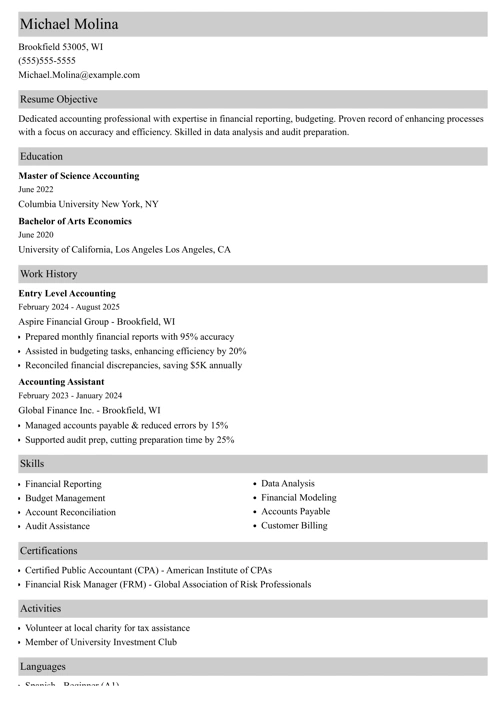
Sample resume made with our builder—See more resume examples here.
One of our users, Pam, had this to say:
Zety is well worth the money! All you do is input your info and Zety turns it into a professional resume that appears like you took hours to make.
See our other related guides:
- Accounting Resume Examples
- Accounting Intern Resume Examples
- Accounting Assistant Resume Examples
- Accounting Clerk Resume Examples
- Finance Resume Examples
- Tax Accountant Resume Examples
- Financial Analyst Resume Examples
- Best Resume Examples for All Jobs
Sample Entry-Level Accounting Resume Template
Michael Molina
michaelmolina@aol.com
619-241-5828
Career Objective
Enthusiastic and motivated bachelor of science in mathematics with strong accounting and deductive reasoning skills. Eager to accurately and efficiently maintain client and company balance at J Cooper Trading. Successfully assisted in the Payson School District’s payroll disbursements and two consecutive internal audits. Achieved 100% accuracy in preparing ZonaPop’s expense report.
Education
2012–2015 BS in Mathematics
University of Arizona
- Pursued a passion for financial analysis and economics through related electives.
2014–present (in the process of obtaining CPA status)
Rasmussen College
Work Experience
Accounting Assistant (Volunteer Work)
Payson School District
February 2012, 2014
- Streamlined payroll department’s activities through disbursement reorganization and new software application.
- Actively assisted the internal audit team with the school’s audits.
Administrative Assistant (Summer Internship)
ZonaPop
July–August 2014
- Reorganized and maintained the accounting department’s filing system.
- Assisted in expense report preparation.
- Achieved 100% accuracy in preparing ZonaPop’s expense report.
Skills
- Time management
- Critical thinking
- Monitoring
- Complex problem solving
- Active listening
- Writing
- Speaking
- Systems analysis
Languages
- English—native
- Spanish—fluent
- Italian—conversational
And here is how to write a proper, top-notch entry-level accounting resume:
1. Choose the Best Format for Your Entry-Level Accounting Resume
Accountants are expected to know their company’s operations through and through—after all, the company’s success and integrity ride on all of the financials being in check. Investments, payroll, accounts receivable and payable, taxes—no one has a handle on them like an accountant does. Your entry-level accountant resume needs to not only convince the hiring manager that you’re the one, but it has to do it within about six seconds.
So—
To make your entry-level accounting resume do its job, first you have to follow these resume formatting rules:
- Start with your contact information.
- Choose your resume type. Entry-level resumes usually follow the chronological format.
- Use clear, legible resume fonts and lots of white space to make it easy on the eyes.
- Export your entry level accounting resume as a PDF to keep your resume layout intact.
- Since accounting is rather a conservative industry, use a traditional resume template.
Pro Tip: How many pages should a resume be for entry-level accounting jobs? One sheet is fine, unless you’ve got enough achievements or sections to fill a two-page resume.
2. Write a Resume Objective for Entry-Level Accounting Position
A resume objective, also known as a resume profile, is a concise paragraph at the top of your resume. Its purpose is two-fold: to express your genuine interest in the job, and to demonstrate how you’d be the perfect fit for it. You can think of it as an elevator pitch.
You would use a career summary if you had 2+ years of relevant experience. In your case, however, use the resume objective. In it, summarize your education, skills, and relevant experience (if you have any). Volunteering and internships count as professional experience, too.
Your resume introduction should be 3–4 sentences long. For it to be effective, always tailor it to the company you are applying to.
Read more: How to Add Internship to a Resume
3. Craft Your Entry Level Accounting Resume Education Section Like a Pro
If you’ve just graduated or if you have very little professional experience, put your resume job descriptions below your education section. This will help you put your best foot forward.
Follow these rules to format it right:
- For your college education, start with the years you attended, followed by the earned degree and the name of the school. You can also add your GPA.
- Add unfinished college and any minors if your course of study was relevant to accounting.
- In bullet form, list any extracurricular activities, coursework, and even projects related to accounting.
4. Write a Strong Entry-Level Accounting Resume Work Experience Section
Chances are you have no accounting work experience per se. You should still include a job history section, emphasizing those aspects that are relevant to accounting. Use the same approach if changing careers. Did your interning or volunteering experiences somehow relate to accounting work? Include those as well.
Your entry-level accounting resume experience section needs to be tailored to the job and highlight your related strengths and skills:
- Put most recent work first, and follow it with previous positions chronologically descending.
- Each listing needs to include your job title, company name, dates worked, and bullet points describing your achievements and accomplishments.
- Begin each bullet point with an action word for maximum effect, and make it relate to the specific job you’re seeking.
- Quantified, measurable achievements work best. Simply listing duties and tasks does very little in making your resume stand out.
5. Stress Your Entry-Level Accounting Skills
Accounting requires a lot of diversified skills. It doesn’t mean you should add every skill that comes to your mind to your resume. List your best skills only, adjusting them based on the particular accounting job you’re applying for. Here’s how to build an entry-level accounting skills section into your resume:
- Start by making a list of all the job skills you have, including soft skills, hard skills, technical skills, plus any other relevant skills you possess.
- Make a shortlist of all your skills that are most relevant to the job listing and include those in your entry level accounting resume.
Use the list below as reference.
Entry-Level Accountant Resume Skills
- Time management skills
- Critical thinking skills
- Monitoring skills
- Problem-solving skills
- Active listening skills
- Writing skills
- Communication skills
- Systems analysis skills
- Mathematics skills
- Judgment and decision-making skills
- Active learning skills
- Coordination skills
- Persuasion skills
- Service orientation skills
- Social perceptiveness skills
- Written comprehension skills
- Deductive reasoning skills
- Number facility skills
Here’s an important thing. If you don’t possess relevant skills, don’t make them up and lie on your resume. Instead, try taking some online courses from EdX, Udemy, or Coursera to improve your skillset.
Insights from 11 million resumes crafted with our builder show that:
- On average, the typical resume for an Entry-Level Accountant includes 15 skills.
- Skills such as accounting, budget forecasting, data inputting, and financial reporting are top choices for Entry-Level Accountants.
- The average resume length for Entry-Level Accountants is 2 pages.
Making a resume with our builder is incredibly simple. Follow our step-by-step guide, use ready-made content tailored to your job and have a resume ready in minutes.
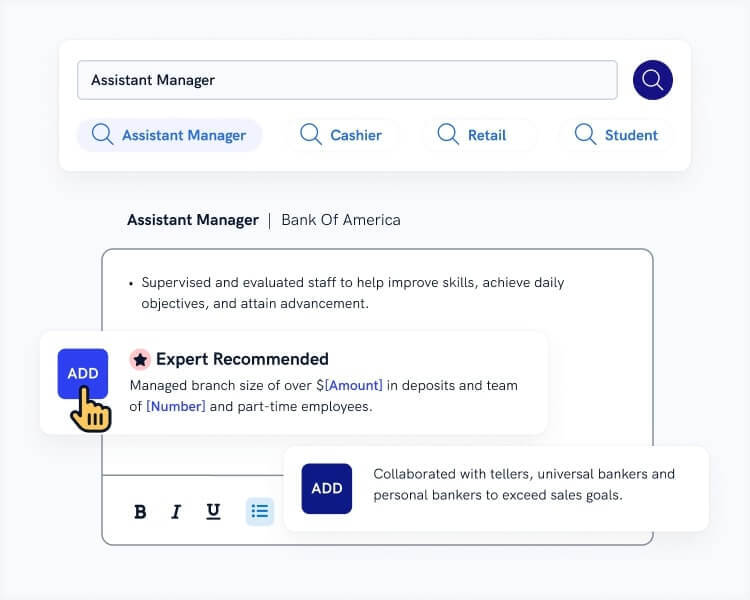
When you’re done, our online resume builder will score your resume and our ATS resume checker will tell you exactly how to make it better.
6. Add Extra Sections to Your Entry-Level Accounting Resume
Though accounting is all about numbers and sheets, you’re so much more than your excellent math skills. Use extra sections to show the recruiter your human side. Think of any special abilities, talents, or even interests you have that help you be a great accountant. Include them in their own sections.
- Name it language skills, certifications, achievements, hobbies, or whatever fits.
- Impress the hiring manager with your energy and uniqueness.
Even if your interest doesn’t benefit your accounting in an obvious way, having a creative hobby can benefit your work as well as your well-being. Studies show that creative hobbies help people recover from the demands of the workplace (e.g. during a tax season).
Read more: How to Improve Your Resume
7. Include a Cover Letter with Your Entry-Level Accountant Resume
That’s right. Writing a cover letter is still a great idea. It shows intent, thoroughness, and genuine interest in the job.
Just follow these steps to create your accounting cover letter and you’re all set:
- Use a reader-friendly, elegant cover letter format.
- Start your cover letter with an introductory paragraph to simply and directly tell the recruiter how your accounting know-how and ambition will benefit the company’s success.
- Use the body of your letter to show off with your achievements and education.
- Don’t be shy—end your cover letter with a call to action, asking for a meeting.
What’s the right cover letter length? A one-pager is usually the best.
Pro Tip: Don’t forget to follow up on your job application. A quick email or phone call can be just the trick that gets you hired.
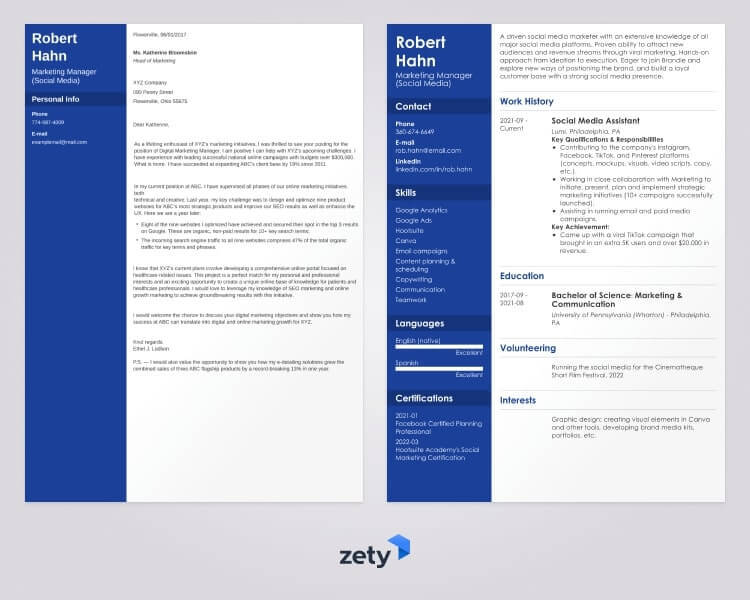
Plus, a great cover letter that matches your resume will give you an advantage over other candidates. You can write it in our cover letter generator here. Here’s what it may look like:
So there it is—
Everything you needed to know about writing a proper resume for entry-level accountant positions.
See more guides for accountants:
- Accounting Manager Resume Examples
- Staff Accountant Resume Examples
- Bookkeeper Resume Examples
- Senior Accountant Resume Examples
- Certified Public Accountant Resume Examples
- Accounts Payable Resume Examples
- Accounts Receivable Resume Examples
- Controller Resume Examples
- Auditor Resume Examples
- Senior Accountant Resume Examples
About Zety’s Editorial Process
This article has been reviewed by our editorial team to make sure it follows Zety’s editorial guidelines. We’re committed to sharing our expertise and giving you trustworthy career advice tailored to your needs. High-quality content is what brings over 40 million readers to our site every year. But we don’t stop there. Our team conducts original research to understand the job market better, and we pride ourselves on being quoted by top universities and prime media outlets from around the world.
Sources

Follow Zety as a preferred source in Google
Get more resume writing tips, career insights, and workforce trends in your personalized search experience. Learn more >

Share:


