












Table of Contents
Get more resume writing tips, career insights, and workforce trends in your personalized search experience.
Whether you’re a student trying to gain experience, a parent balancing responsibilities, or a professional looking to supplement your income, finding a part-time job can feel overwhelming.
The good news? You don’t need to undersell yourself to show you’re seeking part-time work. A strong part-time job resume can clearly highlight your skills and experience while still reflecting the value you bring to an employer.
We’ll walk through how to make a resume for a part-time job with step-by-step guidance, practical tips, and tailored examples to help you stand out and land more interviews.
Want to save time and have your resume ready in five minutes? Try Zety’s Resume Builder. It’s fast and easy to use. Plus, you’ll get ready-made content to add with one click.
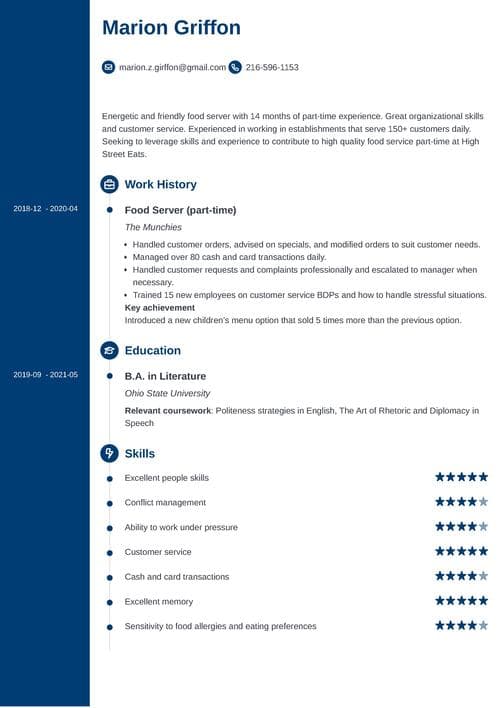
See more professional resume examples made with our builder.
One of our users, Chris, had this to say:
You cannot go wrong with Zety. The company does best at enhancing your resume and helping market yourself better to land the job you love.
Is a Resume Necessary for a Part-Time Job?
Yes, in most cases, you should write a resume for a part-time job. While some entry-level positions may only require an application, many employers still use resumes to evaluate your skills, experience, and availability before deciding who to interview.
A resume is especially important if you’re applying for competitive part-time roles, changing careers, reentering the workforce, or hoping to earn a higher hourly wage. Even if you have little or no work experience, a well-written resume can highlight transferable skills, education, volunteer work, and relevant achievements.
The bottom line: Submitting a resume can help you stand out from other candidates and improve your chances of landing a part-time job.
How Do You Write a Resume for a Part-Time Job?
To write a resume for a part-time job, tailor it to the role by highlighting relevant skills, experience, and achievements. Use a clear structure with contact details, a summary or objective, skills, work experience, and education.
Here’s how to make a resume for a part-time job:
Choose the Right Resume Format
The first step in writing a resume for a part-time job is choosing the right format. The best format depends on your experience and helps employers quickly understand your strengths.
Different layouts work better depending on your background and level of experience. Here are the three main resume formats and when to use them:
- Functional format: Best for candidates with limited work experience, employment gaps, or career changers, the functional format highlights transferable skills over work history. It works well because it highlights what you can do rather than when or where you did it, helping shift focus to transferable abilities.
- Combination format: Best for most part-time job seekers, the combination format blends skills and work history into one structure. It works well because it showcases your strongest abilities at the top while providing enough employment detail to support your experience, making it both flexible and easy to scan.
- Chronological format: Best for job seekers with consistent work experience, the chronological format lists your most recent role first and works backward. It works well because it clearly shows your work history, making it easy for employers to see stability, progression, and relevant experience at a glance.
💡Pro tip: Many employers use applicant tracking systems (ATS) to screen resumes before a hiring manager reviews them. No matter which format you choose, you should tailor your resume to the job description by naturally incorporating important skills and keywords from the posting.
Add Your Contact Information
Add your contact information at the top of your resume so employers can quickly reach you. Include your full name, phone number, professional email address, and city and state.
If relevant, you can also add a LinkedIn profile, a personal website, or a portfolio to showcase your experience or work samples. Make sure all details are accurate and up to date, and avoid including unnecessary personal information or unprofessional email addresses, such as nicknames or outdated usernames.
Here’s an example of how to include this information in your resume header:
Jordan Taylor
Seattle, WA
(555) 123-4567
jordan.taylor@email.com
Write a Strong Resume Summary or Objective
Write a short resume summary or objective at the top of your resume to quickly introduce who you are and what you offer. Both should be about two to four sentences long, but they serve different purposes depending on your experience level.
- Use a resume summary if you already have relevant experience through paid work, internships, volunteering, or leadership roles. It highlights your key skills, experience, and strengths to show employers what you bring to the job.
- Use a resume objective if you’re new to the workforce, changing careers, or don’t have much relevant experience yet. It focuses on your career goals, the type of part-time role you’re looking for, your motivation, and your transferable skills.
Here’s an example of a resume objective for a student seeking part-time work:
Motivated and responsible student seeking a part-time position to build professional experience while contributing strong communication, teamwork, and organizational skills. Eager to learn and support a fast-paced environment while balancing academic commitments.
Here’s an example of a resume summary for a career changer seeking part-time work:
Experienced professional with 7+ years of experience in customer service and administrative support, transitioning into retail and customer experience. Proven track record of improving efficiency, supporting team operations, and delivering high-quality service in fast-paced environments. Skilled in communication, problem-solving, and organization, with a history of maintaining high customer satisfaction and meeting performance goals. Adaptable and dependable, with a strong ability to quickly learn new systems and contribute from day one.
Highlight Job-Relevant Skills
Organize your skills section to match the resume format you’re using.
Employers hiring for part-time jobs often prioritize transferable skills over extensive experience, so focus on transferable skills and relevant achievements from work, school, volunteering, caregiving, or personal projects. The goal is to help employers quickly understand what you bring to the role.
Here’s a breakdown of how skills are organized for the different resume formats:
- In a functional resume, skills take priority and are grouped into categories with supporting examples to emphasize abilities over job history.
- In a combination resume, the skills section is shorter and placed near the top to support both skills and experience.
- In a reverse-chronological resume, the skills section is brief and placed below work experience, serving mainly to reinforce your job history.
Here’s an example skills section for a student applying for a part-time role:
Professional Skills
Customer Service & Communication
- Collaborated with three to six peers per group project to coordinate tasks and deliver completed assignments on time.
- Presented academic work in front of 30 classmates, clearly explaining key points and responding to questions.
- Participated in class discussions and group activities, communicating ideas clearly and respectfully.
Organization & Time Management
- Managed a full course load of four to six classes per term while completing 100% of assignments on time.
- Balanced concurrent projects per term using planners and digital tools to track deadlines.
- Used self-directed planning tools (checklists, calendars, or task boards) to manage multistep work.
Digital & Technical Skills
- Used Google Docs, Slides, and Sheets for 10+ assignments per term to create and organize academic work.
- Created presentations, written reports, and visual materials for multiple classes each term.
- Utilized learning platforms such as Google Classroom and Canvas to submit and manage coursework.
Include Any Relevant Experience
Include relevant experience by listing any work, volunteer, or informal experience that shows transferable skills—even if you don’t have a formal job yet.
If you don’t have traditional work experience, don’t leave this section out. Instead, replace it with school projects, volunteering, leadership roles, caregiving, tutoring, or personal projects that demonstrate responsibility and real-world skills.
Focus on what you did, the skills you used, and the results you achieved. Use bullet points and include measurable details where possible (such as group size, number of projects, or frequency of tasks) to make your experience more concrete and credible. Start each bullet point with a strong action verb, such as “assisted,” “coordinated,” or “organized.”
Here’s a work history section for a stay-at-home parent transitioning back into part-time work:
Work Experience
Professional Development & Personal Experience | June 2018–Present
- Maintain strong organizational, time management, and multitasking skills through ongoing personal and household management responsibilities.
- Complete structured online courses, which have included Google Digital Garage: Fundamentals of Digital Marketing and Microsoft Learn Excel Fundamentals.
- Use digital tools (email, spreadsheets, scheduling platforms) to stay organized and efficient.
Retail Sales Associate | Target | Portland, OR | July 2016–May 2018
- Assisted an average of 30+ customers per shift with product selection and store inquiries.
- Operated the POS system to process transactions accurately and handle cash and card payments.
- Restocked merchandise and maintained organized, customer-ready displays across assigned departments.
Administrative Assistant | Brightview Office Services | Portland, OR | April 2014–July 2016
- Managed scheduling, filing, and data entry for a team of eight staff members.
- Responded to emails and phone inquiries, ensuring timely and professional communication.
- Maintained accurate records and updated internal databases with 99% data accuracy.
If you have a gap in your work history, you don’t need to draw attention to it or overexplain it. Instead, include it as a neutral, skills-focused entry (e.g., “Professional Development” or “Independent Experience”). This keeps your resume honest while shifting focus to what you did during that time, such as developing skills, managing responsibilities, or completing personal projects.
Add Your Education Credentials
Add your education credentials by listing your highest completed level of education in a simple, easy-to-scan format. Include the school name, location, degree or diploma earned, and graduation year (or expected graduation date if you’re still studying).
If you’re early in your career or applying for part-time work, the education section helps reinforce reliability, foundational skills, and your ability to complete structured programs. If you have little or no work experience, you can place your education section above your work experience.
Here’s an example:
Education
Bachelor of Arts in Psychology (In Progress)
University of Oregon | Eugene, OR
Expected Graduation: 2026
- Relevant coursework: Introductory Psychology, Research Methods, Statistics, Human Development, Cognitive Psychology
Associate of Arts
Lane Community College | Eugene, OR
Graduated: 2024
- Relevant coursework: English Composition, College Algebra, Communications, Sociology, Intro to Business
Feature Optional Sections
Include optional sections when they strengthen your resume by showcasing additional skills or relevant experience.
Common sections include volunteer experience, projects, certifications, awards, languages, extracurricular activities, and student organizations. Keep each section brief and focused on outcomes or skills rather than general descriptions.
Here’s an example of a certifications section for a part-time resume:
Certifications
- Google Digital Garage: Fundamentals of Digital Marketing – Google, March 2025
- Microsoft Learn: Excel Basics for Data Analysis – Microsoft, January 2025
- LinkedIn Learning: Customer Service Foundations – LinkedIn, October 2024
- HubSpot Academy: Inbound Marketing Certification – HubSpot, August 2024
- CPR & First Aid Certification – American Red Cross, Valid through June 2026
Making a resume with our builder is incredibly simple. Follow our step-by-step guide, use ready-made content tailored to your job, and have a resume ready in minutes.
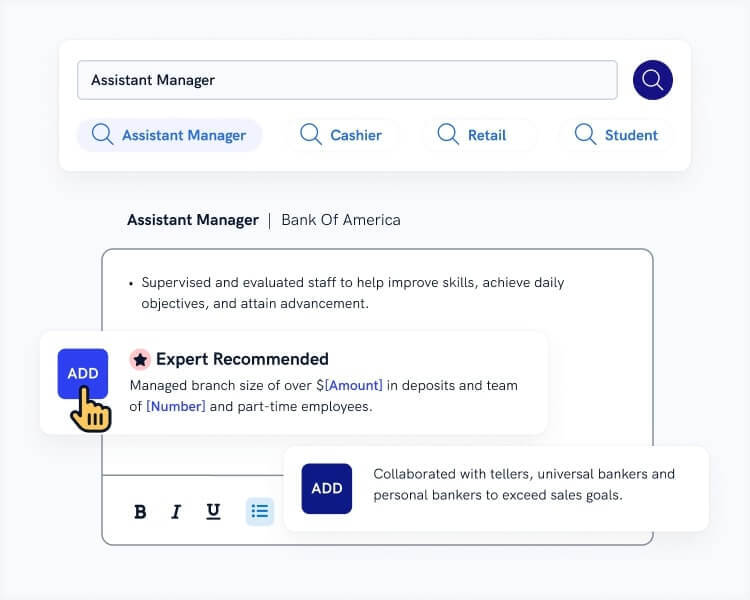
When you’re done, Zety’s Resume Checker will score your resume and show you exactly how to improve it.
Part-Time Job Resume Examples
Below are part-time job resume examples tailored to different roles and experience levels. Each resume example below demonstrates how to tailor your experience, skills, and accomplishments to a specific type of part-time position.
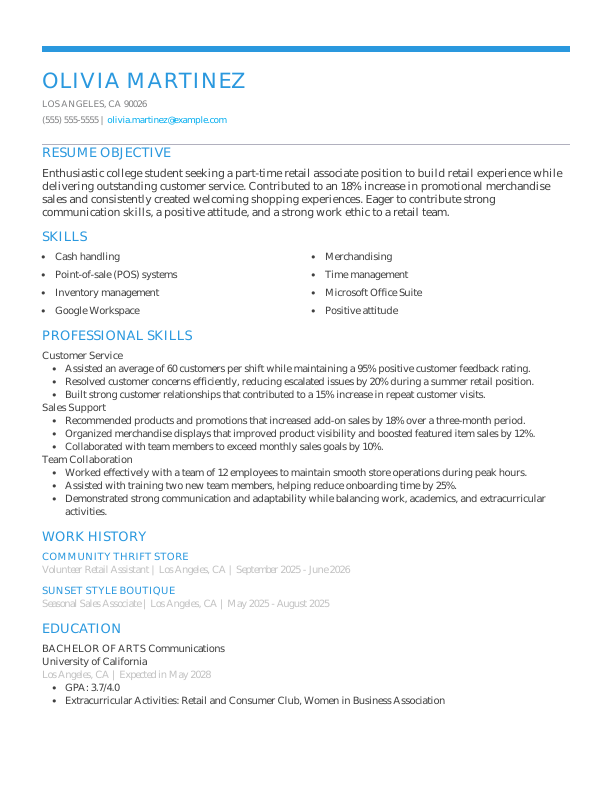
Part-Time Retail Associate Resume
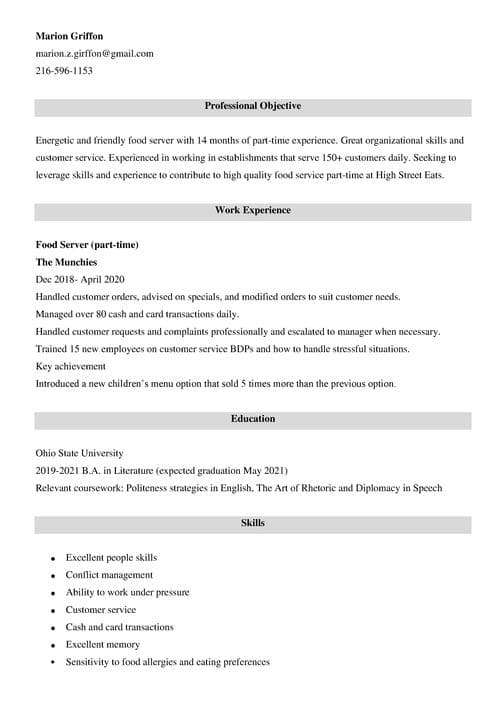
This sample resume for a part-time job in retail shows how to highlight customer service experience, cash-handling skills, and teamwork in a fast-paced environment.
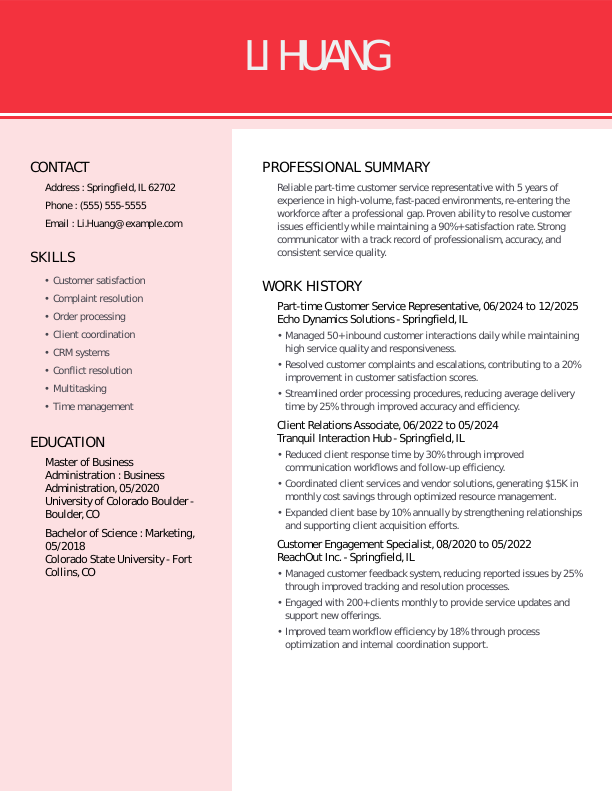
Part-Time Customer Service Representative Resume
This resume for a part-time customer service role showcases communication skills, problem-solving ability, and experience handling customer inquiries professionally.
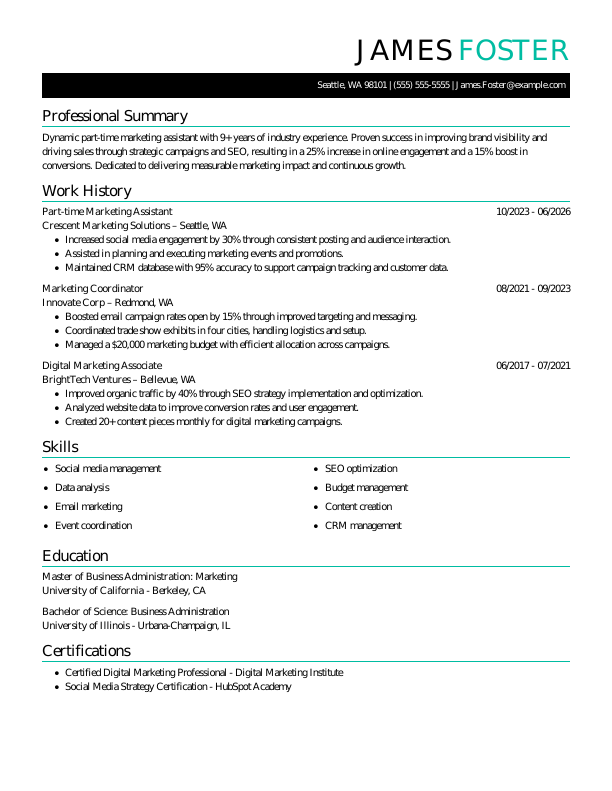
Part-Time Marketing Assistant Resume
This resume for a part-time marketing assistant role emphasizes content creation, social media management, and campaign performance tracking, focusing on measurable results like engagement growth, content output, and audience reach to demonstrate marketing impact.
Common Part-Time Job Resume Mistakes to Avoid
Many part-time job applications get rejected not because candidates lack experience, but because their resumes are unclear, unfocused, or poorly formatted.
Avoiding these common mistakes can significantly improve your chances of getting interviews and help employers quickly see your value and fit for the role:
- Using a generic resume for every job application. Employers want to see a resume tailored to the specific role. Adjust your skills, summary, and experience to match the job description instead of sending the same document everywhere.
- Leaving out measurable results. Simply listing duties like “worked with customers” is too vague. Include numbers where possible, such as “assisted 40+ customers per shift” or “handled 80+ transactions daily.”
- Overloading the resume with unnecessary information. Avoid adding irrelevant jobs, outdated skills, or long personal details. Keep the focus on experience and skills that directly relate to part-time work.
- Ignoring formatting and readability. Dense paragraphs, inconsistent fonts, or cluttered layouts make resumes hard to scan. Use clear headings, bullet points, and consistent formatting to ensure your experience is easy to evaluate.
- Including availability directly on the resume. Availability is usually discussed during the interview process, not listed on the resume itself. Including it can take up valuable space and may unintentionally limit flexibility in how employers view your schedule.
Key Takeaways
A strong part-time job resume highlights your most relevant qualifications clearly and concisely. Keep these best practices in mind:
- Choose a clean, easy-to-read resume format that highlights your most relevant skills and experience near the top so employers can quickly understand your fit for the role.
- Start with a clear resume summary or objective that briefly explains your strengths, experience level, and the type of part-time role you’re targeting.
- Use measurable results wherever possible, such as numbers, outcomes, or responsibilities, instead of vague descriptions of tasks or duties.
- Emphasize transferable skills like communication, teamwork, organization, and problem-solving that apply across many part-time roles.
- Tailor your resume for each application by adjusting your skills, summary, and experience to match the specific job description.
- Keep your resume concise, focused, and relevant so employers can quickly see why you’re a strong match for a part-time position.
Frequently Asked Questions
How do I put a part-time job in my resume?
To put a part-time job on your resume, list it in your work experience section just like a full-time position. Include the job title, employer name, dates of employment, and a few bullet points highlighting your responsibilities and achievements.
Focus on transferable skills and measurable results to show employers the value you contributed, regardless of the number of hours worked.
What skills should I put on a resume for a part-time job?
The best skills to put on a resume for a part-time job are those that match the role you’re applying for. Common examples include customer service, communication, teamwork, time management, problem-solving, and organization.
If the position requires specific technical skills, such as cash handling, data entry, or software proficiency, include those as well to show you’re qualified for the job.
How long should a resume be for a part-time job?
A resume for a part-time job should usually be one page long. A one-page resume gives employers a quick overview of your most relevant skills, experience, and qualifications without overwhelming them with unnecessary details.
If you have extensive experience directly related to the role, a two-page resume may be acceptable, but one page is the standard for most part-time job applications.
How do I write a resume for a part-time job with no experience?
To write a resume with no experience for a part-time job, focus on your skills, education, volunteer work, extracurricular activities, and relevant achievements.
Employers understand that many entry-level candidates lack formal work experience, so they’re often looking for qualities such as communication, reliability, teamwork, and a strong work ethic. Highlighting these strengths can help demonstrate your potential and make your resume more competitive.
About Zety’s Editorial Process
This article has been reviewed by our editorial team to make sure it follows Zety’s editorial guidelines. We’re committed to sharing our expertise and giving you trustworthy career advice tailored to your needs. High-quality content is what brings over 40 million readers to our site every year. But we don’t stop there. Our team conducts original research to understand the job market better, and we pride ourselves on being quoted by top universities and prime media outlets from around the world.

Follow Zety as a preferred source in Google
Get more resume writing tips, career insights, and workforce trends in your personalized search experience. Learn more >

Share:


